
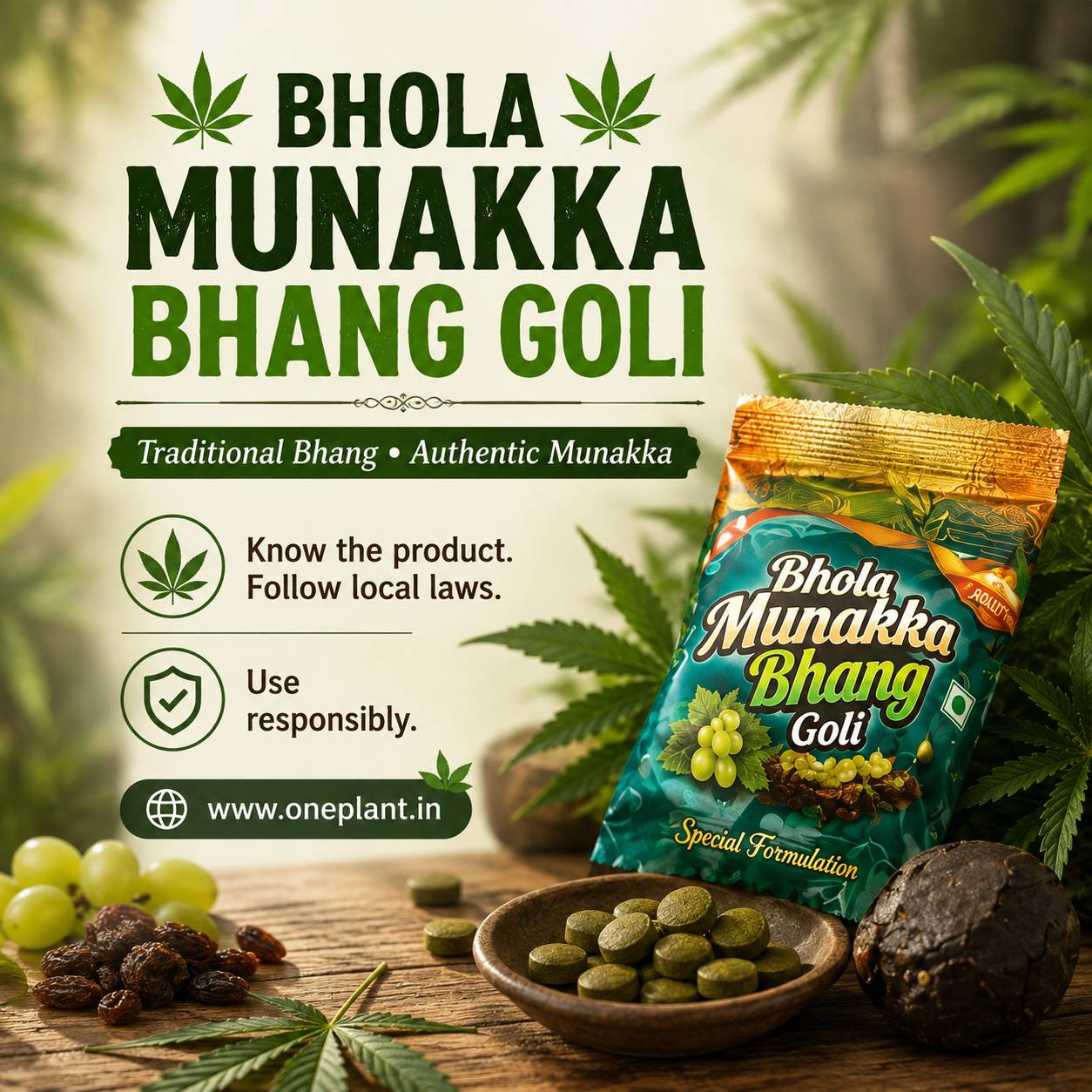
If you have come across munakka bhang goli, you may have noticed that the product can be described in several ways: Munakka, Bhang Goli, Bhola Munakka, Vijaya Goli or simply Bhang Goli. The terminology can be confusing, especially when labels combine traditional Indian ingredients with modern product descriptions.
At its simplest, a Munakka Bhang Goli is a traditional-style edible preparation in which munakka (dried grapes/raisins) is used as part of a formulation containing bhang derived from cannabis leaves, along with other herbs or spices depending on the recipe.
But the name alone does not tell you everything.
The most useful way to understand a product is to look beyond the front of the pack and examine the ingredient list, plant part mentioned, serving information, manufacturer details, warnings and applicable legal requirements.
Explore Bhola Munakka Bhang Goli
What is Munakka Bhang Goli?
“Munakka Bhang Goli” generally refers to a small edible preparation combining munakka with bhang-derived ingredients. “Munakka” commonly means dried grapes or raisins, while “goli” simply means a pill, ball or small tablet-like preparation.
“Bhang” is a traditional Indian preparation associated with the cannabis plant. The terminology is important because cannabis products are not all the same. The central Narcotic Drugs and Psychotropic Substances Act, 1985 defines “cannabis (hemp)” in terms that include charas, ganja and certain mixtures, while leaves and seeds are treated differently from flowering or fruiting tops under that definition. State laws can also have their own provisions concerning bhang and intoxicating preparations.
That is why it is better not to assume that every product carrying the word “bhang” has the same composition.
A Bhang Goli is also not automatically identical to a cannabis flower, resin product or hemp-seed food. The plant part, formulation and applicable regulations matter.
Munakka, Bhola, Bhang Goli and Vijaya: what do these terms mean?
These words often appear together, but they describe different aspects of a product.
Munakka
Munakka is a traditional name for dried grapes or raisins. In a goli formulation, it can provide a naturally sweet, dense base.
On a label, look for terms such as:
- Munakka
- Raisin
- Vitis vinifera
- Dried grape
If the product specifically highlights Vitis vinifera, it is referring to the botanical name associated with the grape plant.
Bhang Goli
“Bhang Goli” is a product-style description rather than a guarantee of a standardised recipe.
Two products sold under similar names can have different formulations. Their ingredient order, plant material, additional herbs, serving size and manufacturing details may differ.
Vijaya
Vijaya is a traditional term associated with cannabis in Indian herbal and Ayurvedic terminology. When a product label says Vijaya, it is important to check exactly what plant part or preparation the manufacturer means.
A responsible label should make it reasonably clear whether the formulation refers to leaf material, an extract, powder or another preparation.
Bhola Munakka
“Bhola Munakka” is commonly used as a product name for a particular type of Munakka Bhang Goli. For a branded product, however, the brand name should never replace checking the actual ingredient and product information.
For example, the OnePlant product page describes its Bhola Munakka Bhang Goli as a combination involving munakka and bhang leaf powder, with ginger, black pepper and rock salt also listed as part of the formulation.
Common ingredients in Munakka Bhang Goli
Recipes can vary, so the ingredient list on the actual package should always take priority.
For the OnePlant Bhola Munakka Bhang Goli formulation, the product information identifies the following ingredients or ingredient categories:
1. Munakka
Munakka is dried grape material and is often used as the sweet, fruit-based component of the goli.
From a label-reading perspective, the important point is that “munakka” is not itself a synonym for bhang. It is a separate ingredient.
2. Vijaya or cannabis leaf
The bhang component is the part that deserves the closest attention when reading a label.
OnePlant’s product information identifies Vijaya/cannabis leaf powder as part of its formulation. The product page should be checked for the latest formulation information rather than relying on a third-party description.
This is also where readers should avoid assuming that a product’s effects, strength or cannabinoid content can be determined simply from the word “Vijaya.” Unless a label provides a verified quantitative specification, it is not appropriate to guess the amount or potency.
3. Ginger
Ginger, including dried ginger or shunthi in traditional terminology, can appear in herbal formulations as a spice and traditional digestive ingredient.
Its presence does not turn the product into a medical treatment. It is simply one component of the formulation.
4. Black pepper
Black pepper is another familiar Indian spice that may be included in traditional herbal preparations.
When you see black pepper on an ingredient panel, check whether the label gives its form—for example, whole spice, powder or another preparation.
5. Rock salt
Rock salt, sometimes described as Saindhava Lavana, may be included in some traditional formulations.
Again, the key point is transparency: the ingredient list should tell you what is actually present rather than leaving the buyer to infer the recipe from the product name.
How to read a Munakka Bhang Goli label
This is probably the most useful skill for anyone comparing products.
Instead of judging a goli by packaging, colour or marketing claims, work through the label systematically.
1. Start with the complete ingredient list
Look for the actual ingredients rather than relying only on phrases such as:
- Herbal formula
- Traditional formulation
- Ayurvedic blend
- Natural ingredients
- Plant-based
These descriptions may sound informative but do not tell you exactly what is inside.
A useful ingredient list should identify the principal ingredients clearly.
2. Check the plant part
For cannabis-related products, the plant part matters.
A label referring to:
- leaf
- flowering tops
- seeds
- resin
- extract
- powder
is giving you materially different information.
Do not treat “cannabis,” “bhang,” “hemp” and “Vijaya” as interchangeable terms without checking the formulation.
3. Look for quantities where available
If a label gives ingredient quantities or percentages, record them.
If it does not, do not attempt to reverse-engineer the formulation from taste, appearance or online comments.
For example, saying that one goli contains a particular amount of THC, CBD or cannabis simply because it is called Munakka Bhang would be unsupported unless the manufacturer provides verified information.
4. Check serving or dosage information
A label may provide a suggested serving size or other directions.
Follow the product’s current label rather than copying a dosage recommendation from a social-media post, forum or another product.
If the label is unclear, that is a reason to seek professional guidance rather than experimenting with larger amounts.
5. Check manufacturer and batch information
A useful product label should provide traceability information appropriate to the product category.
Look for details such as:
- Manufacturer or marketer
- Batch or lot number
- Manufacturing date
- Expiry or best-before information
- Net quantity
- Storage instructions
- Customer-care information
- Applicable licence or registration information, where relevant
The exact labelling requirements depend on how a product is legally classified and sold.
6. Read warnings instead of skipping them
Warnings are especially important for preparations that may have intoxicating or psychoactive effects.
Do not assume that a product is harmless simply because it is described as herbal or traditional.
What is actually known about the ingredients?
There is an important distinction between traditional use, product information and scientific evidence.
Traditional Indian systems have used numerous plants and preparations for generations. That historical use is relevant cultural and formulation information, but it should not automatically be presented as proof that a product can prevent, treat or cure a disease.
Similarly, an ingredient having nutritional compounds or bioactive constituents does not mean that a particular goli has a clinically proven therapeutic effect.
This distinction is particularly important with cannabis-containing preparations.
A responsible product article should therefore avoid promises such as “cures anxiety,” “guarantees sleep,” “treats chronic pain” or “detoxifies the body” unless there is appropriate evidence and the claim is legally permitted.
For consumers, the safest approach is straightforward: understand what the product contains before deciding whether it is appropriate for you.
Traditional use is not the same as a medical claim
Bhang has a long cultural history in parts of India, including associations with festivals and traditional preparations.
That history can help explain why products such as Bhang Goli exist, but it should not be confused with modern clinical evidence.
The same principle applies to ingredients such as munakka, ginger and black pepper.
A good product description can say:
“This ingredient is traditionally used in Indian food or herbal formulations.”
It should be much more cautious about saying:
“This ingredient treats a medical condition.”
That distinction makes health-related content more trustworthy and helps readers make informed decisions.
Safety and responsible-use considerations
A Munakka Bhang Goli containing cannabis-derived material should not be treated like an ordinary sweet or raisin snack.
Effects can vary between people and between formulations. A person who has never used a cannabis-containing edible should not assume that another person’s experience predicts their own.
Some practical precautions are worth keeping in mind:
- Read the full label before use.
- Do not combine intoxicating products with alcohol or other substances.
- Do not drive, ride a bike in traffic or operate machinery if you may be impaired.
- Keep the product away from children and pets.
- Store it according to the manufacturer’s instructions.
- Do not assume that taking more will simply produce a proportionally better experience.
- If you take medicines or have a medical condition, ask an appropriately qualified healthcare professional before using a cannabis-containing preparation.
If the product causes unexpected or severe symptoms, seek appropriate medical assistance rather than trying to counteract the effects with another substance.
Storage matters too
Because Munakka Bhang Goli is an edible preparation, storage should not be overlooked.
The OnePlant product information recommends keeping the product in its original container in an airtight, dry, dark place and away from children and pets.
Always follow the latest storage directions printed on the product you actually purchase.
This is especially important if the product is kept in a household where children or visitors could mistake the goli for an ordinary sweet or herbal tablet.
Is Munakka Bhang Goli legal in India?
This is one area where a simple “yes” or “no” answer can be misleading.
India’s central NDPS framework distinguishes cannabis plant material and products in specific ways. In particular, the statutory definition of “cannabis (hemp)” refers to charas and ganja and excludes seeds and leaves when those leaves are not accompanied by flowering or fruiting tops.
However, state-level excise and intoxicant laws can treat bhang differently, and rules governing manufacture, sale, possession, transport and consumption can vary.
For that reason, never assume that because bhang is available in one Indian state, the same product is automatically lawful to buy, carry or consume elsewhere.
Before purchasing, transporting or consuming a cannabis-containing product, verify the current rules in your state or Union Territory, as well as any rules that may apply to interstate transport.
[VERIFY: Current state-specific rules for the reader’s location should be checked against the relevant state excise department and current legislation.]
A practical checklist before buying
If you are comparing different Munakka Bhang Goli products, ask these questions:
- Does the label clearly identify the ingredients?
- Is the cannabis-derived ingredient clearly described?
- Does the label identify the relevant plant part?
- Are quantities provided where they are important?
- Is there clear serving or usage information?
- Are manufacturer and batch details available?
- Is there an expiry or best-before date?
- Are storage instructions provided?
- Are warnings clearly visible?
- Can you verify that the product is legally sold in your location?
If several of these questions cannot be answered from the packaging or official product information, be cautious.
Understanding the OnePlant Bhola Munakka Bhang Goli
For readers specifically researching Bhola Munakka Bhang Goli, OnePlant’s product information identifies munakka and bhang leaf powder as core components and also lists ginger, black pepper and rock salt in the formulation.
That makes the product a useful example of why reading the complete label is more informative than searching only for the word “bhang.”
The product page is the best place to check the current formulation, packaging information, instructions and availability because product details can change.bhang goli
Frequently Asked Questions
1. What is Munakka Bhang Goli?
Munakka Bhang Goli is a traditional-style edible preparation that combines munakka, or dried grapes/raisins, with bhang-derived cannabis material and, depending on the formulation, additional herbs or spices.
2. Is Munakka the same as Bhang?
No. Munakka generally refers to dried grapes or raisins. Bhang refers to a traditional cannabis preparation. In a Munakka Bhang Goli, the two may be combined in one formulation.
3. What is Vijaya in Bhang Goli?
Vijaya is a traditional Indian term associated with cannabis. If it appears on a product label, check the manufacturer’s description to understand which plant part and form of preparation are being used.
4. What ingredients are commonly found in Bhola Munakka Bhang Goli?
The OnePlant product information identifies munakka and bhang leaf powder, along with ginger, black pepper and rock salt. Formulations can vary, so always check the latest product label.
5. Does every Bhang Goli have the same strength?
No. Product formulations can differ. Unless a manufacturer provides reliable quantitative information, you should not infer cannabinoid content or potency from the product name, size or appearance.
6. Is Bhang Goli legal everywhere in India?
Not necessarily. Cannabis and bhang-related rules can differ between states and Union Territories. Verify the current local rules before purchasing, possessing, transporting or consuming such a product.
7. How should I read a Bhang Goli label?
Start with the full ingredient list, then check the plant part, quantities if provided, serving information, manufacturer details, batch/date information, warnings and storage instructions. Also check whether the product category and sale are permitted where you live.
8. Is Bhang Goli the same as ganja?
No. The terms refer to different cannabis preparations or plant materials. Under the central NDPS Act, “ganja” specifically refers to flowering or fruiting tops, subject to the statutory definition. Bhang is treated differently in the central framework and can also be regulated under state laws.
Conclusion
Munakka Bhang Goli sits at the intersection of traditional Indian formulations, cannabis terminology and modern packaged-product expectations. The easiest way to understand it is not to rely on the name alone.
Look at the ingredients. Check the plant part. Read the serving information. Pay attention to warnings and storage instructions. Most importantly, distinguish traditional descriptions from scientifically established health claims.
For a product such as Bhola Munakka Bhang Goli, the manufacturer’s current product information should be your first reference for the formulation and instructions. And because cannabis-related rules can differ across India, verify the applicable local regulations before buying, carrying or consuming the product.
Visit us: https://oneplant.in/products/bhola-munakka-bhang-goli