
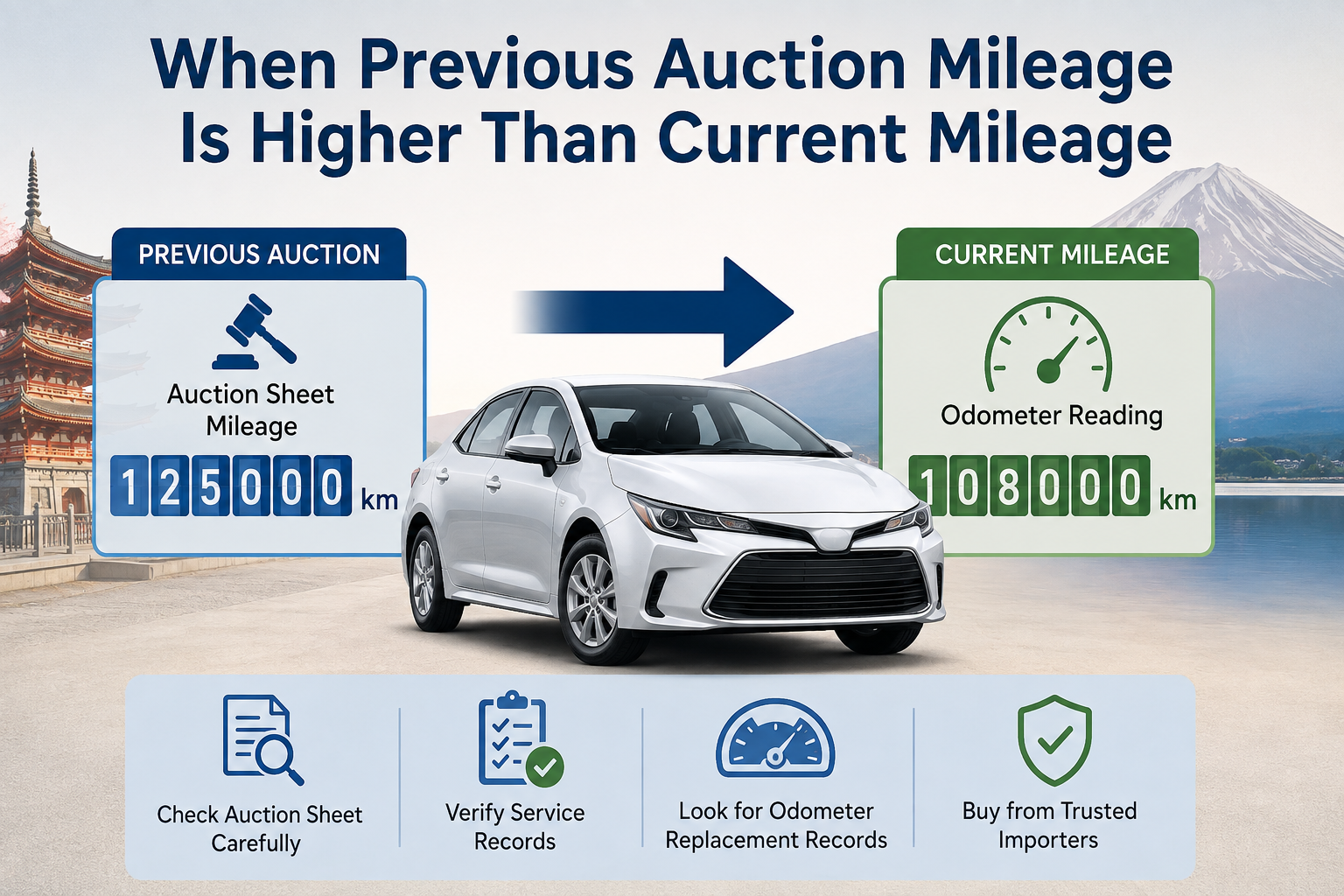
Buying a used vehicle often involves examining more than its exterior condition, service history, and mechanical specifications. For imported vehicles, mileage records deserve particular attention. A situation that can immediately raise questions is when a car’s previous Japanese auction mileage appears higher than its current recorded mileage. At first glance, this may resemble an obvious odometer rollback, but the reality can be more nuanced.
For buyers considering Japanese used cars in UK, understanding this discrepancy is essential. Mileage inconsistencies can arise from administrative errors, dashboard replacements, data-entry mistakes, or deliberate tampering. Knowing how to interpret the available evidence helps distinguish a legitimate discrepancy from a serious warning sign.
Understanding Japanese Auction Mileage Records
Japanese vehicle auctions typically record mileage when a car enters the auction system. The auction sheet may include the odometer reading, condition assessment, inspection notes, and other information relevant to the vehicle’s history.
Once a vehicle leaves Japan, its mileage can change naturally through transportation, inspections, road testing, servicing, and preparation for export. Therefore, the current mileage should normally be equal to or slightly higher than the mileage documented at an earlier auction.
For example, if an auction sheet records 82,450 kilometres, but a later inspection shows 81,900 kilometres, the difference warrants investigation. The vehicle has apparently travelled fewer kilometres than it did previously, which is physically impossible under ordinary circumstances.
Why Can the Current Mileage Be Lower?
There are several possible explanations for a mileage discrepancy. Not every case automatically proves fraudulent activity.
1. Odometer Replacement
One of the more legitimate explanations is that the vehicle’s instrument cluster was replaced. A damaged, defective, or malfunctioning dashboard may have been exchanged for another unit.
However, this should be properly documented. If the replacement dashboard displays a lower mileage, supporting paperwork or service records should ideally explain the change.
2. Data-Entry Errors
Auction and export records involve considerable amounts of information. A single incorrect digit can create an apparent mileage discrepancy.
For instance, an auction record might mistakenly state 91,200 kilometres instead of 81,200 kilometres. Such errors can occur during data entry, translation, or subsequent database registration.
This is why a discrepancy should be investigated against multiple records rather than judged from one figure alone.
3. Odometer Tampering
Unfortunately, deliberate mileage alteration is another possibility. Reducing the displayed mileage can make an older vehicle appear less used and potentially increase its perceived market value.
This is particularly significant when evaluating Japanese used cars for sale, because buyers may understandably place considerable emphasis on low mileage. A vehicle advertised at 65,000 kilometres may appear substantially more attractive than the same vehicle showing 105,000 kilometres.
A lower current reading following a substantially higher auction reading should therefore be treated as a serious verification issue.
The Importance of the Japanese Auction Sheet
The auction sheet can provide valuable historical evidence. It may show the mileage recorded when the vehicle was inspected before sale, alongside the auction date and other condition information.
Buyers should compare this historical figure with:
- The current odometer reading
- Export documentation
- Inspection records
- Service invoices
- Vehicle registration information
- Import documentation
- Previous inspection reports
- Any available mileage certificates
A single document rarely tells the entire story. A coherent collection of records is considerably more persuasive.
Mileage Authenticity Is About More Than One Number
Mileage should be assessed as part of the vehicle’s broader history. A car showing an unusually low current reading may still have substantial evidence of higher usage.
For example, service records could indicate that the vehicle underwent maintenance at 120,000 kilometres before the dashboard later displayed 85,000 kilometres. Tyre wear, steering-wheel deterioration, pedal wear, seat condition, and other physical characteristics may also contradict an implausibly low mileage reading.
This is where careful scrutiny becomes invaluable. Authentic mileage generally leaves a pattern across different records and components.
What Buyers in the UK Should Check
For purchasers importing Japanese vehicles into Britain, verification should occur before committing to the transaction whenever possible.
A buyer should request the original or properly translated auction documentation and compare the mileage shown there with the mileage currently advertised. If the numbers do not align, the seller should be able to provide a credible explanation supported by evidence.
For Japanese used cars in UK, buyers should also consider the vehicle’s MOT history once it becomes available in the UK. Recorded mileage at different MOT dates can provide another useful chronological reference.
The objective is not simply to find a low-mileage car. It is to establish whether the mileage progression makes sense.
Red Flags That Deserve Extra Attention
Certain circumstances should prompt greater caution. These include a substantial mileage reduction without documentation, missing auction sheets, vague explanations about dashboard replacement, inconsistent service records, and physical wear that appears incompatible with the displayed mileage.
Another warning sign is when several independent records contain different mileage figures and there is no convincing chronological explanation.
A discrepancy of a few kilometres may have an innocuous explanation. A reduction of tens of thousands of kilometres is much harder to dismiss without strong supporting evidence.
How Professional Verification Helps
Experienced exporters and vehicle specialists can help buyers interpret auction documentation and identify inconsistencies before purchase. They can compare historical records, inspect auction grades and notes, and assess whether the mileage appears consistent with the vehicle’s overall condition.
This additional scrutiny can be particularly useful when purchasing remotely. Imported vehicles often change hands across borders, making direct inspection difficult for the eventual buyer.
A transparent seller should be comfortable explaining discrepancies rather than treating reasonable questions as an inconvenience.
Should a Buyer Automatically Reject the Vehicle?
Not necessarily. The correct response depends on the size of the discrepancy and the evidence supporting it.
A small difference caused by an administrative mistake may be relatively straightforward to resolve. A dashboard replacement accompanied by proper documentation can also be legitimate. Conversely, a large unexplained reduction with no reliable supporting records should be regarded as a substantial risk.
The guiding principle is simple: an unexplained mileage reduction should never be ignored.
Making a More Informed Purchase
Mileage is one of the most influential factors in evaluating a used vehicle, but it should never be considered in isolation. Condition, maintenance history, auction grade, accident history, mechanical health, ownership records, and documentation all contribute to a vehicle’s true value.
For buyers searching for Japanese used cars for sale, historical mileage verification can prevent an attractive-looking bargain from becoming an expensive mistake.
A lower current mileage than a previous Japanese auction record does not automatically establish fraud. Nevertheless, it creates a question that deserves a clear, documentary answer. By comparing auction sheets, service records, inspection information, and physical condition, buyers can build a much more reliable picture of the vehicle’s history.
Ultimately, trustworthy vehicle purchasing is founded on consistency. When the mileage, documentation, condition, and chronology all tell the same story, confidence in the vehicle becomes considerably stronger.