
Running a business involves customer enquiries to manage, employees to coordinate, payments to track, tasks to complete and decisions to make. At first, these activities may seem easy to handle. A few spreadsheets, separate applications, and regular team updates might be enough.
But as a business grows, things can quickly become complicated. This is where smart software solutions can make a real difference. But how does it actually work?
Why Do Business Operations Become So Complicated?
Business operations usually build up as a company grows, adds new departments, serves more customers, and introduces additional tools. Some common reasons include:
- Disconnected systems: Different departments use separate applications that do not share information properly.
- Manual processes: Employees spend valuable time entering data, preparing reports, and sending routine updates.
- Scattered information: Customer records, sales details, and project information sit across multiple platforms.
- Communication gaps: Important updates get delayed or fail to reach the right people.
- Limited visibility: Managers struggle to get a clear picture of daily performance and ongoing tasks.
Imagine a customer contacting a company for a service. The sales team records the enquiry in one spreadsheet, the support team receives the details through email and the accounts department tracks payments separately.
Everyone is doing their part, but nobody has the complete picture.
What Is Smart Software?
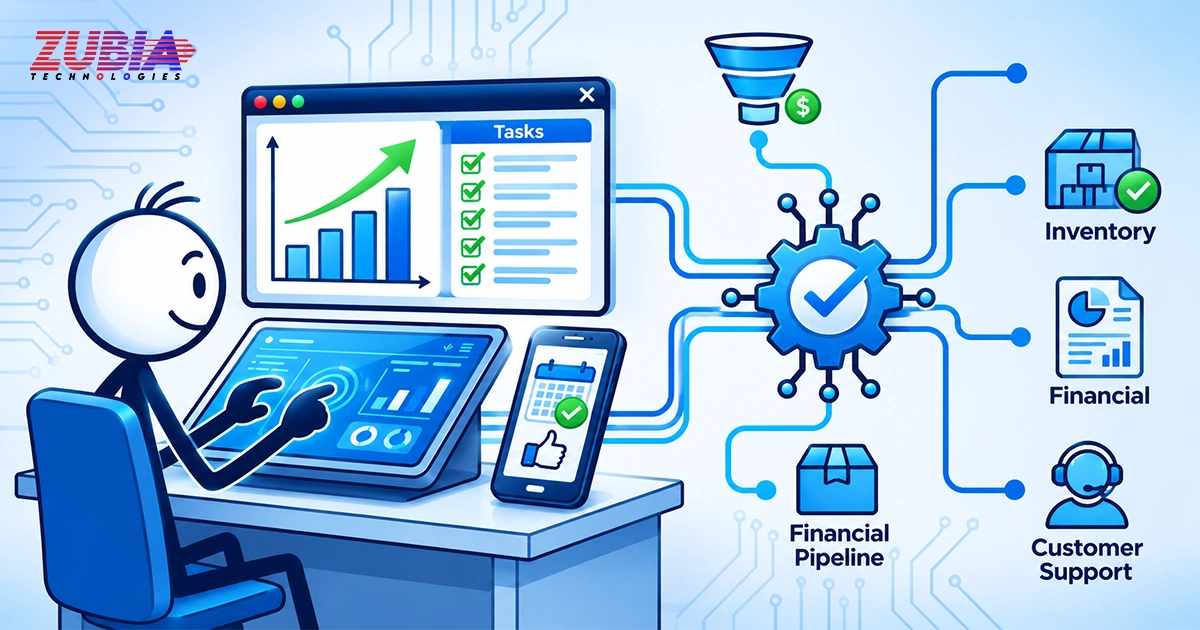
Smart software uses automation, integration and data analysis to streamline your business activities. It reduces manual work, connects different systems and provides real-time insights: all designed to make your operations smoother and more efficient.
Five Ways Smart Software Makes Daily Business Operations Easier
The real value of smart software becomes clear when we look at the task’s businesses handle every day.
-
Automating Repetitive Tasks
How much time do employees spend on work that follows the same steps every day?
Sending reminders, entering customer details, assigning tasks, updating records and preparing routine notifications are common examples. These activities may seem small individually, but together they can take up a significant part of the working day. Business process automation helps reduce this manual workload.
-
Bringing Business Information into One Place
Searching for information should not feel like looking for a needle in a haystack.
When customer records, sales information, project updates and financial details should stored at a centralized software helps bring relevant business information together.
For example, a CRM system can give authorized employees access to customer details, previous interactions, enquiry history, and follow-up records through one platform.
-
Improving Communication Between Teams
A missed update can delay an entire process. Imagine the sales department closing a deal, but the operations team does not receive the latest requirements. Work gets delayed, the customer must explain everything again, and employees spend time figuring out what went wrong.
Shared software systems can reduce these communication gaps.
-
Making Customer Management More Organized
Customer experience does not depend only on the quality of a product or service. The way a business handles enquiries, follow-ups, complaints and ongoing relationships matters just as much.
When customer information is scattered, employees may not know what was discussed previously or which action needs to happen next. A Customer Relationship Management (CRM) system helps solve this problem by organizing customer information and interactions.
-
Making Business Decisions with Better Information
Running a business involves making decisions every day. Managers need to understand sales performance, employee productivity, customer activity, expenses, and operational progress. But decisions become difficult when the necessary information is incomplete or spread across multiple files.
Reporting tools and business dashboards can help bring important figures together.
The difference is simple: instead of spending hours collecting information before making a decision, teams can access organized reports and focus on what the data means.
Better Business Operations Start with the Right Technology
Complex operations do not always require complicated solutions. In many cases, businesses can improve daily workflows by organizing information, automating repetitive activities, connecting existing systems, and giving employees better tools to manage their responsibilities.
The right technology should make work easier, not create another layer of tasks. At Zubia Technologies, we understand that every business has different operational requirements. Our services include custom software development, website development, application development, mobile application development, and IT consulting. We focus on developing technology solutions that address business needs and support more organised operations.
Connect with Zubia Technologies to discuss a Smart Software Solution that meets your requirements.
Stop Working Around Complicated Processes
Business growth should not mean adding more confusion to everyday operations. When employees rely on disconnected tools and repetitive manual tasks, even simple activities can become time-consuming. Smart Software Solutions helps bring structure to these processes, making information easier to access and work easier to coordinate.
The goal is not to use the most technology. It is to use the right technology to solve the problems that matter.
If you also want to market your businness then click: