
Why Manufacturers Need a Unified B2B and B2C Ecommerce Platform
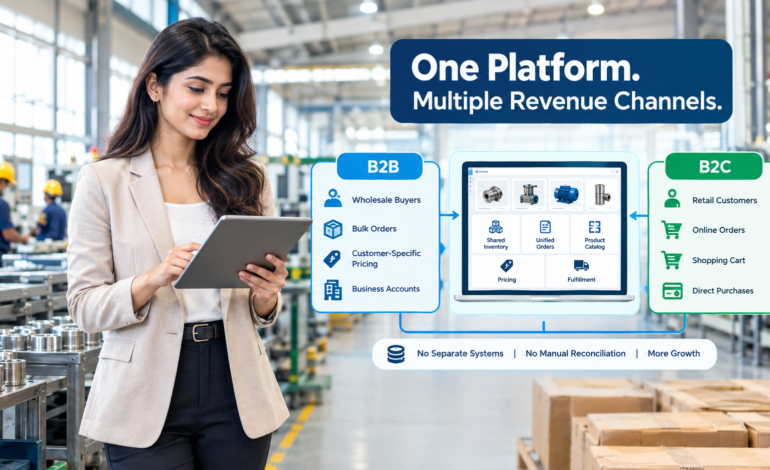
Manufacturers need a unified B2B and B2C ecommerce platform because they sell to both business buyers and end consumers, often simultaneously. Managing these on separate systems creates inventory conflicts, pricing errors, and operational chaos. A single platform with built-in B2B and B2C support reduces costs, prevents overselling, and gives manufacturers a complete view of their business in one place.
The Problem Nobody Talks About at Manufacturing Conferences
Walk into most manufacturing businesses in India and you’ll find the same hidden mess underneath a functioning exterior.
On one side, there’s a WhatsApp thread for reseller orders. On another, an Excel sheet tracking wholesale invoices. And somewhere in the middle, a website that’s technically live but nobody’s really managing it properly because the team is stretched across too many tools.
This is how most manufacturers currently handle selling. Not because they’re disorganized, but because the tools they started with were never built for how manufacturing businesses actually work.
The real problem isn’t the business. It’s the setup.
Most ecommerce platforms were built for a single use case: one seller, one type of customer, one price. A manufacturer almost never fits that model. You might sell 500 units of a product to a distributor at a negotiated wholesale rate on Monday, and sell 2 units of the same product to a retail customer online on Tuesday. Managing that correctly, without double-selling or showing the wrong price to the wrong customer, requires a system that understands both worlds.
This blog is about why those two worlds need to live in one platform, and what happens when they don’t.
What Is a Unified B2B and B2C Ecommerce Platform?
A unified B2B and B2C ecommerce platform is a single system that handles both wholesale (business-to-business) and retail (business-to-consumer) sales from one backend.
Instead of running a separate wholesale portal and a separate retail website, you manage both from a single dashboard. Inventory is shared and updated in real time across both channels. Pricing rules are set per customer type. Orders from resellers and direct customers flow into the same fulfillment pipeline.
What it is NOT: two separate storefronts stitched together by an integration. That’s the old way, and it creates as many problems as it solves.
A genuine unified platform means:
- One product catalog that powers both channels
- Customer-specific pricing (wholesale vs retail) from the same system
- Shared inventory that updates across both channels simultaneously
- A single order management view regardless of where the order came from
- One reporting dashboard that shows the full picture
Why Do Manufacturers Specifically Need This?
Most manufacturers don’t sell just one way. The business model itself involves multiple customer types.
Resellers and distributors buy in bulk at wholesale rates. They need MOQ (minimum order quantity) rules, custom pricing, credit terms, and bulk invoicing.
Retail and D2C customers buy one or a few units at full price. They need a smooth online shopping experience, fast checkout, and order tracking.
Institutional buyers (hotels, hospitals, corporate buyers) often sit somewhere between the two, needing custom quotes and sometimes account-specific catalogs.
Running all of this through separate systems creates a fragmentation problem. Your inventory doesn’t know which system sold what until someone manually reconciles it. Your sales team doesn’t have a single view of what’s actually available. And when a wholesale order comes in for a product that just sold out through your retail site, you’ve got a problem.
A 2022 Forrester report found that B2B buyers increasingly use the same purchasing behavior as retail consumers, expecting self-service ordering, real-time stock visibility, and fast fulfillment. This convergence is pushing manufacturers to think about their wholesale and retail channels together, not in separate boxes.
What Happens When You Run B2B and B2C on Separate Systems
Let’s be specific about the operational damage this causes.
Inventory Overselling
Your retail website shows 50 units in stock. A wholesale buyer places an order for 60 through your WhatsApp or a separate portal. Both orders get confirmed. You only have 50 units. Now you’re canceling someone’s order and damaging a relationship.
This is not a theoretical scenario. It happens constantly to manufacturers running split systems. Real-time inventory sync between your B2B and B2C channels is what prevents this.
Wrong Pricing Shown to Wrong Customers
Wholesale pricing should never be visible to retail customers, and retail prices shouldn’t be shown to your regular distributors. When these are managed separately, pricing leaks happen. A distributor sees the retail price and asks why they’re not getting a better deal. Or worse, a retail customer somehow accesses your wholesale rate.
A unified platform lets you set pricing rules by customer type, login status, or account. The right price shows to the right customer automatically.
Reconciliation Nightmares
When orders come from multiple systems, someone has to compile them into a single picture at the end of the day or week. This is manual work. It introduces errors. And it scales terribly as your order volume grows.
One system means one source of truth. You don’t need to reconcile, because everything is already together.
Missed Business Insights
When your B2B and B2C data lives in separate places, you can’t answer the questions that actually drive better decisions: Which products move faster through distributors vs direct channels? Which customer type has the highest lifetime value? Where is inventory moving fastest?
Unified data gives you unified insight.
Shopify vs Shopaccino: How Each Handles B2B and B2C for Manufacturers
These are the two most discussed platforms for manufacturers entering ecommerce. Here’s how they actually compare on the things that matter.
How Does Shopify Handle B2B for Manufacturers?
Shopify is the world’s largest ecommerce platform with over 4.6 million stores globally. For pure retail and D2C, it’s excellent. But for manufacturers who need B2B functionality alongside their retail channel, the picture gets complicated.
B2B on Shopify requires Shopify Plus, which starts at $2,300 per month. That’s a serious investment for a mid-size manufacturer. The Plus tier unlocks features like:
- Company accounts for B2B buyers
- Customer-specific pricing and catalogs
- Net payment terms
- Draft orders for custom quotes
Outside of Shopify Plus, native B2B support is limited. You can use third-party apps from the Shopify App Store to add wholesale features, but this means:
- Additional monthly costs per app
- Integration dependencies that can break with platform updates
- Separate support channels for each tool
- Data that may not sync cleanly between apps and your core store
For D2C and retail, Shopify is genuinely strong. The storefront tools, themes, checkout optimization, and marketing integrations are mature and well-tested.
The gap for manufacturers: A manufacturer on Shopify Basic or Advanced (not Plus) essentially has a retail platform with B2B features bolted on through apps. If you outgrow those apps or need tighter integration between your B2B and B2C workflows, you’re either upgrading to Plus or rebuilding.
How Does Shopaccino Handle B2B and B2C for Manufacturers?
Shopaccino was built specifically because platforms like Shopify don’t serve manufacturers and distributors well at standard pricing tiers.
The core difference: B2B and B2C selling is not an add-on in Shopaccino. It’s the architecture of the platform itself.
What this means practically:
Single catalog, dual pricing. You maintain one product catalog. Shopaccino applies pricing rules based on customer type, login, or account tier. Wholesale customers see wholesale prices. Retail customers see retail prices. No separate product lists to maintain.
Customer account management for B2B buyers. Resellers and distributors get their own accounts with negotiated pricing, credit limits, and order history. Your sales team can manage these from the same dashboard as your retail orders.
Shared inventory across channels. When a wholesale order comes in for 200 units and your retail store has 80 of those units reserved, Shopaccino handles the allocation. No manual inventory reconciliation between systems.
Zero transaction fees. Every sale goes directly to you. For high-volume manufacturers processing large wholesale orders, this difference compounds fast. On Shopify (without Shopify Payments, which isn’t available in India), transaction fees apply on every order.
Built-in mobile app for your customers. D2C buyers can shop from a branded mobile app. This is included, not a separate subscription.
Multi-warehouse fulfillment. If your manufacturing units or warehouses are in multiple locations, Shopaccino routes orders to the nearest or most appropriate warehouse automatically.
On-the-go business management. Sales reps, warehouse staff, and management can track and manage orders from mobile, which matters for manufacturers whose teams aren’t desk-bound.
Feature Comparison: Shopify vs Shopaccino for Manufacturers
| Feature | Shopify (Standard Plans) | Shopify Plus | Shopaccino |
| B2B customer accounts | Via apps only | Yes | Yes (built-in) |
| Customer-specific pricing | Via apps only | Yes | Yes (built-in) |
| B2B + B2C from one system | Partial (app-dependent) | Yes | Yes |
| Mobile app for customers | Via third-party builder | Via third-party builder | Included |
| Multi-warehouse fulfillment | Basic + apps | Advanced | Built-in |
| Transaction fees (India) | Yes (2% on Basic) | 0.15%-0.25% | Zero |
| India-specific logistics | Via apps | Via apps | Native |
| Starting price | $29/month | $2,300/month | Contact for pricing |
| Built for manufacturers | No | Partial | Yes |
A Real Scenario: What a Typical Manufacturer Faces
Consider a textile manufacturer in Surat. They produce fabric and finished garments. Their customer base includes:
- 35 wholesale buyers (retailers, boutiques, distributors) across Gujarat and Maharashtra
- A growing group of individual customers buying directly through Instagram and Google Ads
- Two institutional accounts (hotels buying uniform fabrics)
Right now, they manage wholesale orders through WhatsApp and Google Sheets. Their website handles retail but doesn’t show live inventory to wholesale buyers. Every Monday morning, someone spends two hours reconciling what sold where.
What they need is not complicated. They need one place where every customer type can buy, every order is recorded, inventory updates in real time, and pricing is controlled per account.
On Shopify’s standard plans, they’d need to add multiple apps to cover B2B. On Shopify Plus, they’d pay $2,300 a month, which doesn’t make sense at their current scale.
On Shopaccino, this is the default setup. Wholesale accounts with custom pricing, a retail storefront, shared inventory, and a branded mobile app for D2C buyers. The manufacturer gets off WhatsApp, stops the weekly reconciliation, and has a live view of their business at any point.
What Does Unification Actually Save You?
Let’s make this concrete.
Time saved on reconciliation: If your team spends 5 hours a week manually syncing orders across systems, that’s 260 hours a year. At even a modest cost of Rs. 200 per hour for staff time, that’s Rs. 52,000 per year in unproductive labor, not counting the errors that cost more.
Inventory loss prevention: Overselling one wholesale order per month because of an inventory sync lag, and having to offer refunds or discounts to recover the relationship, is a real cost that’s hard to quantify but easy to feel.
Transaction fee savings: A manufacturer processing Rs. 20 lakh per month through Shopify Basic pays 2% in transaction fees, which works out to Rs. 40,000 per month or Rs. 4.8 lakh per year, purely to the platform. On Shopaccino, that number is zero.
App subscription savings: A typical Shopify store needing B2B features, a mobile app builder, a wholesale pricing app, and a multi-location inventory app could easily add Rs. 15,000 to Rs. 25,000 per month in app costs alone.
What Features Should a Unified Platform Have for Manufacturers?
If you’re evaluating platforms, here’s a practical checklist.
Non-Negotiable Features
- Dual pricing by customer type. Wholesale and retail prices from the same product catalog, controlled by customer login or account tier.
- Shared inventory across channels. Real-time stock that updates whether the sale came from a wholesale buyer or a retail customer.
- B2B account management. Business accounts with their own pricing, order history, credit terms, and repeat ordering capability.
- MOQ (Minimum Order Quantity) rules. Wholesale buyers should be prevented from ordering below your minimum. Retail customers shouldn’t see MOQ restrictions.
- Single order dashboard. Every order, from every channel, visible in one place with status tracking.
Important for Scale
- Mobile access for your team. Warehouse staff and sales reps need to check and update orders from anywhere.
- Multi-warehouse support. If you operate from more than one location, inventory allocation and order routing should be automatic, not manual.
- Customer mobile app. D2C buyers shop on phones. A branded app keeps them in your ecosystem, not a third-party marketplace.
- Integrated logistics. Direct connections with shipping and logistics partners reduce manual data entry and speed up fulfillment.
Good to Have
- GST-compliant invoicing. Especially for Indian manufacturers, tax documentation needs to be accurate and automatic.
- Export-ready features. If you sell internationally or plan to, multi-currency and international payment support should be native.
- Analytics by channel. Revenue, inventory movement, and customer data broken down by B2B vs B2C so you can make decisions based on actual channel performance.
The Mindset Shift Manufacturers Need to Make
Here’s something that often gets overlooked in these platform discussions.
Choosing a unified platform isn’t just a technology decision. It’s an operational decision.
When your B2B and B2C channels run separately, you’re essentially running two businesses with two different sets of data, two different customer experiences, and two different fulfillment workflows. Bringing them together forces you to think about how your business actually works as a whole.
Who gets which price? How is inventory allocated between channels during peak season? What happens when a product sells out on the retail side but there’s still a wholesale order pending?
These are questions you should be able to answer clearly before choosing a platform. The platform will implement whatever logic you give it. The logic itself has to come from your business model.
Manufacturers that go through this process almost always discover opportunities they hadn’t seen before. A product that moves well through retail but slowly through wholesale might be better positioned as a D2C-first product. A category that flies off shelves for wholesale buyers might be worth testing with D2C pricing. You only see this when you have one view of everything.
How to Evaluate if You’re Ready to Unify Your Channels
A few honest questions before you make the switch:
Are you currently managing B2B and B2C through separate tools? If yes, you’re already paying the coordination tax whether you realize it or not.
Have you had inventory conflicts between channels in the last six months? Even once is a signal. As you scale, it will happen more often.
Do your wholesale customers have to call or WhatsApp to place orders? If so, you’re creating friction for your own buyers and wasting your sales team’s time on order entry.
Is your current setup costing you more in apps and subscriptions than you’d pay for a purpose-built platform? Most manufacturers who calculate this honestly find the answer is yes.
Do you have plans to add a D2C channel or grow the one you have? Starting that on a separate system when a unified option exists makes no sense.
Diagram: Split System vs Unified Platform
SPLIT SYSTEM (Current State for Most Manufacturers)
Wholesale Orders Retail Orders
(WhatsApp / Portal) (Website / Marketplace)
| |
Separate inventory Separate inventory
Separate pricing Separate pricing
Separate orders list Separate orders list
| |
└──── Manual sync ────────┘
|
Weekly reconciliation
Inventory conflicts
Pricing errors
Missed insights
UNIFIED PLATFORM (Shopaccino Model)
Wholesale Buyers Retail / D2C Buyers
(B2B accounts) (Website + Mobile App)
| |
└────── One Platform ──────┘
|
Single product catalog
Real-time shared inventory
Customer-specific pricing
Unified order dashboard
Integrated logistics
One set of reports

