
Loan Management Software with Integrated KYC, Credit Bureau & AA APIs
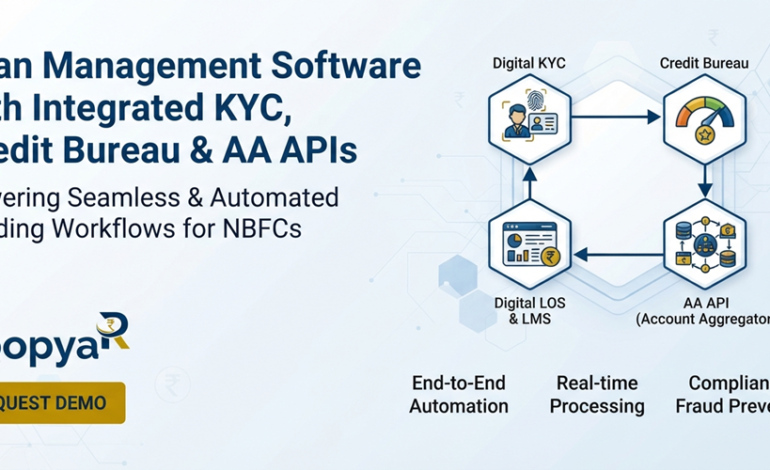
Every loan decision a bank or NBFC makes rests on three questions: who is this borrower, what is their credit history, and what can they actually afford to repay. Answering those three questions used to mean stitching together a KYC vendor, a credit bureau connection, a bank-statement analysis tool and a loan management system, and hoping the handoffs between them didn’t slow the borrower down or introduce fraud risk. A modern loan management software with integrated KYC, credit bureau, and Account Aggregator (AA) APIs removes those handoffs entirely. Identity verification, bureau checks and consent-based bank data all run inside the same underwriting workflow, so a lender’s credit and operations teams work from one screen instead of five systems.
This is the exact problem Roopya, a lending infrastructure platform for banks and NBFCs, is built to solve. Roopya’s platform ships with 300+ pre-integrated APIs spanning KYC, credit bureaus, verification services and payment rails, wrapped in a no-code business rule engine that lets a lender configure exactly how those checks fit into their loan journey. The rest of this piece walks through why each of these three layers — KYC, credit bureau data and AA data — matters on its own, how they work together inside a loan management system, and what to look for when evaluating a platform that claims to offer all three.
Why Loan Management Needs More Than a Ledger
A loan management system (LMS), on its own, is a system of record: it tracks disbursements, EMI schedules, repayments, penal charges and closures. That is necessary but it is only half the job. The decisions that determine whether a loan should be sanctioned in the first place — is this person who they claim to be, do they have a clean repayment history, and does their bank account show income consistent with the loan amount — happen upstream, in origination and underwriting. When those checks live in separate tools, three things go wrong in practice: turnaround time stretches from minutes to days, data has to be re-entered or re-uploaded at each handoff (introducing errors), and it becomes hard to build a single, auditable trail of why a loan was approved or declined. Integrating KYC, credit bureau and AA APIs directly into the LMS closes that gap.
Layer One: KYC Integration
Know Your Customer (KYC) verification confirms identity, address and document authenticity before a lender takes on any credit risk. In India this typically draws on a defined set of sources: Aadhaar-based e-KYC and offline XML verification, PAN verification against the Income Tax database, the Central KYC Registry (CKYC) for previously verified records, DigiLocker for pulling government-issued documents directly from the source, and video KYC for in-person-equivalent verification where regulations require it.
On Roopya’s platform, these checks are part of the same pre-integrated API library used for underwriting, so a lender configuring a personal loan product can require Aadhaar e-KYC and PAN verification, while a business loan product on the same platform can additionally pull GSTN records and CKYC data — without a developer writing new integration code for either. Roopya’s AI-powered document analysis layer adds automated OCR and document authenticity checks on top of this, extracting and cross-verifying identity documents, address proofs and income documents in seconds rather than the hours a manual review would take, while flagging anomalies that suggest tampering or identity mismatch.
- Reduces onboarding drop-off by keeping KYC inside the same application flow instead of routing borrowers to a separate portal
- Cuts fraud risk with automated document authenticity and face-match checks rather than manual visual review
- Creates a single audit trail linking the KYC outcome to the underwriting decision, which matters for regulatory inspection
- Lets different loan products on the same platform use different KYC depth — lighter for small-ticket loans, fuller for larger exposures
Layer Two: Credit Bureau Integration
Credit bureau data answers a narrower but critical question: how has this person or business repaid credit before? In India, the four licensed credit information companies — CIBIL, Experian, Equifax and CRIF High Mark — each maintain independently sourced credit histories, and lenders commonly pull from more than one bureau, particularly for higher-ticket or business loans, since coverage and scoring can differ between them.
A loan management system with bureau APIs built in lets a credit policy pull the right bureau (or combination of bureaus) automatically based on loan type, ticket size or applicant segment, rather than having an operations team manually log into separate bureau portals for each application. Roopya’s no-code business rule engine is designed for exactly this: a lender can set rules such as “pull CIBIL and Experian for loans above a defined ticket size, and decline automatically below a defined bureau score,” and have that rule apply consistently across every application without engineering involvement. This is also where soft-pull versus hard-pull policy matters — a soft pull for pre-qualification followed by a hard pull only after the borrower proceeds keeps unnecessary inquiries off a borrower’s report, and a well-built LMS should let a lender configure exactly when each type of pull happens in the journey.
- Automated bureau pulls remove manual data entry and the transcription errors that come with it
- Multi-bureau strategies (waterfall or blended scoring) become a configuration choice, not a custom build
- Bureau data feeds directly into the same rule engine that drives KYC and AA-based decisions, so all three sit in one policy
- Historical bureau pulls are logged against the loan file automatically, supporting audit and dispute resolution
Layer Three: Account Aggregator (AA) API Integration
The Account Aggregator framework, regulated by the RBI and coordinated industry-wide through Sahamati under the technical specifications published by ReBIT, is the newest and, for many lenders, the most transformative of the three layers. It lets a borrower consent to share their own financial data — bank account statements, and increasingly mutual fund, insurance and other holdings — directly from the institution that holds it (the Financial Information Provider, or FIP) to the lender requesting it (the Financial Information User, or FIU), through a licensed Account Aggregator that acts purely as a consent-based data pipe. Critically, the AA itself never decrypts or stores the underlying financial data — it only routes it — and the borrower can view, narrow or revoke that consent at any time from their AA app.
Why does this matter for underwriting? Bureau data shows how a borrower has repaid credit in the past; it says little about a self-employed borrower, a gig worker, or a small business with thin or no credit history. AA data shows actual, verified cash flow — salary credits, business receipts, existing EMI outflows, and account balances — sourced directly from the bank rather than from a borrower-uploaded PDF statement that can be edited or manipulated. For lenders serving MSMEs, new-to-credit borrowers, or small-ticket and payday-style loan products, this is often the difference between being able to underwrite a segment responsibly at all and having to decline it outright for lack of data. As of early 2026 the AA ecosystem has scaled to billions of financial accounts enabled for sharing and hundreds of live participants, with lending consistently the largest use case by transaction volume — this is no longer an experimental data source but a mainstream part of underwriting infrastructure for Indian lenders.
A platform that has AA integration built into the loan management system — rather than as a bolt-on analytics tool a credit team uses separately — can trigger a consent request automatically at the underwriting step, ingest the resulting statement data, and feed derived metrics (average monthly balance, income regularity, existing obligation ratio) straight into the same rule engine used for KYC and bureau outcomes. Roopya’s platform architecture, with its pre-integrated API layer and no-code rule engine, is built to plug in an AA connection as one more data source in that single underwriting policy, alongside bureau and KYC data, rather than as a separate system a credit analyst has to reconcile by hand.
- Gives verified, bank-sourced cash flow data instead of borrower-uploaded, editable bank statements
- Extends responsible underwriting to thin-file, self-employed and MSME borrowers that bureau-only scoring underserves
- Consent is time-bound, purpose-bound and revocable by the borrower — supporting data-privacy compliance by design
- Combines with bureau and KYC outcomes in one rule engine for a single, explainable credit decision
| Layer | What It Verifies | Typical Sources Roopya Connects To |
| KYC | Identity, address, liveness, document authenticity | Aadhaar e-KYC/XML, PAN verification, CKYC Registry, DigiLocker, video KYC, GSTN |
| Credit Bureau | Credit history, existing exposure, repayment behaviour, bureau score | CIBIL, Experian, Equifax, CRIF High Mark |
| Account Aggregator | Real bank cash flow, income stability, obligations, alternate data | RBI-licensed AAs operating under the Sahamati/ReBIT protocol, connecting to banks, NBFCs, depositories, insurers and GSTN as FIPs |
How These Three Layers Work Together Inside Roopya
The value of integrating KYC, credit bureau and AA APIs isn’t just that each check runs faster individually — it’s that they run together, in sequence, inside one workflow, with the outcome of each step feeding the next. A typical configured journey on Roopya’s platform looks like this: a borrower applies through a digital application form; Aadhaar e-KYC and PAN verification confirm identity within seconds; a bureau pull (or multi-bureau pull, per the lender’s configured policy) returns a credit score and repayment history; an AA consent request is triggered for cash-flow verification where the loan product requires it; and the no-code business rule engine combines all three outputs against the lender’s credit policy to return an automated decision — approve, decline, or refer for manual underwriting — typically within minutes rather than days.
This matters operationally in three ways. First, turnaround time (TAT) drops sharply, which is often the single biggest competitive differentiator in retail and small-ticket lending, where borrowers compare lenders on speed as much as on rate. Second, the lender gets one auditable file per loan showing exactly which checks ran, what each returned, and how the rule engine used them — which is what regulators and internal audit teams look for during inspection. Third, because the rule engine sits above all three data sources, a lender can change credit policy (tighten a bureau score cutoff, add an AA-based income check for a new product, adjust KYC depth for a new geography) without waiting on a development cycle, since it is a configuration change rather than a code change.
Fraud Detection Across All Three Layers
Integrating these APIs into a single platform also strengthens fraud detection, because inconsistencies become visible across layers rather than being checked in isolation. A document that passes a basic KYC check but shows signs of tampering under AI-powered analysis, a bureau profile that doesn’t match the applicant’s declared income, or AA-sourced bank data that shows cash flow inconsistent with a loan application — each of these is a weak signal on its own, but taken together inside one rule engine they form a much stronger fraud indicator. Roopya’s platform is built with AI-powered fraud detection modules specifically for this cross-referencing, layering pattern recognition across document analysis, bureau data and cash-flow data rather than relying on any single check to catch fraud on its own.
Compliance: Why Integration Also Means Fewer Compliance Gaps
For regulated lenders, compliance isn’t a separate workstream from underwriting speed — it’s a constraint that shapes how the whole system has to be built. A few points matter specifically for KYC, bureau and AA integration:
- RBI’s KYC master direction and the CKYC framework require specific verification steps and record-keeping; an integrated LMS should log every KYC outcome against the loan file automatically.
- Bureau pulls are governed by the Credit Information Companies (Regulation) Act, and require documented borrower consent for each pull, particularly hard inquiries — this consent should be captured and stored as part of the loan application record.
- Account Aggregator data flows are governed by the RBI Master Direction on NBFC-Account Aggregators; the AA framework’s core design (encrypted, consent-scoped, revocable, with the AA never seeing plaintext data) is itself a compliance feature, not an add-on lenders need to build separately.
- India’s Digital Personal Data Protection (DPDP) framework adds a further layer of obligation around how borrower data obtained through any of these three channels is stored, used and eventually deleted.
A platform built for the Indian regulatory environment specifically — rather than a generic global LMS adapted after the fact — is more likely to keep pace with these requirements as they evolve. Roopya positions this as a core part of its platform, describing itself as continuously updated to stay compliant with regulatory change rather than requiring a lender to track and implement each update independently.
Use Cases Across Loan Products
Because the underlying KYC, bureau and AA connections are the same regardless of loan type, a single platform can support very different products by simply changing how the rule engine weighs each data source:
- Personal loans: fast Aadhaar e-KYC plus bureau-led scoring, with AA data used to validate income for higher-ticket approvals
- Small-ticket and payday-style loans: lightweight KYC and a bureau check, often supplemented heavily by AA cash-flow data where bureau history is thin
- Business and SME loans: PAN and GSTN verification, bureau checks on the business and promoters, and AA-based cash-flow analysis of business bank accounts in place of, or alongside, financial statements
- Gold and secured loans: lighter KYC and bureau weighting, since collateral reduces reliance on income-based underwriting
- Embedded finance and loan-service-provider partnerships: the same API stack exposed through Roopya’s open API architecture so a partner platform can originate loans without building its own verification stack
What to Evaluate When Choosing an Integrated LMS
Not every platform that claims “integrated KYC and bureau APIs” delivers the same depth. A few practical questions are worth asking any vendor, including Roopya, when evaluating fit:
- Are the KYC, bureau and AA integrations native to the LMS, or are they separate modules that require manual reconciliation?
- Can credit policy — bureau cutoffs, KYC depth, AA-based income rules — be changed by a business user through configuration, or does it require a development request?
- Does the platform support multiple bureaus and multiple AAs, or is it locked to a single provider that may not offer full market coverage?
- Is there a single audit trail per loan file showing every KYC, bureau and AA event, timestamped and consent-linked?
- How is pricing structured — fixed licence cost regardless of volume, or a pay-as-you-use model that scales with actual loan volume?
- How quickly can a new loan product be configured and go live on the platform once the underlying APIs are already connected?
KYC, credit bureau checks and Account Aggregator data each answer a different question about a borrower, and each has, historically, lived in its own tool. Bringing all three into a single loan management system — with one rule engine, one audit trail, and one configuration layer — is what actually shortens loan turnaround time, tightens fraud detection, and keeps a lending operation compliant as regulation around KYC, bureau reporting and account aggregation continues to evolve. That is the specific problem Roopya’s lending infrastructure is built around: 300+ pre-integrated APIs, a no-code business rule engine, and a platform designed to bring a lender from onboarding to a fully underwritten decision inside a single workflow. Lenders evaluating a move from disconnected tools to an integrated platform can
Frequently Asked Questions
What is a Loan Management Software with integrated KYC, Credit Bureau and AA APIs?
It is a lending platform where identity verification (KYC), credit history checks (credit bureau) and consent-based bank data access (Account Aggregator) are built into the loan workflow itself, instead of being done manually or through separate, disconnected tools. Roopya’s platform runs all three checks inside the same origination and underwriting screen, so a lender’s team never has to leave the system to verify a borrower.
Is Account Aggregator (AA) data integration mandatory for lenders in India?
It is not legally mandatory, but it has become the practical standard for cash-flow-based underwriting because it gives a lender consent-verified, bank-sourced statements instead of borrower-uploaded PDFs. Many banks and NBFCs now use AA data alongside bureau data to assess thin-file and self-employed borrowers who don’t have a long credit history.
How is Account Aggregator data different from a credit bureau report?
A credit bureau report shows past repayment behaviour on existing loans and cards, reported by lenders. AA data shows actual bank account transactions, balances, and cash flow, shared directly by the borrower’s bank with their consent. The two are complementary: bureau data tells you how someone has repaid before, and AA data tells you what they can currently afford to repay.
Which KYC methods does Roopya support?
Roopya’s lending infrastructure is built on a library of 300+ pre-integrated APIs that includes Aadhaar-based e-KYC, PAN verification, CKYC registry checks, DigiLocker document pulls, and video KYC, so a lender can configure the exact KYC journey they need for a given loan product without custom development.
Does using an AA integration mean the lender can see a borrower’s bank login details?
No. The Account Aggregator framework is designed so the AA itself is a consent-based data pipe that does not decrypt or store the underlying financial data, and lenders never receive banking credentials. Data flows only after the borrower approves a specific, time-bound, purpose-bound consent inside their AA app.
How long does it take to go live with an integrated LMS like Roopya?
Because the KYC, bureau and AA connections are pre-built rather than custom-integrated, lenders on Roopya’s no-code platform can typically configure a loan product and start processing applications within a day, compared to the weeks or months a ground-up integration would normally take.
Can this kind of platform be used for both banks and NBFCs?
Yes. Roopya is built specifically for banks, NBFCs and MFIs, and its business rule engine, KYC stack, bureau connections and AA integration are configurable per lender, so the same underlying infrastructure can support very different loan products and risk policies.

