ATAR Explained – What It Is, Why It Matters for Australian and International Students
What Is ATAR?
ATAR stands for Australian Tertiary Admission Rank. It is a number between 0.00 and 99.95 that shows where you rank compared to all other students your age who started high school with you in Year 7.
-
An ATAR of 80.00 means you performed as well as or better than 80% of your cohort.
-
An ATAR of 99.95 is the highest possible and sits at the very top of the state’s Year 12 group.
Importantly, ATAR is not a percentage mark; it is a percentile rank that lets universities compare students from different schools and subjects on a common scale.
How ATAR Works in Australia
Each state in Australia has its own Year 12 system (HSC in NSW, VCE in VIC, QCE in QLD, WACE in WA, SACE in SA, TCE in TAS, BSSS in ACT), but they all convert those results into the same 0.00–99.95 ATAR ranking system.
The general process is:
-
Your subject scores (e.g., HSC marks, VCE study scores) are first scaled to account for difficulty and cohort strength.
-
A best‑fit combination of your best subjects (for example, five subjects in Queensland, 10 units in NSW, or the “Primary Four” in Victoria) is used to form an aggregate.
-
All students are ranked by this aggregate, then grouped into ATAR bands (0.00–99.95) so universities can see how you compare nationally.
Each state has its own admissions centre (UAC, QTAC, VTAC, etc.) that calculates and releases ATARs, but the final number is directly comparable across Australia.
What Is an ATAR Calculator?
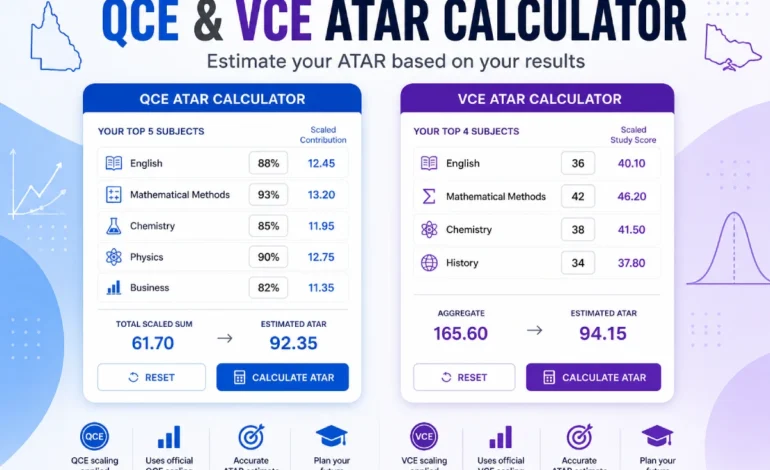
An ATAR Calculator is an online tool that helps Year 11 and 12 students estimate their Australian Tertiary Admission Rank (ATAR) based on their subject scores and predicted results. It uses each state’s rules—such as how many subjects count and how raw marks are scaled—to generate a projected ATAR between 0.00 and 99.95, giving students a realistic idea of which university courses they may be eligible for. Students input their expected HSC, VCE, QCE, WACE, or SACE marks, and the calculator automatically applies typical scaling patterns and aggregates to show how different subject combinations or performance improvements can raise their score. While it does not replace the official ATAR issued by admissions centres like UAC or QTAC, an ATAR Calculator is a powerful planning tool for setting goals, choosing subjects, and understanding course cut‑offs before final results are released.
Why ATAR Is Important for Australian Students
For Australian high‑school leavers, the ATAR is the main gateway to university admission. It is used to:
-
Set cut‑off or minimum ATAR requirements for each course.
-
Decide who gets offers in competitive programs like medicine, law, engineering, and aviation.
For example:
-
A lower‑ATAR course might accept students with ATAR 60–70.
-
A highly competitive course can require 90–99.95, meaning only the very top students gain entry.
Some states also run Education Access Schemes (EAS) or adjustment factors that slightly boost your effective ATAR if you have faced hardship, rural location, or elite‑sport commitments.
Even then, your base ATAR is the starting point for most entry decisions.
Why ATAR Matters for International Students
International students can encounter ATAR in two main ways:
-
International students studying Year 12 in Australia
If you are completing HSC, VCE, QCE, or another Australian Year 12 system, you will receive an Australian ATAR like local students.
That ATAR is what many universities use for direct entry into undergraduate degrees. -
International students from overseas
If you studied outside Australia (e.g., A‑Levels, IB, or national high‑school exams), universities often convert your scores into an ATAR equivalent.
This lets admissions officers compare your performance against Australian students using the same scale.
In both cases, understanding ATAR helps international students:
-
Judge whether their scores meet a course’s minimum requirement.
-
Compare competitiveness across different universities and programs.
-
Decide if they need to improve their scores, retake exams, or consider alternative pathways (such as foundation years or diplomas).
How ATAR Guides University Choice and Planning
ATAR is not just a final number that appears on results day; it is a planning tool throughout Years 11 and 12.
Students (and their parents) use ATAR to:
-
Choose subject combinations that optimise their scaled aggregate.
-
Set realistic course targets (e.g., aiming for ATAR 80 if medicine is 95+).
-
Decide whether to consider alternative pathways if their projected ATAR is below a course’s cut‑off.
For international students, ATAR‑equivalent tables help them:
-
Translate their IB, A‑Level, or national scores into a familiar Australian benchmark.
-
Decide which universities to apply to based on their equivalent ATAR band.
ATAR Is Not the Only Pathway
While ATAR is important, it is not the only way into Australian higher education. Many students access university through:
-
Foundation programs for international students.
-
Diploma pathways into the second year of a degree.
-
VET qualifications or mature‑age entry criteria.
However, for students who are taking or can convert to an ATAR, it remains one of the most direct and widely understood entry routes into undergraduate study in Australia.
Final Thoughts
ATAR is Australia’s national ranking system for university admission, used by both domestic and international students to prove academic readiness for undergraduate study.
Knowing what ATAR is, how it is calculated, and why it matters helps you plan your Year 12 (or equivalent) experience more strategically and choose realistic university options—whether you study in Australia or overseas.