
Autonomous AI Agents vs. Copilots: What US Businesses Are Adopting
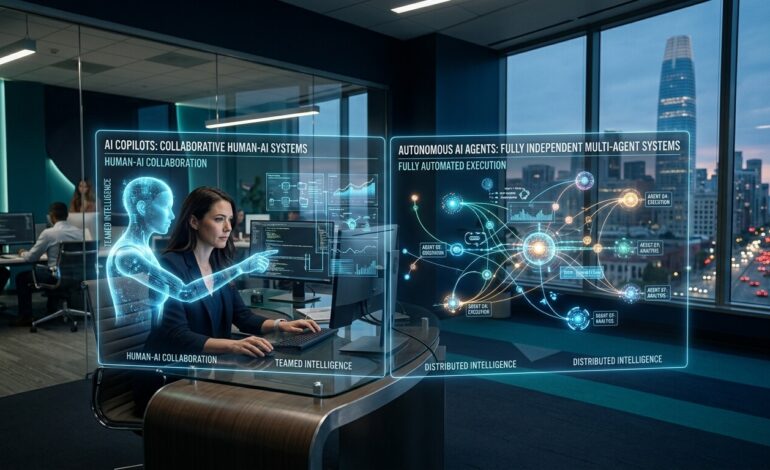
Over the past few years, artificial intelligence has evolved at a dizzying pace across the American corporate landscape. The initial wave of corporate AI adoption relied almost entirely on copilots interactive, human-in-the-loop assistants designed to summarize emails, draft code snippets, and answer real-time prompts. However, corporate America is now entering a new chapter defined by autonomous AI agents.
While copilots assist human workers in completing discrete tasks, agentic AI represents a leap toward self-directed execution. Armed with logic, memory, and specialized tools, autonomous agents can analyze a high-level goal, break it down into sequential steps, and execute entire multi-tier workflows with minimal human supervision. As corporate leadership across North America re-evaluates software budgets and operational efficiency, understanding the distinct value propositions and adoption curves of copilots versus autonomous agents has become essential.
Understanding the Difference: Copilots vs. Autonomous AI Agents
As enterprise decision-makers parse through the latest updates in Technology News USA, a fundamental shift in AI strategy has emerged. To understand where enterprise technology spending is heading, it is crucial to clearly delineate between these two architectures. According to global technology research and advisory insights published by Gartner, agentic AI is rapidly transforming enterprise application roadmaps, with task-specific autonomous agents expected to be embedded across major software platforms over the coming years.
AI Copilots function fundamentally as collaborative partners. They are reactive by design, waiting for a human prompt before generating content, summarizing documents, or recommending lines of code. The human remains the driver, holding the context, initiating the action, and validating every output. For example, a marketing director might prompt a copilot to draft an email campaign, but the director must review, edit, schedule, and hit send.
Autonomous AI Agents, by contrast, act as goal-driven digital workers. Rather than simply answering a prompt, an agent is assigned an objective such as “Identify at-risk enterprise accounts and execute a win-back email sequence.” The agent independently gathers data from customer relationship management (CRM) systems, evaluates account health scores, writes tailored messages, interacts with internal APIs to deliver the content, and monitors responses without requiring constant human hand-holding.
Why US Businesses Are Transitioning to Agentic Systems
The rapid pivot toward autonomous agents across US enterprises is primarily driven by three key operational mandates:
-
Moving Beyond the “Prompting Bottleneck”: Copilots offer undeniable personal productivity gains, but their capacity is capped by human bandwidth. An employee can only write so many prompts in a day. Autonomous agents eliminate this bottleneck by operating continuously in the background, executing complex business rules automatically.
-
Complex Multi-Step Orchestration: Modern enterprise operations rarely exist in a single software tool. Copilots typically struggle when required to bridge isolated enterprise applications. AI agents utilize tool-calling and API access to interact with databases, web applications, customer service channels, and financial ledgers simultaneously.
-
Measurable ROI and Cost Efficiency: While early generative AI investments centered on broad experimentation, corporate boards are now demanding direct return on investment. Autonomous agents deliver clear operational savings by reducing cycle times for complex administrative tasks from days to minutes.
Real-World Adoption Trends Across US Industries
The deployment of autonomous AI agents is taking root across several core sectors in the United States, each leveraging agentic automation to resolve specific operational bottlenecks:
-
Financial Services & Banking: US financial institutions are deploying autonomous agents for automated fraud detection, trade reconciliation, and mortgage document processing. Rather than merely flagging suspicious transactions for human review, intelligent agents cross-reference user transaction history, location data, and risk profiles in real-time to decide whether to temporarily block or clear a card.
-
Customer Service and Logistics: Supply chain managers in the US utilize autonomous multi-agent teams to manage inventory replenishment and carrier dispatching. In customer support hubs, agents go far beyond basic chatbots by handling multi-step refund validations, updating database records, and issuing store credits end-to-end.
-
Software Engineering & IT Maintenance: Tech enterprises are increasingly adopting coding and debugging agents. Instead of just suggesting auto-complete code snippets, advanced developer agents can read an entire bug report, locate the bug across thousands of files in a codebase, author a fix, run automated tests, and submit a pull request for human approval.
Challenges: What Is Slowing Down Full Autonomy?
Despite the accelerating momentum behind agentic AI, US business leaders are approaching total automation with measured caution. Transitioning from human-supervised copilots to autonomous execution presents several operational challenges:
1. Trust and System Reliability: Hallucinations or errors made by a copilot are caught by the human user. However, an autonomous agent executing incorrect actions at scale such as sending faulty invoices or misconfiguring cloud server settings can cause significant financial and reputational harm.
2. Security and Data Governance: Granting AI agents read-and-write permissions across critical internal software infrastructure creates new security attack vectors. US IT teams must build strict permission boundaries, robust audit trails, and deterministic guardrails before deploying autonomous agents in production environments.
3. The “Human-in-the-Loop” Hybrid Model: Rather than granting total autonomy immediately, most US organizations are implementing a hybrid governance model. In this setup, autonomous agents execute routine, low-risk steps independently, but pause and request explicit human authorization before completing high-value or sensitive transactions.
Frequently Asked Questions (FAQs)
Q1: What is the main difference between an AI copilot and an autonomous AI agent?
A: An AI copilot acts as a passive assistant that requires human prompts to execute individual tasks (human-in-the-loop). An autonomous AI agent acts as a goal-oriented worker that can plan multi-step workflows, interact with enterprise APIs independently, and execute end-to-end tasks with minimal human intervention (human-on-the-loop).
Q2: Are US businesses replacing AI copilots with autonomous agents?
A: Not entirely. Most US enterprises are taking a hybrid approach. Copilots remain essential for creative tasks, decision-support, and real-time human collaboration, while autonomous agents are being deployed to automate repetitive, multi-step backend operations like customer refunds, IT debugging, and inventory replenishment.
Q3: What are the biggest risks of deploying autonomous AI agents in an enterprise?
A: The primary concerns center on data governance, security vulnerabilities, and unpredictable system actions (hallucinations executing at scale). To mitigate these risks, organizations establish strict API permission boundaries, deterministic policy-as-code guardrails, and explicit human authorization checkpoints for high-risk transactions.
Q4: How do multi-agent AI systems work in a corporate environment?
A: Instead of using one massive AI model for every task, multi-agent architectures deploy a network of specialized, narrow AI agents that work together. For instance, one agent scouts data, another analyzes filings, and a third drafts outreach all coordinated under a central governance model to ensure accuracy and compliance.
The Road Ahead: The Rise of Multi-Agent Systems
As US businesses look toward the future, the enterprise AI ecosystem is rapidly shifting toward multi-agent orchestration frameworks. Instead of relying on a single mega-agent to execute every corporate duty, companies are building specialized networks of narrow agents that collaborate with one another.
In a modern sales setup, for instance, a “Data Scout Agent” identifies incoming leads, passes the prospect profile to a “Research Agent” to extract company filings, and forwards the synthesis to a “Copywriter Agent” to draft a tailored outreach message all supervised by a manager-level governance system. This modular strategy ensures higher accuracy, tighter security controls, and superior task specialization.
Ultimately, copilots and autonomous agents will continue to coexist across the corporate landscape. Copilots will remain indispensable tools for creative brainstorming, executive decision-making, and specialized strategic work. However, for repetitive, rule-based enterprise workflows, autonomous AI agents are rapidly taking center stage redefining how business gets done across the United States.
{
“@context”: “https://schema.org”,
“@type”: “FAQPage”,
“mainEntity”: [
{
“@type”: “Question”,
“name”: “What is the main difference between an AI copilot and an autonomous AI agent?”,
“acceptedAnswer”: {
“@type”: “Answer”,
“text”: “An AI copilot acts as a passive assistant that requires human prompts to execute individual tasks (human-in-the-loop). An autonomous AI agent acts as a goal-oriented worker that can plan multi-step workflows, interact with enterprise APIs independently, and execute end-to-end tasks with minimal human intervention.”
}
},
{
“@type”: “Question”,
“name”: “Are US businesses replacing AI copilots with autonomous agents?”,
“acceptedAnswer”: {
“@type”: “Answer”,
“text”: “Not entirely. Most US enterprises are taking a hybrid approach. Copilots remain essential for creative tasks, decision-support, and real-time human collaboration, while autonomous agents are being deployed to automate repetitive, multi-step backend operations like customer refunds, IT debugging, and inventory replenishment.”
}
},
{
“@type”: “Question”,
“name”: “What are the biggest risks of deploying autonomous AI agents in an enterprise?”,
“acceptedAnswer”: {
“@type”: “Answer”,
“text”: “The primary concerns center on data governance, security vulnerabilities, and unpredictable system actions (hallucinations executing at scale). To mitigate these risks, organizations establish strict API permission boundaries, deterministic policy-as-code guardrails, and explicit human authorization checkpoints for high-risk transactions.”
}
},
{
“@type”: “Question”,
“name”: “How do multi-agent AI systems work in a corporate environment?”,
“acceptedAnswer”: {
“@type”: “Answer”,
“text”: “Instead of using one massive AI model for every task, multi-agent architectures deploy a network of specialized, narrow AI agents that work together. For instance, one agent scouts data, another analyzes filings, and a third drafts outreach—all coordinated under a central governance model to ensure accuracy and compliance.”
}
}
]
}

