
How Do Medical Device Packaging Machines Handle Syringes, Swabs, Gauze, and Test Kits?
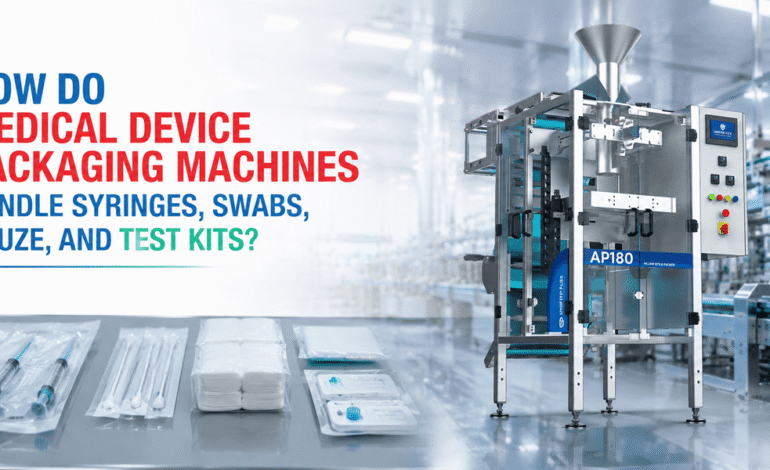
A medical packaging line may handle sterile syringes, individual swabs, stacks of gauze, or test kits containing several components. Although these products may be packaged within the same production environment, their handling and protection requirements are not identical.
A syringe needs secure positioning around sensitive components. Swabs and gauze require controlled handling to avoid unnecessary compression or material disruption. Test kits may contain several individual components that need to be counted, positioned, inspected, and packaged together.
This is where medical device packaging machines can support a controlled and repeatable packaging process. Depending on the product and package format, automated systems can perform or assist with product feeding, placement, pouch forming, tray loading, filling, sealing, inspection, coding, and material handling.
The right equipment is selected according to factors such as product size, shape, sensitivity, packaging material, production volume, required protection, cleanliness requirements, and downstream processes. For manufacturers handling repetitive packaging tasks, automatic packaging machines can also reduce manual handling and provide greater consistency across production runs.
In medical packaging, consistency matters because every package is part of the product’s journey from production to point of use.
Why Do Medical Devices Require Specialized Packaging?
Medical devices and related products can vary considerably in size, shape, material, and handling requirements. A rigid syringe cannot be handled in exactly the same way as soft gauze, while a multi-component test kit requires a different approach from an individually packaged swab.
Packaging may need to protect products from:
- Physical damage during handling and transportation
- Dust, moisture, and other environmental factors
- Contamination where applicable
- Punctures and abrasion
- Unwanted movement inside the package
- Damage to sensitive components
- Loss of package integrity
For products supplied sterile, the packaging system may also need to maintain an appropriate sterile barrier until the package is opened.
Medical packaging machines therefore need to provide controlled movement, accurate product placement, suitable packaging materials, and dependable sealing. The exact configuration depends on the product, packaging format, sterilization method where applicable, and intended use.
The packaging machine is only one part of the overall process. Product design, packaging materials, sealing parameters, inspection, handling, storage, and distribution conditions can all influence finished package performance.
How Are Syringes Packaged by Automatic Packaging Machines?
Syringes have a relatively rigid structure, but certain areas, such as the tip, needle, cap, or plunger, may require additional protection. Packaging equipment needs to position the syringe correctly while preventing unnecessary movement during sealing and subsequent transportation.
Depending on the application, syringes may be packaged in pouches, trays, or other protective formats.
Secure Positioning and Orientation
Pockets, guides, fixtures, or controlled feeding mechanisms can help maintain the correct syringe orientation. Consistent positioning also helps keep sensitive areas away from the seal zone.
Protection of Critical Components
The packaging configuration can help reduce unwanted movement around the needle, tip, cap, or plunger. Appropriate spacing and package design can provide additional protection during handling and transportation.
Controlled Sealing
Temperature, pressure, dwell time, and other sealing parameters need to be appropriate for the selected packaging material and process. Consistent sealing helps support package integrity across production runs.
Material Compatibility
Films, trays, and other packaging materials should be suitable for the intended product, processing conditions, sterilization method where applicable, storage period, and distribution environment.
Inspection and Traceability
Depending on the system, sensors or vision equipment can help identify missing components, incorrect positioning, or selected packaging defects. Coding systems can also support lot identification and other production records where required.
The objective is not simply to place a syringe inside a package. The complete packaging process needs to maintain product condition and package integrity from filling through storage and distribution.
What Packaging Methods Work for Swabs?
Swabs are relatively small and may contain soft or fibrous materials that can be affected by rough handling. Automated packaging systems therefore need to transfer and position them without applying unnecessary force.
Individual swabs may be suitable for pouch-style packaging when single-use presentation is required. Depending on the application, multiple swabs can also be packaged together.
How Does Gentle Product Transfer Work?
Guides, conveyors, vacuum systems, soft handling mechanisms, or other transfer methods can be configured according to the characteristics of the product.
The objective is to move each swab consistently while reducing unnecessary contact and mechanical stress. The handling method should also help maintain the intended product shape and condition.
Can Swabs Be Packaged Individually or in Groups?
The packaging format depends on how the product will be supplied and used.
Individual pouches can provide separate product presentation, while multi-pack formats can accommodate several swabs or related components within one package.
The selected format also affects the feeding system, package dimensions, sealing process, and required level of automation.
Why Is Seal Integrity Important for Swabs?
The package needs to remain closed and intact throughout handling, storage, and transportation. Where a sterile barrier is required, the packaging process needs to be designed around the applicable material and process requirements.
For clinical applications, opening requirements may also influence the package design. Some products may require a package that can be opened in a controlled manner while maintaining the intended product presentation.
How Do Medical Device Packaging Machines Handle Gauze and Other Soft Materials?
Gauze presents different challenges because it can compress, shift, fold, or produce loose fibers when handled incorrectly.
Packaging equipment needs to control the product without excessive compression while keeping the package area suitable for sealing.
Depending on the product, gauze may be packaged in pouches, trays, or other formats.
Several factors can influence the process:
- Portion control: The system may need to handle a specified quantity or configuration of gauze.
- Gentle placement: Controlled transfer can reduce unnecessary compression or movement.
- Package size: Adequate internal space can help prevent excessive compression.
- Seal-area management: Loose fibers or material entering the seal area can affect sealing performance.
- Material compatibility: Packaging materials should suit the intended processing and storage conditions.
- Opening requirements: Some applications may require easy-open packaging for convenient product presentation.
Automated systems can also support counting, portioning, folding, feeding, or controlled placement where these functions are required.
Different medical products demand different handling strategies, and packaging performance starts with matching the process to the product.
How Do Medical Device Packaging Machines Handle Test Kits?
Test kits can be more complicated because a single package may contain several different components. These could include swabs, containers, reagents, instructions, or other items depending on the type of kit.
The packaging process therefore needs to do more than simply fill a pouch. Components may need to be counted, positioned, inspected, and secured before final sealing.
Component Placement
Trays with individual pockets can keep components separated and organized. For simpler configurations, pouch packaging may be suitable.
Defined pockets can be useful when components have different shapes or need to remain in specific positions within the package.
Kit Assembly
Where several components are included, the packaging process may combine automated product feeding with manual or automated assembly steps.
The selected setup depends on the number of components, production volume, component characteristics, and required level of automation.
Inspection
Inspection systems can help confirm the presence or position of selected components before the package moves to the next production stage.
For multi-component kits, this can help identify missing or incorrectly positioned items before final packaging or secondary packaging.
Final Packaging
Once the components are correctly positioned, the package can be sealed and prepared for coding, secondary packaging, or distribution.
This makes automatic packaging machines useful for production environments where repeatable component handling and organized package presentation are important.
What Role Does Sterile Barrier Packaging Play?
Not every medical product requires a sterile barrier, but products supplied sterile may require packaging that protects the sterile contents until the point of use.
A sterile barrier system can involve packaging materials and sealing processes selected according to the product, sterilization method, storage requirements, distribution conditions, and intended use.
Important considerations can include:
- Barrier material selection
- Compatibility with sterilization processes
- Consistent seal formation
- Protection against punctures and abrasion
- Seal-area cleanliness
- Package integrity testing
- Appropriate product presentation
- Traceability and process documentation
The packaging machine is one part of this process. Material selection, package design, sealing parameters, handling, sterilization where applicable, inspection, storage, and transportation all contribute to final package performance.
Manufacturers should therefore evaluate the complete packaging system rather than viewing the packaging machine as an isolated piece of equipment.
How Is Package Integrity Maintained During Automated Packaging?
Package integrity can be affected at several points in the production process. A package may have suitable materials and sealing parameters, but poor product handling, contamination of the seal area, punctures, or damage after sealing can still affect the finished package.
Automated packaging systems can incorporate controls designed to maintain process consistency.
Controlled Sealing
Temperature, pressure, dwell time, and other parameters can be controlled according to the sealing process and packaging material.
Consistent process parameters can help reduce variation across production runs, although the appropriate settings depend on the actual material and process.
Accurate Product Placement
Keeping products away from critical seal areas can reduce the risk of material interfering with the seal.
Controlled placement is particularly important for products such as gauze, where loose fibers or excess material can enter the sealing area.
Inspection
Depending on the system, sensors, vision equipment, or other inspection methods can help identify missing components, incorrect positioning, coding issues, or selected packaging defects.
Process Monitoring and Documentation
Packaging operations may also benefit from monitoring important process parameters and recording production information.
Documentation can support quality procedures, process validation activities, troubleshooting, and traceability where required.
Downstream Handling
Finished packages still need appropriate handling after sealing. Conveyors, secondary packaging, storage, and transportation can all affect package condition.
For this reason, package integrity should be considered across the complete packaging workflow rather than only at the sealing station.
How Do Packaging Systems Integrate With Production Environments?
Medical device packaging equipment does not operate independently. It may need to connect with product feeding, inspection, labeling, coding, secondary packaging, and other production stages.
Depending on the application, equipment may also need to support controlled production environments and cleaning procedures.
Important integration considerations include:
- Product feeding and orientation
- Packaging material handling
- Inspection and rejection
- Coding and traceability
- Secondary packaging
- Data collection
- Cleaning and maintenance
- Operator access
- Environmental requirements
- Production line layout
Equipment designed for the intended production environment should allow operators and maintenance teams to perform required procedures without unnecessarily disrupting the packaging process.
Smooth material flow can also help reduce manual intervention between production stages.
What Types of Automatic Packaging Machines Can Be Used?
The most suitable machine depends on the product and packaging format. There is no single machine configuration that is appropriate for every medical device application.
Common equipment categories can include:
|
Packaging System |
Potential Application |
|
VFFS Machines |
Suitable pouch-style applications where the product and packaging material are compatible with vertical form-fill-seal processing |
|
Pouch Packaging Machines |
Individual products, components, and selected medical supplies |
|
Tray Packaging Systems |
Products that benefit from defined pockets and controlled positioning |
|
Automatic Bagging Machines |
Applications using pre-formed bags or similar packaging formats |
|
Inspection Systems |
Product presence, positioning, coding, and selected package checks |
|
Automated Feeding Systems |
Controlled transfer of products into the packaging process |
The machine configuration should be based on the product’s dimensions, material characteristics, packaging format, production requirements, required protection, and level of automation.
For some applications, multiple systems may work together as part of a broader packaging line rather than relying on a single machine.
What Factors Should Be Considered When Selecting Medical Packaging Equipment?
Selecting packaging equipment requires more than comparing machine speed. Manufacturers should consider how the complete system will perform with the actual product and packaging material.
Key factors include:
- Product Size and Geometry: The machine needs to accommodate the dimensions, shape, weight, and physical characteristics of the product.
- Product Sensitivity: Fragile, soft, or easily deformed products may require gentler transfer methods and additional product support.
- Packaging Format: Pouches, trays, bags, and other formats require different equipment configurations.
- Required Protection Level: The required barrier, package structure, sealing method, and sterilization compatibility can influence equipment and material selection.
- Production Volume: Required output can influence machine capacity, feeding arrangements, automation levels, and line configuration.
- Changeover Requirements: Products with different sizes or packaging formats may require tooling, recipe, or setup changes. Frequent changeovers should therefore be considered before equipment selection.
- Sealing Requirements: Packaging materials and seal specifications need to be compatible with the machine and process.
- Inspection Needs: Some applications require product presence, placement, coding, component completeness, or package checks.
- Cleanability: Equipment design should suit the applicable production environment, cleaning procedures, and maintenance requirements.
- Integration: The packaging machine may need to connect with feeding, inspection, labeling, cartoning, coding, or other upstream and downstream processes.
- Documentation: Production data and process records may be required as part of the manufacturer’s quality system.
Evaluating these factors before selecting equipment can help manufacturers choose a system that fits both the product and the production environment.
How Can Automation Improve Medical Device Packaging?
Automation can reduce repetitive manual handling and provide greater consistency across production cycles. This can be particularly useful when manufacturers package large quantities of small or similar products.
Depending on the system, automation may support:
- Product feeding
- Counting
- Orientation
- Placement
- Pouch or tray loading
- Sealing
- Inspection
- Coding
- Reject handling
- Data collection
Automation is not simply about packaging faster. It is about making each handling, placement, sealing, and inspection step more consistent.
Automation does not remove the need for proper process design. Instead, it provides a controlled way to perform repeatable tasks when the machine configuration is properly matched to the product.
For manufacturers handling several product formats, automated systems can also be designed around changeover requirements and different production volumes.
The level of automation should therefore be based on the actual production requirements rather than simply selecting the highest possible level of automation.
How Do Pouches and Trays Compare for Medical Device Packaging?
Pouches and trays can both be suitable for medical applications, but they provide different packaging characteristics.
|
Feature |
Pouch Packaging |
Tray Packaging |
|
Product presentation |
Flexible and compact |
Defined product position |
|
Product positioning |
Depends on package and handling method |
Individual pockets can provide fixed locations |
|
Space requirements |
Often compact |
May require more package volume |
|
Multi-component products |
Suitable for selected configurations |
Useful where components need defined positions |
|
Product protection |
Depends on material and design |
Structure can provide additional physical support |
|
Automation |
Can be integrated with automated filling and sealing |
Can support automated loading and sealing processes |
The choice depends on the product, required protection, package presentation, production requirements, sterilization considerations where applicable, and material characteristics.
A tray may be useful when components need defined positions, while a pouch can provide a compact format for selected products.
What Should Manufacturers Consider Before Installing Automatic Packaging Machines?
Before selecting equipment, manufacturers should define the complete packaging process.
Start by identifying the products that will be packaged and documenting their dimensions, weight, material characteristics, and handling sensitivity. Next, determine the required package format and protection level.
It is also useful to establish:
- Expected production volume
- Required packaging speed
- Product changeover frequency
- Packaging material specifications
- Sealing requirements
- Inspection requirements
- Cleanliness and environmental conditions
- Upstream and downstream equipment
- Coding and traceability requirements
- Maintenance requirements
- Operator requirements
Testing the actual products and packaging materials before final equipment selection can also help identify issues with feeding, placement, sealing, or changeover.
A machine that performs well with a sample product may require different tooling, feeding arrangements, or sealing parameters when used in a full production environment.
Product trials can therefore provide useful information before installation and help manufacturers identify adjustments that may be required for consistent production.
What Are the Main Packaging Considerations for Syringes, Swabs, Gauze, and Test Kits?
Each product type presents a different combination of packaging requirements.
|
Product Type |
Common Packaging Format |
Main Handling Consideration |
Protection Focus |
|
Syringes |
Pouch or tray |
Secure positioning and component protection |
Physical protection and package integrity |
|
Swabs |
Individual or multi-pack pouch |
Gentle transfer and controlled placement |
Cleanliness and product condition |
|
Gauze |
Pouch or tray |
Portioning and low-compression handling |
Material condition and containment |
|
Test Kits |
Custom tray or multi-component pouch |
Accurate component placement |
Organization and package integrity |
|
Mixed Components |
Hybrid packaging systems |
Coordinated feeding and placement |
Product protection and consistent sealing |
The table shows why equipment selection needs to be based on the individual characteristics of the product rather than simply the desired production speed.
Frequently Asked Questions About Medical Device Packaging Machines
Can One Packaging Machine Handle Different Medical Products?
Some packaging systems can accommodate multiple products when they have suitable tooling, feeding arrangements, changeover procedures, and packaging formats.
The ability to handle different products depends on their dimensions, materials, handling requirements, package specifications, and machine configuration.
Are Automatic Packaging Machines Suitable for Delicate Medical Products?
They can be, provided the system is designed around the product’s handling requirements.
Controlled feeding, guided transfer, suitable tooling, supportive package formats, and appropriate machine settings can help reduce unnecessary mechanical stress.
What Is the Difference Between Pouch and Tray Packaging?
Pouches provide a flexible packaging format that can be suitable for individual products and selected multi-component applications.
Trays provide defined pockets that can help position and organize products.
The appropriate format depends on product geometry, protection requirements, presentation, production needs, and packaging materials.
Why Is Seal Integrity Important in Medical Packaging?
A properly formed seal helps keep the package closed and protects the contents during handling, storage, and transportation.
For products supplied sterile, maintaining the required sterile barrier is particularly important.
Can Packaging Machines Inspect Products Before Sealing?
Depending on the equipment configuration, sensors or vision systems can be used to check selected characteristics such as product presence, positioning, component completeness, or coding before final packaging.
How Important Is Process Documentation?
Process documentation can support quality procedures, validation activities, traceability, monitoring, and troubleshooting.
The specific records required depend on the manufacturer’s processes, products, and applicable requirements.
What Should Manufacturers Consider When Choosing Medical Packaging Equipment?
Manufacturers should consider product characteristics, packaging format, production volume, handling sensitivity, sealing requirements, inspection needs, changeover requirements, cleanliness, integration, documentation, and the required level of automation.
Testing the actual product and packaging materials can also help determine whether the proposed equipment configuration is suitable.
Wrapping Up
Medical device packaging machines can support the packaging of syringes, swabs, gauze, test kits, and other products by combining controlled handling with suitable packaging formats, accurate placement, sealing, inspection, and process monitoring.
Syringes may require secure positioning and protection around sensitive components. Swabs need controlled handling to reduce unnecessary mechanical stress. Gauze may require careful portioning and low-compression transfer, while test kits often depend on accurate placement of multiple components.
Automatic packaging machines can bring greater consistency to repetitive packaging tasks, but the right system depends on the product, packaging material, production volume, package format, protection requirements, and required level of automation.
A well-planned packaging process considers product handling, package design, feeding, sealing, inspection, downstream movement, storage, and documentation as parts of the same workflow.
By matching the equipment configuration to these requirements and testing the actual products and packaging materials before implementation, manufacturers can build a more consistent packaging process while maintaining the intended condition, protection, and presentation of the finished product.
Stay tuned for more news and updates on Proai Articles!

