
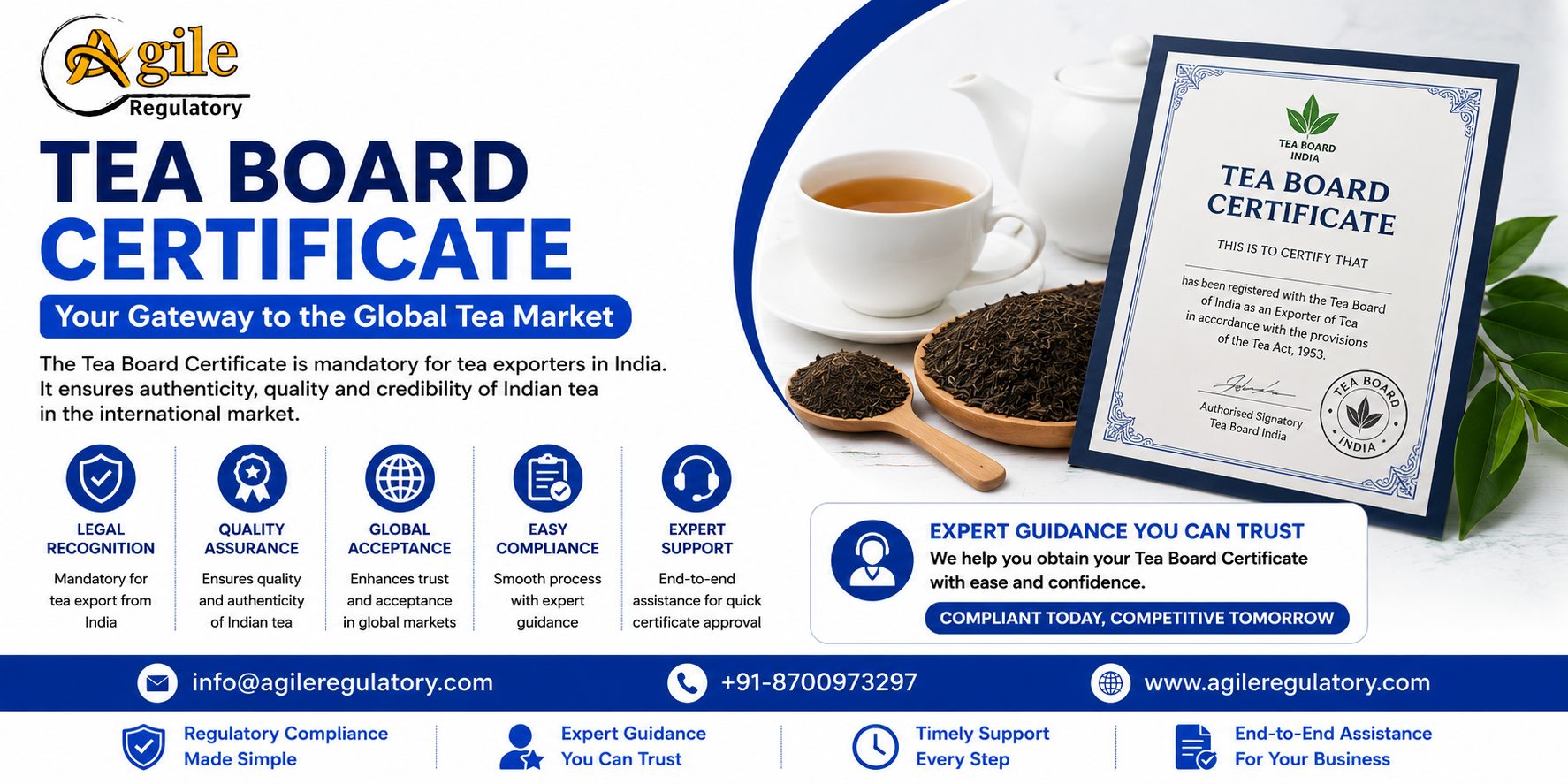
Introduction
India is globally recognized for producing some of the finest teas, including Assam, Darjeeling, Nilgiri, and Kangra tea. The Indian tea industry contributes significantly to the country’s economy through domestic sales and exports. To regulate and promote the tea sector, the Tea Board of India, established under the Tea Act, 1953, oversees various activities related to tea production, manufacturing, warehousing, trading, and exports.
Businesses involved in the tea industry often refer to Tea Board Registration as a Tea Board License. Although the Tea Board generally issues registrations and approvals rather than a separate “license” in many cases, obtaining the appropriate Tea Board registration is essential for eligible businesses engaged in tea-related activities.
This guide explains everything you need to know about the Tea Board License, including eligibility, required documents, registration process, benefits, compliance requirements, and how Agile Regulatory can help simplify the process.
What Is a Tea Board License?
A Tea Board License is a commonly used term for the registration or authorization issued by the Tea Board of India to businesses involved in the tea industry. Depending on the nature of the business, registration may be applicable for:
- Tea manufacturers
- Tea exporters
- Tea importers
- Tea packers
- Tea blenders
- Tea warehouse operators
- Tea brokers
- Tea traders
- Tea processing units
- Tea plantation owners
The registration confirms that the business complies with applicable Tea Board regulations and is authorized to undertake the relevant tea-related activities.
Why Is a Tea Board License Important?
Obtaining a Tea Board License provides several business advantages.
- Supports legal operation of tea-related businesses.
- Enhances business credibility.
- Facilitates domestic and international trade.
- Helps businesses comply with Tea Board regulations.
- Improves confidence among buyers and exporters.
- Supports participation in government export promotion initiatives.
- Strengthens business reputation in the tea industry.
For exporters, Tea Board registration also enhances trust with overseas buyers and business partners.
Who Should Apply for a Tea Board License?
The following businesses should consider Tea Board registration:
- Tea manufacturers
- Tea exporters
- Tea importers
- Tea traders
- Tea brokers
- Tea warehouse operators
- Tea processors
- Tea packers
- Tea blenders
- Tea plantation owners
- Tea auction participants
Businesses engaged in regulated tea industry activities should verify the registration requirements applicable to their operations.
Eligibility Criteria
Applicants should satisfy the following requirements.
Registered Business Entity
The applicant should operate through a legally registered business such as:
- Sole Proprietorship
- Partnership Firm
- LLP
- Private Limited Company
- Public Limited Company
Tea Business Activities
The business should be engaged in tea manufacturing, processing, packaging, warehousing, exporting, importing, or trading.
Statutory Registrations
Applicants should possess the required statutory registrations, including GST registration and an Import Export Code (IEC) where applicable.
Documents Required
The following documents are generally required:
- PAN Card
- Aadhaar Card
- GST Registration Certificate
- Business Registration Certificate
- Certificate of Incorporation
- Partnership Deed or LLP Agreement (if applicable)
- Memorandum and Articles of Association (for companies)
- Business address proof
- Import Export Code (IEC), where applicable
- Bank certificate or cancelled cheque
- Passport-size photographs
- Authorized signatory details
- Digital Signature Certificate (if required)
Additional documents may be requested depending on the category of Tea Board registration.
Tea Board License Registration Process
Step 1: Verify Eligibility
Identify the applicable Tea Board registration category based on your business activities.
Step 2: Prepare Required Documents
Collect all statutory registrations and supporting business documents.
Step 3: Submit the Application
Complete the Tea Board registration application with accurate business information.
Step 4: Upload Supporting Documents
Submit all required documents in the prescribed format.
Step 5: Verification
The Tea Board of India reviews the application and verifies the submitted information.
Step 6: Registration Approval
Upon successful verification, the Tea Board issues the applicable registration or approval.
Benefits of Tea Board License
Legal Recognition
Operate your tea business in accordance with Tea Board regulations.
Export Growth
Tea Board registration supports exporters in expanding into international markets.
Better Market Credibility
Registered businesses gain greater trust among buyers, distributors, and international customers.
Government Support
Receive updates on government policies, export promotion programs, and tea industry initiatives.
Business Expansion
Expand your tea business through improved credibility and market access.
Industry Compliance
Maintain compliance with Tea Board regulations and industry standards.
Compliance Requirements
After obtaining Tea Board registration, businesses should:
- Keep business details updated.
- Follow Tea Board regulations.
- Maintain proper business records.
- Comply with export regulations, where applicable.
- Renew registrations whenever required.
- Cooperate during inspections and verification procedures.
Maintaining compliance helps businesses continue operations without regulatory interruptions.
Common Mistakes to Avoid
Many applications are delayed because of:
- Incorrect application details
- Missing documents
- Incomplete statutory registrations
- Poor document quality
- Failure to meet eligibility requirements
- Delay in responding to Tea Board queries
Proper preparation significantly improves the approval process.
Why Choose Agile Regulatory?
Obtaining a Tea Board License requires proper documentation, compliance with Tea Board regulations, and accurate application filing. Agile Regulatory provides end-to-end assistance for Tea Board registration, helping businesses complete the process quickly and efficiently.
Our services include:
- Eligibility assessment
- Documentation support
- Tea Board registration assistance
- Import Export Code (IEC) guidance
- Export compliance consultation
- Application filing support
- Registration renewal assistance
- Ongoing regulatory advisory services
With extensive experience in regulatory compliance and export registrations, Agile Regulatory helps tea businesses avoid delays and complete their registrations smoothly.
Conclusion
A Tea Board License is an important registration for businesses involved in India’s tea industry. It enhances credibility, supports legal compliance, facilitates exports, and opens new opportunities in domestic and international markets. Whether you are a tea manufacturer, exporter, trader, processor, or warehouse operator, obtaining the appropriate Tea Board registration is a valuable step toward sustainable business growth.
Partnering with Agile Regulatory ensures a hassle-free registration process with professional guidance at every stage, allowing you to focus on expanding your tea business.
Frequently Asked Questions (FAQs)
1. What is a Tea Board License?
A Tea Board License is a commonly used term for the registration or authorization issued by the Tea Board of India to eligible businesses engaged in tea-related activities.
2. Who should apply for Tea Board registration?
Tea manufacturers, exporters, importers, packers, blenders, warehouse operators, tea traders, brokers, and plantation owners may require Tea Board registration based on their business activities.
3. Is Tea Board registration mandatory?
The requirement depends on the nature of the business. Businesses engaged in regulated activities under the Tea Board should comply with the applicable registration requirements.
4. Is an Import Export Code (IEC) required?
Yes. Businesses exporting tea generally require a valid Import Export Code issued by DGFT.
5. What documents are required?
Common documents include PAN, GST registration, business registration certificate, address proof, IEC (where applicable), bank details, and supporting business documents.
6. How long does the registration process take?
The processing time depends on document verification, the completeness of the application, and the procedures of the Tea Board of India.
7. Can tea traders apply for Tea Board registration?
Yes. Tea traders and other eligible businesses involved in tea-related activities can apply under the applicable registration category.
8. How can Agile Regulatory help?
Agile Regulatory provides complete support for Tea Board registration, documentation, application filing, export compliance, renewal services, and regulatory consultation to ensure a smooth and efficient registration process.