
The Business Case for Upgrading to Fine-Pitch LED
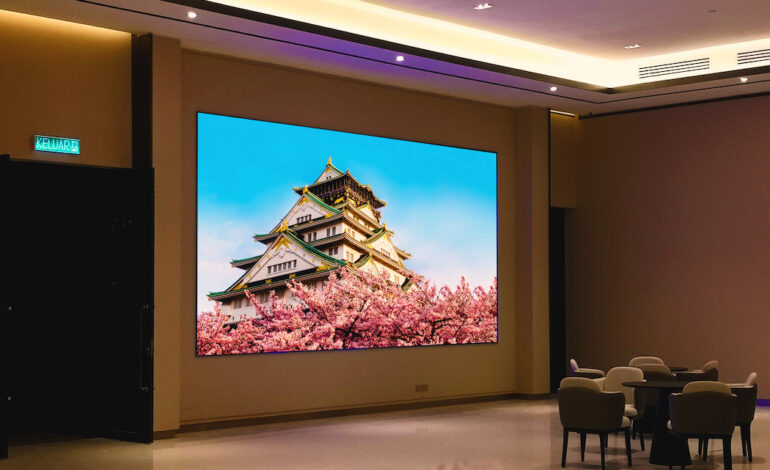
Commercial display technology has changed dramatically over the past decade. Projectors gave way to flat-panel displays. LCD video walls replaced printed signage. And now, fine-pitch LED is redefining what’s possible for businesses that rely on high-impact visuals—whether that’s a bustling retail floor, a corporate headquarters, or a high-stakes control room.
For any organisation investing in an indoor LED screen today, fine-pitch LED represents the most significant leap forward in display capability. The pixel density is tighter, the image quality sharper, and the operational lifespan longer than virtually any comparable technology. But this isn’t simply a hardware upgrade. Choosing fine-pitch LED is a strategic business decision—one with measurable returns across engagement, efficiency, and brand perception.
What Is Fine-Pitch LED Technology?
Pixel pitch refers to the distance (in millimetres) between the centre of one LED pixel and the centre of the next. The smaller the pitch, the higher the pixel density, and the sharper the image—particularly at close viewing distances.
Fine-pitch LED typically refers to displays with a pixel pitch of 2.5mm or less, with ultra-fine variants pushing below 1mm. This makes them suitable for environments where viewers are just a few metres away, such as boardrooms, broadcast studios, and retail spaces. Traditional large-format LED displays, by contrast, were designed for viewing distances of ten metres or more.
Beyond resolution, fine-pitch LED panels offer several technical advantages over older display technologies:
- Higher brightness and contrast: Fine-pitch LED panels maintain vivid, accurate colours even in brightly lit environments, outperforming LCD displays and rear-projection systems.
- Wider viewing angles: Content remains clear and consistent across a broader field of view, which matters in large meeting rooms or open retail spaces.
- Seamless panel joins: Unlike LCD video walls, fine-pitch LED produces no visible bezels between tiles, creating a truly uninterrupted image.
The Business Benefits: Why Upgrade?
Enhanced Visual Experience and Audience Engagement
First impressions carry weight. Whether a client is walking into a corporate lobby or a shopper is browsing a retail display, the quality of your visual communication shapes their perception of your brand.
Fine-pitch LED transforms passive screens into high-impact communication tools. In boardrooms, content is rendered with the clarity needed for detailed data visualisation and confident presentations. In retail environments, vibrant, seamless displays have been shown to draw attention more effectively than static signage or lower-resolution alternatives. In control rooms, operators benefit from sharp, consistent imagery that supports faster and more accurate decision-making.
The cumulative effect? Stronger brand authority, more engaged customers, and better-informed teams.
Operational Efficiency and Long-Term Cost Savings
Fine-pitch LED displays are built to last. Most carry operational lifespans of 100,000 hours or more—significantly longer than projectors, which require bulb replacements every few thousand hours, and comparable LCD panels, which can suffer from backlight degradation over time.
Maintenance requirements are lower, too. LED panels are modular by design, meaning individual tiles can be replaced without taking the entire display offline. This reduces both downtime and repair costs.
Energy efficiency is another advantage worth noting. Fine-pitch LED consumes less power relative to projected brightness than many projection systems, which translates to meaningful savings across a large installation or a multi-site deployment.
Versatility and Design Flexibility
One of the most compelling arguments for fine-pitch LED is its adaptability. Unlike fixed-format display systems, LED panels can be configured into virtually any size or shape—flat, curved, angled, or even cylindrical.
This flexibility opens up architectural possibilities that simply aren’t available with traditional display formats. Fine-pitch LED can be integrated into curved lobby walls, wrap around pillars, or fill an entire broadcast studio backdrop. For designers and facilities teams, this level of customisation means the display becomes part of the space, rather than an addition to it.
Applications span a wide range of sectors:
- Corporate boardrooms and meeting spaces
- Retail showrooms and flagship stores
- Broadcast studios and live event production
- Emergency management and network operations control rooms
- Museums, galleries, and experiential venues
Return on Investment: How to Quantify the Upgrade
ROI from a fine-pitch LED installation comes from multiple directions, and it’s worth thinking through each one.
On the revenue side, higher visual impact in retail environments can drive increased dwell time and conversion. Research from the digital signage industry consistently points to improved sales performance in spaces with dynamic, high-quality displays, though specific outcomes will vary based on content strategy and context.
On the cost side, reduced maintenance, lower energy consumption, and fewer replacement cycles all contribute to a lower total cost of ownership over a five- to ten-year horizon. When compared to a projector-based system requiring regular lamp replacements and alignment recalibration, fine-pitch LED often delivers a lower cumulative cost despite a higher upfront investment.
For organisations that depend on display infrastructure for critical operations—broadcasters, financial trading floors, utility control rooms—the value of reliability is harder to quantify but no less real. A display system that doesn’t fail during a live broadcast or a network incident is worth considerably more than its purchase price.
What to Consider Before Making the Switch
Upgrading to fine-pitch LED requires some upfront planning to ensure the investment delivers as expected.
Define your viewing distance first. Pixel pitch should be selected based on how close your audience will be to the screen. A rough guideline: multiply the pixel pitch (in millimetres) by 1,000 to get the minimum comfortable viewing distance in millimetres. A 1.5mm pitch, for instance, suits viewing distances of around 1.5 metres or more.
Assess your content and resolution requirements. Fine-pitch LED’s advantages are most apparent when paired with high-resolution content. If your existing content library is low-resolution, factor in the cost and effort of updating it alongside the display investment.
Plan for installation and calibration. Fine-pitch LED panels require professional installation and initial calibration to ensure colour uniformity and optimal performance. Partnering with an experienced integrator—one who offers ongoing support—will protect the longevity of the system.
Consider future scalability. One of the advantages of modular LED systems is that they can be expanded. If there’s a possibility your display needs will grow, choose a system and supplier that can accommodate that.
Fine-Pitch LED Is the Future of Commercial Display
Display technology will continue to evolve, but fine-pitch LED has established itself as the benchmark for indoor visual communication. Pixel pitches will continue to shrink, driving even greater resolution at shorter viewing distances. Integration with real-time data, interactive content, and AI-driven personalisation will expand what these systems can do.
For businesses evaluating their display infrastructure now, the question isn’t whether fine-pitch LED will eventually become the standard—it’s whether to move ahead of that curve or wait.
The operational savings, the visual impact, and the design flexibility all point in the same direction. If your organisation depends on communicating clearly, persuasively, and reliably through screens, fine-pitch LED deserves serious consideration. Speak to a specialist about what a fine-pitch LED installation could look like for your space—and start building the business case today.