
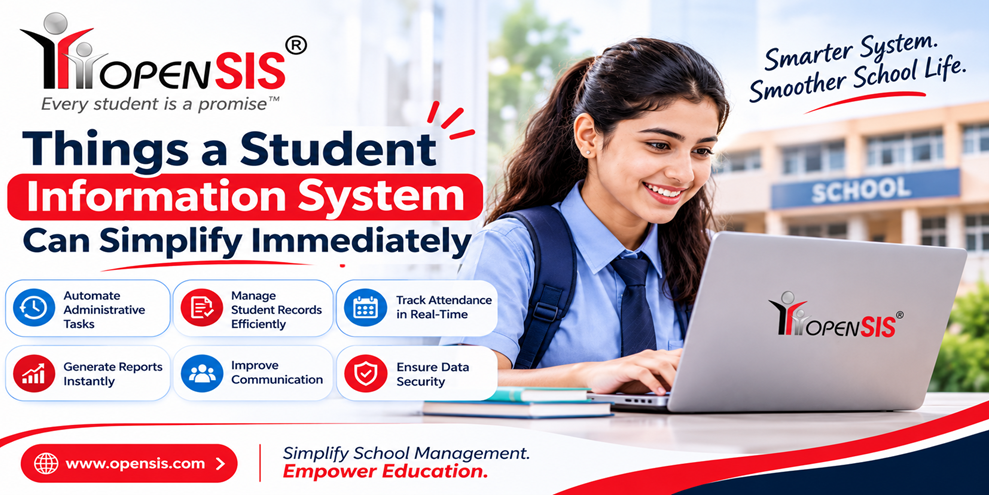
School administration involves hundreds of small decisions, including updates, and recurring tasks. From maintaining student records and tracking attendance to preparing reports, even daily responsibilities can take up a surprising amount of time. When these processes depend on disconnected applications, spreadsheets, and manual data entry, administrative work can become harder to manage than it needs to be. A Digital School Management System like openSIS gives schools a centralized way to manage student information and connect essential administrative workflows. Rather than requiring leaders to search through multiple files or repeatedly enter the same details, it helps organize information so authorized users can access and update it when needed.
The benefits are not limited to digital transformation only. When a system is implemented properly, several daily tasks can become easier after implementation. The exact results depend on the school’s existing processes, data quality, and the features of the platform. But the foundation remains the same, reducing daily mundane tasks. Here are areas where a Modern Student Information System can simplify school administration.
Student Record Management
Student records are the foundation of school administration. Contact information, enrollment details, academic history, and health data must remain accurate and accessible to the leaders. When these details are spread across spreadsheets, paper files, and separate departmental tools, finding a complete record can become a big task. A Digital School Management System centralizes student data within a structured environment. Instead of maintaining multiple versions of the same profile, authorized staff can work from a single dashboard and follow a consistent data ecosystem. This makes routine record management easier. Reliable records also improve the quality of administrative processes. A well-implemented SIS can simplify student record management by helping schools –
- Maintain centralized student profiles with consistent information
- Update contact details and guardian information through defined workflows
- Reduce duplicate records and repeated data entry
- Retrieve relevant student information without searching multiple files
Attendance Tracking and Reporting
Attendance management is more than marking who is present each morning. Schools must maintain reliable records because attendance data can help leaders read student behavioral patterns. When teachers use different recording methods or enter attendance data manually, this straightforward daily process can generate excess work. A Modern Student Information System with attendance capabilities can bring attendance records into a common environment. Depending on the system, teachers may record attendance digitally, and authorized staff may generate reports without having to hunt down separate registers. Centralized workflows also make it easier to establish how updates are made. An SIS can make attendance management easier through –
- Digital attendance entry and centralized recording
- Consistent procedures for correcting attendance errors
- Daily, weekly, or term-based attendance reports
Enrollment and Admissions Workflows
Enrollment periods can place pressure on administrative teams. Applications need to be reviewed, student details recorded, and a large volume of data handled. If every step relies on separate files and email thread, staff members may struggle to understand which applications are complete and which require further attention. Digitalization can simplify the operations and organize relevant data in a single structure. When a school operates from a single dashboard, staff members don’t have to run around for data confirmation and validation. An organized workflow makes responsibilities clearer to manage. It also helps prevent data from being buried between files. Staff members can spend less time on data correction and searching and more time completing the work that actually matters to push enrollment forward.
Lastly,
School administrators regularly need information about enrollment, attendance, and other operational tasks. The challenge is often to manage the data with accuracy and make it available to the leaders. When reports depend on manually handling spreadsheets and checking figures on different systems, producing even a basic report can take longer than expected.
A Modern Student Information System can make reporting more efficient by keeping relevant data organized and providing accurate reporting tools. Dashboards can help you find the information they need with ease.
FAQ
-
Frequently Asked Questions (FAQs)
1. What is a Student Information System (SIS)?
A Student Information System (SIS) is software that helps schools manage student records, attendance, grades, admissions, schedules, and other academic information from one centralized platform.
2. How can a Student Information System simplify school administration?
An SIS automates routine administrative tasks such as attendance tracking, student enrollment, report generation, grade management, and record keeping, reducing manual work and saving valuable time.
3. What tasks can a Student Information System automate immediately?
A Student Information System can simplify several daily tasks, including:
-
Student enrollment and admissions
-
Attendance tracking
-
Grade and report card management
-
Class scheduling
-
Student data management
-
Parent-teacher communication
-
Academic reporting
4. How does an SIS improve student data management?
An SIS stores student information in a centralized database, making it easier for authorized staff to access, update, organize, and maintain accurate student records.
5. Can a Student Information System improve attendance tracking?
Yes. An SIS makes attendance management easier by allowing teachers to record attendance digitally, monitor attendance patterns, and generate attendance reports.
6. How does an SIS help teachers save time?
Teachers can use an SIS to manage attendance, enter grades, access student records, track academic progress, and communicate with parents without relying on multiple manual processes.
7. Can parents access student information through an SIS?
Yes. Many SIS platforms provide parent portals where parents can check attendance, grades, academic progress, announcements, and other important school updates.
8. Is a Student Information System useful for K-12 schools?
Absolutely. K-12 schools can use an SIS to manage student information, classroom activities, attendance, grading, communication, and administrative workflows across different grade levels.
9. How does an SIS reduce administrative errors?
By reducing repetitive manual data entry and centralizing student records, an SIS helps minimize duplicate records, calculation mistakes, outdated information, and reporting errors.
10. How can schools choose the right Student Information System?
Schools should evaluate ease of use, customization, reporting capabilities, data security, integration options, scalability, parent and student portals, and customer support before selecting an SIS.
11. Is a cloud-based Student Information System better for schools?
A cloud-based SIS allows authorized users to access information through the internet, supports remote access, reduces dependence on local infrastructure, and can simplify software maintenance.
12. How does OpenSIS help simplify school management?
OpenSIS helps educational institutions manage student information and streamline essential school operations through centralized student records, academic management, attendance, grading, and communication capabilities.
These FAQs are aligned with OpenSIS’s published features, including attendance, grading, admissions, scheduling, reporting, and user portals.
-