
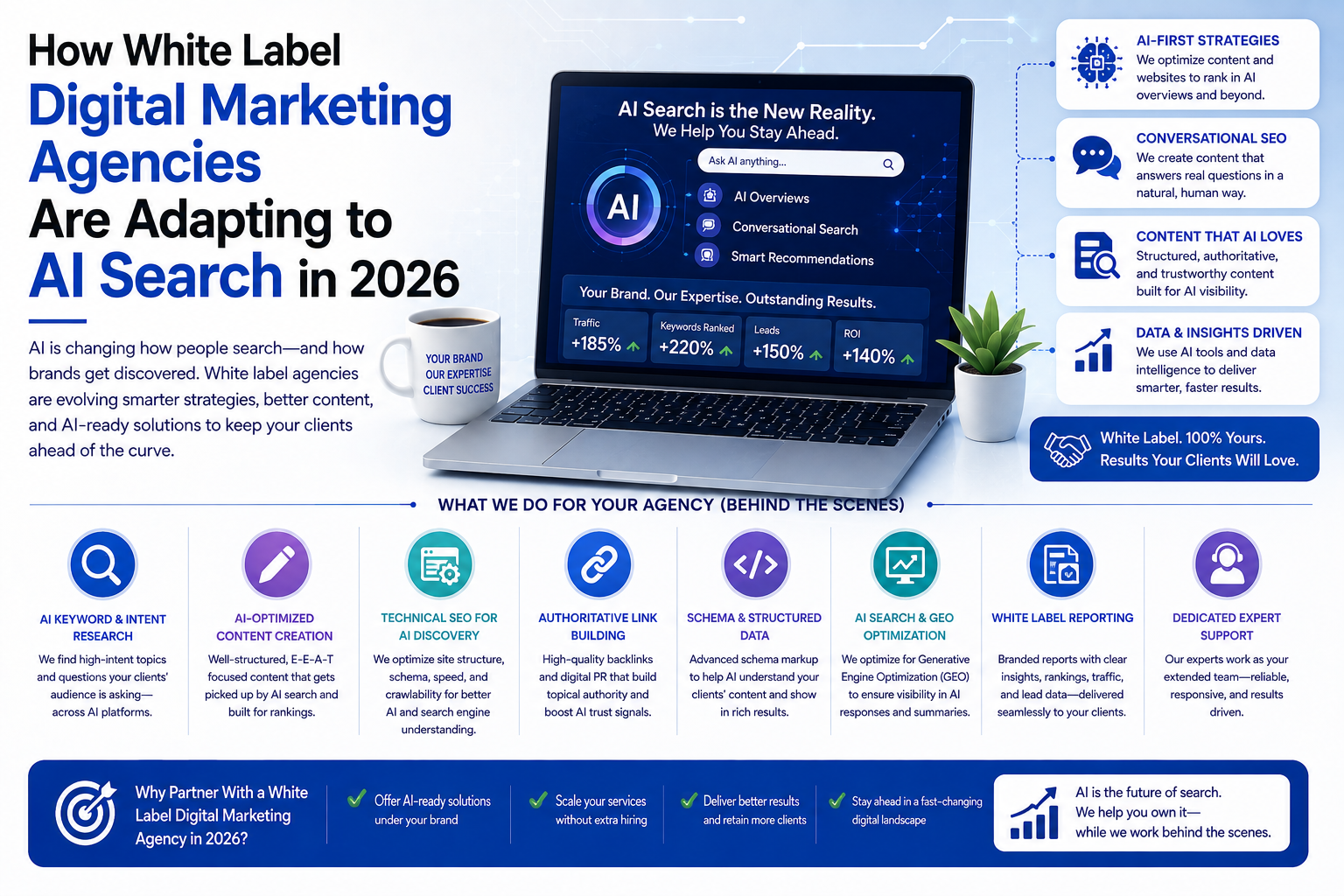
Search is no longer just a list of blue links. In 2026, a growing share of queries are answered directly inside AI systems like ChatGPT, Gemini, Perplexity, Copilot, and Google’s AI Overviews, often with zero clicks to a website. For agencies, this shift has quietly rewritten the rules of visibility. And nowhere is the pressure higher than for a white label digital marketing agency, where reseller partners expect the same ranking wins and reporting clarity they got in the pre-AI era, even though the underlying game has changed.
This article breaks down exactly how white label digital marketing services are retooling their processes, deliverables, and pricing models to stay relevant as AI answer engines take a growing share of search traffic.
Why AI Search Changed the Rules for White Label Digital Marketing
Traditional SEO rated success mainly through two lenses: Page Quality and Needs Met. Did the page deserve to rank, and did it satisfy the searcher’s intent? That logic still applies, but a second, parallel system now sits alongside it. AI answer engines don’t rank pages in a list, they select, synthesize, and cite sources to build a single answer. That means content now has to win on two fronts at once: classic search ranking and AI citation likelihood.
For a white label digital marketing agency reselling SEO, content, and PPC under someone else’s brand, this dual requirement changes what a “good deliverable” even looks like. A page that ranks on page one of Google but never gets pulled into an AI Overview or cited by Perplexity is now only half-optimized. Reseller partners are starting to ask pointed questions: is our content showing up when clients ask ChatGPT about our services? Are we being cited, or are competitors?
Retrievability Is the New Technical SEO
Ranking well used to depend heavily on crawlability, page speed, mobile usability, and backlinks. Those fundamentals still matter, but AI systems add a new layer called retrievability, essentially, can a retrieval system find, parse, and lift a clean passage out of your content without losing meaning.
Agencies offering white label digital marketing are now building retrievability checks directly into their technical audits:
- Confirming content isn’t unintentionally blocked from AI crawlers such as GPTBot, ClaudeBot, and Google-Extended
- Structuring pages into self-contained, chunkable sections with clear headers so a passage makes sense even when pulled out of context
- Adding Schema.org markup, especially FAQ, HowTo, Article, and Organization schema, to make claims machine-legible
- Defining the entity clearly in the first few sentences instead of burying the topic under a slow, narrative-style introduction
This last point matters more than most clients realize. AI systems consistently favor content that states the conclusion first, then supports it with detail, the opposite of the “tell a story before you make your point” structure that used to perform well for on-page engagement metrics.
Answer-Worthiness Now Drives Content Strategy
Ranking and getting cited are not the same skill. A page can sit comfortably on page one of Google while being completely invisible to AI answer engines, and vice versa. This divergence is becoming one of the most useful diagnostic tools inside a modern white label digital marketing services stack.
To win citations, content teams are prioritizing:
Directness. Answering the likely query within the first one to three sentences of each section, before elaborating further.
Specificity. Swapping vague claims for concrete numbers, named entities, dates, and clearly defined terms, since AI systems disproportionately favor citable, verifiable specifics over generalizations.
Self-contained accuracy. Writing every paragraph so it remains correct and unambiguous even if it’s the only paragraph an AI system extracts.
Original data and frameworks. Publishing genuinely original research, proprietary data, or a unique methodology, since AI systems default to whichever source said something first or most clearly when multiple pages say the same generic thing.
This is exactly where agencies like SEO Discovery have adjusted client-facing content workflows, moving away from generic, keyword-stuffed articles toward structured, evidence-backed content built for both a human reader and a retrieval system pulling passages out of it.
E-E-A-T Has a New Cousin: Source Credibility
Google’s E-E-A-T framework (Experience, Expertise, Authoritativeness, Trust) hasn’t gone away, but AI answer engines apply their own version of it called Source Credibility, and it’s arguably stricter. Before an AI system will attribute a claim to a domain, it weighs:
- Whether there’s a named, checkable author or organization behind the content
- Whether other credible, independent sources corroborate the same claim
- Whether the domain has a consistent track record of accuracy rather than being a brand-new or reputation-less site
- Whether the content contradicts well-established consensus without strong justification
For agencies delivering white label digital marketing, this raises the bar on what “content production” actually means. It’s no longer enough to publish volume. Every piece needs identifiable authorship, consistent factual accuracy, and ideally corroboration from other reputable sources in the same space. YMYL topics (anything touching health, finance, safety, or legal outcomes) are held to an even higher standard, and low-effort content that “reads fine” but lacks sourcing gets filtered out of AI answers even when it would have ranked acceptably in classic search a few years ago.
Reporting Has to Cover Two Scorecards, Not One
Reseller partners historically wanted one number: keyword rank. That’s no longer sufficient. A modern white label digital marketing agency now needs to report on two parallel outcomes for every priority keyword:
| Dimension | Search Engine Outcome | AI Answer Engine Outcome |
| Intent match | Needs Met rating | Answer-worthiness |
| Content quality | Page Quality rating | Retrievability plus source credibility |
| Trust | E-E-A-T | Citation likelihood |
| Technical readiness | Crawlability, speed, schema | Crawler access, chunkability |
| Outcome | Ranking tier (Top 3, Page 1, Page 2+) | Citation tier (Primary source, Cited alongside others, Not surfaced) |
When a keyword scores well on classic search but poorly on AI citation, the fix is usually structural: add direct-answer summaries, tighten schema, break up long paragraphs. When it’s the reverse, strong AI citation but weak search ranking, the gap is usually old-fashioned technical and authority SEO. Agencies that can diagnose which side of that gap a client sits on are winning more retained contracts, because they’re solving the actual problem instead of throwing generic tactics at both symptoms at once.
Geo-Targeting Adds Another Layer for Global White Label Teams
Many white label digital marketing operations run content production out of one country while targeting clients and end users in another, commonly the US market from a non-US domain. AI systems and search engines both separate two questions here: where is this content hosted, and who does it credibly serve? A country-code domain carries a default geographic bias, but that bias can be overridden with the right signals.
Agencies serious about this are now checking for explicit US targeting configuration, correct hreflang implementation, US spelling and currency conventions, and corroboration from US-based sources on regulatory or YMYL topics. Skipping this step is one of the most common reasons content that performs well domestically fails to get surfaced, or cited, for the exact market a reseller partner is paying to reach.
What This Means for Agencies and Their Reseller Partners
The agencies pulling ahead in 2026 aren’t the ones producing the most content, they’re the ones producing content that’s structurally built to be found, trusted, and cited by both systems at once. That means retooling content briefs to demand directness and specificity, upgrading technical audits to include retrievability and crawler access, and reporting results on a dual scorecard instead of a single rank number.
If you’re running an agency or exploring white label digital marketing partners for the first time, the questions to ask any prospective partner should go beyond “can you rank us.” Ask how they structure content for AI extraction, how they build source credibility, and whether their reporting shows citation performance alongside traditional rankings. If your current process still measures success by rank position alone, it’s worth a conversation with a team already building for both tracks, reaching out to discuss how your content and technical foundation stack up.
Search didn’t get smaller in 2026, it split in two. Agencies that treat AI answer engines as a parallel discipline rather than a footnote to classic SEO are the ones building durable visibility for their clients. SEO Discovery has approached this shift by embedding retrievability, source credibility, and dual-track reporting directly into its content and technical workflows, because winning half the search landscape was never going to be good enough for clients who need results in bot