
Lending Software for Banks: A Complete Guide to Modern, Secure and Scalable Bank Lending
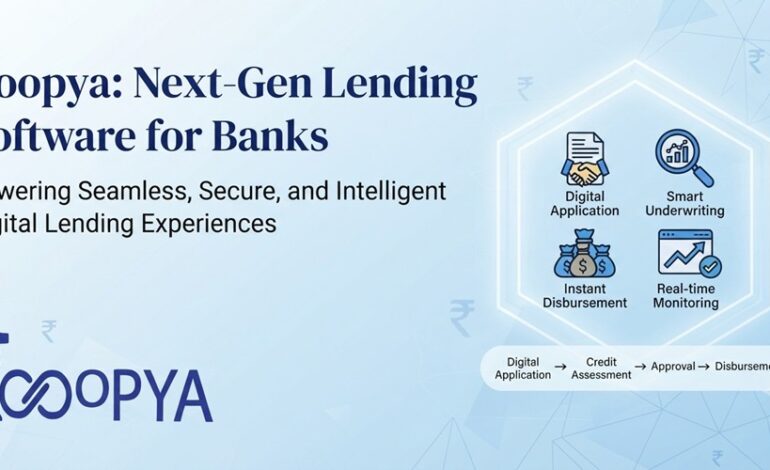
Lending Software for Banks
Banks operate in an environment where lending speed, credit quality, operational control, customer experience, regulatory discipline, and portfolio performance all matter at the same time. A modern lending software platform helps bring these requirements together by digitising and coordinating the journey from customer onboarding and loan application to credit assessment, approval, disbursement, servicing, collections, reporting, and closure.
For a bank, lending software is not simply a replacement for spreadsheets or paper files. It is an operational layer that connects people, policies, data, integrations, workflows, and decisions. The right platform can help lending teams reduce repetitive work, create consistent processes, improve visibility, and respond more quickly to customers while retaining appropriate controls.
Roopya positions its lending infrastructure as a no-code, API-first and AI-powered platform for modern lenders, with capabilities spanning origination, management, integrations, analytics, and lending workflows. Its existing product material describes support for banks, NBFCs, MFIs and fintech lenders, including Loan Origination Software and Loan Management Software.
What Is Lending Software for Banks?
Lending software for banks is a technology platform used to manage and automate the processes involved in creating, servicing, monitoring, and closing loans. Depending on the bank and its operating model, the platform may support retail, MSME, corporate, vehicle, housing, personal, secured, or other credit products.
A complete lending environment generally connects several functional areas: customer onboarding, application capture, KYC and document workflows, credit bureau and data integrations, underwriting, policy rules, approval hierarchies, offer generation, documentation, disbursement, repayment schedules, collections, reconciliation, portfolio monitoring, reporting, and audit trails.
The objective is not to automate every decision without oversight. Instead, good lending software should help the bank automate repeatable activities while keeping human review, approval authority, exception handling, and governance where they are required.
Why Banks Need Modern Lending Software
Bank lending involves a large number of decisions and operational handoffs. A borrower may provide information through a branch, website, mobile application, relationship manager, partner, or another channel. That information then needs to move through verification, credit assessment, documentation, approval, fulfilment, and servicing. If every step operates in a separate system, teams may spend considerable time moving data between applications and resolving inconsistencies.
Modern lending software can create a more connected workflow. Instead of treating origination, servicing, collections, and reporting as isolated activities, banks can establish a common process and shared data model. This can make it easier for employees to see application status, identify pending actions, manage exceptions, and maintain a consistent customer journey.
Technology also matters when a bank introduces new products or changes credit policies. A configurable platform can help teams update workflows and rules without rebuilding the entire technology stack for every operational change.
Key Features of Lending Software for Banks
1. Digital Customer and Application Onboarding
A modern platform can provide structured application journeys across digital and assisted channels. It can capture customer information, application details, documents, consent records, and product-specific information in a controlled workflow. This reduces unnecessary manual re-entry and gives operations teams a clearer view of application status.
2. KYC, Verification and Document Management
Banks need reliable processes for identity, address, document, and other verification activities. Lending software can orchestrate verification workflows and connect approved external services through APIs. Document collection, validation, classification, status tracking, and exception queues can be managed within the broader application journey.
3. Credit Bureau and Data Integrations
Credit assessment may require information from multiple sources. An API-enabled lending platform can connect with relevant bureaus, verification services, account or financial data sources, and other approved providers. Centralising these integrations can reduce operational friction and help ensure that the same information is available to the appropriate decisioning workflow.
4. Credit Decisioning and Underwriting Workflows
Decisioning is one of the most important areas of lending technology. Banks can configure policy rules, scorecards, eligibility criteria, approval matrices, and exception paths according to their products and governance requirements. Automated rules can handle straightforward cases, while cases outside predefined thresholds can be routed to credit officers for review.
5. Loan Offer and Approval Management
After assessment, lending software can support sanction and offer workflows, including approval hierarchies, conditions, documentation status, and customer communication. A central workflow can help reduce the risk of applications being delayed because a task or approval is sitting with the wrong team.
6. Disbursement Management
Disbursement involves operational checks and financial instructions that need to be handled carefully. Software can coordinate fulfilment conditions, approvals, payment instructions, and status tracking while maintaining appropriate controls. The exact process should reflect the bank’s internal policies and regulatory obligations.
7. Loan Servicing and Account Management
Once a loan is disbursed, the technology needs to support the ongoing account lifecycle. Typical capabilities include amortisation and repayment schedules, interest and fee calculations, repayment tracking, prepayment or foreclosure workflows, account updates, customer communications, and loan closure.
8. Collections and Delinquency Management
Collections teams need visibility into overdue accounts, ageing, promises to pay, customer contacts, field activities, and recovery outcomes. Lending software can provide queues, workflows, reminders, segmentation, and dashboards that help teams prioritise actions while applying the bank’s approved policies and customer-treatment standards.
9. Reconciliation and Financial Operations
Lending operations generate large volumes of financial transactions. Reconciliation capabilities can help teams compare expected and received payments, identify exceptions, and maintain operational visibility. Integration with the bank’s accounting and core systems should be designed around the bank’s architecture and control requirements.
10. Analytics, Dashboards and Reporting
Decision-makers need more than transaction records. Lending software can provide dashboards covering application volumes, approval rates, turnaround times, disbursements, repayment behaviour, delinquencies, collections, portfolio trends, and operational exceptions. These insights can support both day-to-day management and strategic planning.
11. Audit Trails, Roles and Access Controls
Banks operate in a highly controlled environment. A suitable lending platform should support role-based access, approval hierarchies, activity logs, configurable permissions, and traceability. These controls help institutions understand who performed an action, when it happened, and what changed.
12. API-First Integration Architecture
No single platform should be expected to replace every banking system. Banks commonly need to connect lending software with core banking, CRM, payment systems, identity and verification providers, credit bureaus, document systems, accounting platforms, data warehouses, communication providers, and other services. An API-first architecture can make these connections easier to manage and evolve.
Loan Origination Software vs. Loan Management Software
Loan Origination Software (LOS) primarily focuses on the front end of the lending journey: application intake, onboarding, verification, credit assessment, underwriting, approval, and disbursement. Loan Management Software (LMS) focuses more heavily on the post-disbursement lifecycle, including repayment schedules, servicing, collections, account management, and portfolio operations.
For many banks, the best architecture is not to treat LOS and LMS as unrelated products. A connected lending environment allows information collected during origination to flow into servicing and portfolio management without unnecessary duplication. Roopya’s existing lending material describes an end-to-end approach covering origination and loan management.
Benefits of Lending Software for Banks
- Faster processing: Digital workflows can reduce unnecessary handoffs and repetitive data entry.
- More consistent operations: Standardised workflows help teams follow approved processes across channels and products.
- Better visibility: Central dashboards can help managers monitor applications, loans, collections, and exceptions.
- Improved customer experience: Faster status updates and smoother application journeys can reduce avoidable friction.
- Scalability: Automation can help a bank process increasing volumes without adding operational work at the same rate.
- Stronger control: Role-based access, approval workflows, and audit trails can support governance.
- Easier integration: APIs can connect the lending workflow to specialist data and financial services.
- Better portfolio management: Consolidated information can support monitoring of repayment, delinquency, and collections trends.
How Lending Software Can Improve the Customer Experience
Borrowers generally do not see the bank’s internal technology architecture. They experience the outcome: how easy it is to apply, how quickly they receive updates, whether document requests are clear, how transparently the bank communicates, and how easy it is to manage repayment.
A people-first lending workflow should therefore minimise unnecessary questions, avoid repeated document requests where possible, provide clear next steps, and make application status understandable. Automation should remove friction rather than simply move it from employees to customers.
Lending Software and Risk Management
Automation does not eliminate lending risk. It can, however, help a bank apply approved policies consistently and create clearer operational controls. Decision rules, verification steps, exception queues, approval limits, and monitoring workflows can be built into the lending process.
Banks should also evaluate model governance, explainability, data quality, access controls, cybersecurity, vendor risk, business continuity, and human oversight. The technology should support the institution’s risk framework rather than replace it.
What Banks Should Look for When Choosing Lending Software
- Functional coverage across the required lending lifecycle.
- Configuration and no-code or low-code capabilities where appropriate.
- Strong API and integration support.
- Security, access control, auditability, and operational resilience.
- Scalability for current and projected lending volumes.
- Configurable workflows, rules, approval matrices, and exception handling.
- Clear data ownership, export capabilities, and integration options.
- Analytics and reporting that business and risk teams can actually use.
- Implementation approach, support model, documentation, and service commitments.
- Transparent commercial model and a realistic total cost of ownership.
- Ability to adapt to new products, channels, policies, and operational requirements.
Questions to Ask a Lending Software Provider
- Which stages of the loan lifecycle are supported out of the box?
- How are workflows configured when the bank changes a policy or product?
- Which APIs and integration patterns are available?
- How are user roles, approvals, audit logs, and exceptions handled?
- How does the platform support high-volume processing?
- What reporting and portfolio analytics are available?
- How are data security, privacy, availability, backups, and disaster recovery addressed?
- How does the provider handle implementation, testing, training, and support?
- Can the bank start with one product or workflow and expand later?
- What are the implementation and ongoing operating costs?
Why Roopya for Modern Bank Lending?
Roopya presents itself as a lending infrastructure platform designed for modern lenders in India. Its published product pages describe no-code, cloud-native and API-first capabilities for lending origination and management, along with integrations and workflow automation.
For banks evaluating a modern lending stack, the practical value of a platform such as Roopya should be assessed against the bank’s specific requirements: product complexity, integration architecture, security and compliance expectations, transaction volumes, governance model, implementation timeline, and internal technology strategy.
Roopya’s published materials also describe capabilities across loan origination, loan management, processing, collections, analytics, and integrations. Rather than choosing software based only on feature count, banks should test real workflows and verify how the platform handles their own products, policies, exceptions, data, integrations, and operational controls.
A Practical Implementation Roadmap
Phase 1: Define the Business Scope
Select the first lending product or process to digitise. Document the current journey, pain points, decision points, manual tasks, integrations, approval levels, and reporting requirements.
Phase 2: Map the Target Workflow
Design the future-state process from application through servicing. Separate activities that should be automated from those that require human review.
Phase 3: Integrate the Required Systems
Connect the lending platform to the systems and external services required for the chosen workflow. Establish data mappings, error handling, authentication, monitoring, and ownership.
Phase 4: Configure Policies and Controls
Configure eligibility rules, credit policies, approval matrices, roles, exception queues, communications, and audit requirements.
Phase 5: Test with Realistic Scenarios
Testing should include normal cases, rejected cases, borderline cases, incomplete applications, integration failures, repayment exceptions, and operational recovery scenarios.
Phase 6: Launch, Monitor and Improve
Start with controlled production usage, monitor operational metrics, gather feedback from users, and refine workflows. Lending software should be treated as a living operational platform rather than a one-time IT installation.
The Future of Lending Software for Banks
The direction of banking technology is toward more connected, configurable, data-driven lending operations. Banks will continue to balance automation with human judgement, digital experiences with strong controls, and faster decisions with responsible credit practices.
AI may assist with document processing, fraud detection, customer communication, workflow prioritisation, analytics, and other tasks, but responsible deployment requires clear governance, data controls, validation, monitoring, and appropriate human oversight. The goal should be better lending outcomes, not automation for its own sake.
The strongest lending platforms will therefore be those that combine flexibility, integration, operational control, usable analytics, and a customer-centred experience. For banks, the question is not simply whether to digitise lending, but how to create a lending operating model that can adapt as customer expectations, products, data sources, regulations, and risk practices evolve.
Conclusion
Lending software for banks has become an important part of building efficient, scalable, and customer-focused lending operations. A modern platform can connect origination, decisioning, disbursement, servicing, collections, reconciliation, analytics, and governance within a more unified operating environment.
The right technology does not replace responsible banking. It gives lending teams better tools to execute approved policies, manage information, serve customers, monitor portfolios, and respond to change. Banks should evaluate providers based on real business workflows, integration capability, security and governance, scalability, implementation quality, and long-term flexibility.
Roopya can be evaluated as part of this modern lending technology landscape, particularly by banks looking for configurable, API-enabled lending infrastructure. The most useful next step is a product-specific assessment using the bank’s actual lending journey, policies, integrations, and operational requirements.
FAQs
What is lending software for banks?
Lending software for banks is a technology platform that helps manage and automate loan processes from application and credit assessment through approval, disbursement, servicing, collections, reporting, and closure.
What are the main features of bank lending software?
Common capabilities include digital onboarding, KYC and document workflows, credit bureau integrations, underwriting, decisioning, approval workflows, disbursement, repayment management, collections, reconciliation, reporting, audit trails, and APIs.
What is the difference between LOS and LMS?
A Loan Origination System primarily manages application, verification, underwriting, approval, and disbursement. A Loan Management System manages the post-disbursement lifecycle such as repayment, servicing, collections, and account management.
Can lending software integrate with core banking systems?
Yes. Modern lending platforms can use APIs and other integration methods to connect with core banking, CRM, payment, verification, credit bureau, accounting, communication, and analytics systems, subject to the bank’s architecture and security requirements.
How does lending software improve bank operations?
It can reduce repetitive manual work, standardise workflows, improve visibility, automate routine tasks, speed up processing, and provide better operational and portfolio reporting.
Is lending software suitable for large banks?
A suitable platform can be designed for high-volume environments, but banks should evaluate scalability, performance, security, integration architecture, resilience, governance, and implementation capability before selecting a provider.
Can lending software support different loan products?
Modern configurable platforms can support multiple products by using configurable workflows, rules, fields, approval paths, documentation requirements, and servicing parameters.
Does lending software replace human credit decisions?
Not necessarily. Banks can use automation for defined rules and routine cases while routing exceptions and higher-risk cases to authorised credit or operations teams.
How does Roopya support lending operations?
Roopya describes its platform as no-code, API-first and AI-powered lending infrastructure, with published capabilities covering loan origination, loan management, processing, integrations, analytics, and lending workflows.
How should a bank choose lending software?
Start with real lending workflows and evaluate lifecycle coverage, configurability, integrations, security, auditability, scalability, analytics, implementation, support, and total cost of ownership.




2 Comments
[…] every loan product works the same way, and good lending software should support product-specific configurations rather than forcing every loan type through one […]
[…] Personal loans are unsecured, which makes collections discipline critical to portfolio health. Lending software that automates reminders, tracks DPD buckets, and prioritizes collector effort based on risk scoring meaningfully reduces NPAs compared to manual, calendar-based follow-ups. […]