
Agentic AI with Python – A Complete Guide for Beginners and Job Seekers
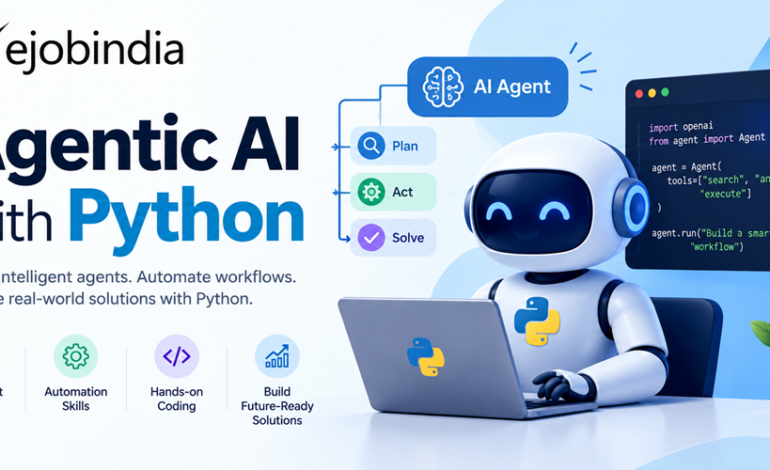
Artificial intelligence has moved beyond simple question-and-answer chatbots. The current wave of innovation centers on agentic AI — systems that don’t just generate text, but actually plan, decide, and act to complete multi-step tasks with minimal human supervision. From automating research and scheduling to powering intelligent customer support and coding assistants, agentic AI is reshaping how software gets built and how work gets done.
Python sits at the center of this shift. It’s the language most agentic AI frameworks are built around, and it’s quickly becoming one of the most in-demand skills for developers, data professionals, and career switchers alike. This guide breaks down what agentic AI actually is, how it differs from traditional AI tools, the Python frameworks powering it, how a basic agent is built, and what it means for your career if you’re exploring this space through eJobIndia.
What Is Agentic AI?
Agentic AI describes AI systems built around autonomous decision-making and action, rather than a single input-output exchange. Instead of you asking a question and receiving one static answer, an agentic system is given a goal, breaks that goal into a sequence of steps, decides which tools or data sources it needs, executes those steps, evaluates the outcome, and adjusts its approach if needed — often repeating this cycle until the goal is achieved.
The key word is “agentic”: the system behaves with a degree of agency. It doesn’t just predict the next word in a sentence; it reasons about what action to take next in pursuit of an objective. This distinction matters because it changes what these systems can be used for — from answering a question to actually completing a task end-to-end, such as researching a topic across multiple sources, filling out a form, booking a meeting, or writing and testing a piece of code.
How Agentic AI Differs from Traditional Chatbots
A conventional chatbot or a single-turn language model call works like this: you provide a prompt, the model generates a response, and the interaction ends there. Any follow-up action — searching the web, calling an API, remembering earlier context — has to be handled manually by the surrounding application or by you.
An AI agent changes this by giving the model access to tools (functions it can call), memory (context it can retain across steps), and a control loop that lets it decide what to do next based on the results of its previous action. In practice, this means an agent can:
- Break a broad goal (“plan a product launch”) into smaller, executable sub-tasks
- Decide which tool or API is appropriate for each sub-task
- Call that tool, observe the result, and adjust its next step accordingly
- Continue the loop autonomously until the goal is met or a stopping condition is reached
- Optionally coordinate with other specialized agents, each responsible for part of the overall task
Why Python Is the Language of Choice for Agentic AI
Python isn’t the only language capable of building AI agents, but it’s by far the most widely used, for several practical reasons:
- Mature AI/ML ecosystem: Libraries for machine learning, data processing, and API integration are more developed in Python than in most other languages.
- First-class framework support: Leading agent frameworks such as LangChain, LangGraph, CrewAI, AutoGen, and LlamaIndex are either Python-native or offer their most complete feature set in Python.
- Readable syntax: Python’s simplicity lowers the barrier to entry, which matters for a field that is evolving quickly and where developers need to prototype fast.
- Strong community and documentation: A large developer community means more tutorials, sample projects, and faster troubleshooting.
- Easy integration with APIs and data sources: Agents are only as useful as the tools they can access — Python makes it straightforward to wrap external APIs, databases, and files as callable tools.
Core Components of an Agentic AI System
Regardless of the specific framework, most agentic AI systems share a similar underlying structure:
- Reasoning/planning engine: Usually a large language model that interprets the goal and decides on a sequence of actions.
- Tools: Functions or APIs the agent can call — for example, a web search function, a database query, a calculator, or a job-listing search endpoint.
- Memory: Short-term memory for the current task and, in more advanced systems, long-term memory that persists across sessions.
- Execution loop: The cycle of reasoning, acting, and observing results, repeated until the task is complete or a limit is reached.
- Guardrails: Constraints that limit what actions an agent can take, how many steps it can run, or what data it can access, to keep behavior safe and predictable.
Popular Python Frameworks for Building AI Agents
A number of open-source frameworks have emerged to simplify agent development in Python:
- LangChain: One of the earliest and most widely adopted frameworks for chaining language model calls together with tools and memory.
- LangGraph: Built on top of LangChain concepts, it models agent workflows as graphs, which makes complex, branching, multi-step processes easier to design and debug.
- CrewAI: Focused on multi-agent collaboration, where several specialized agents with different roles work together toward a shared goal.
- AutoGen: A framework from Microsoft Research designed for building conversational multi-agent systems that can negotiate, delegate, and review each other’s work.
- LlamaIndex: Specializes in connecting agents to external and private data sources, making it useful for building agents that need to search or reason over large document collections.
New frameworks and SDKs continue to appear as the field matures, so it’s worth treating this as a starting point rather than an exhaustive list — the underlying concepts (tools, memory, planning, loops) transfer across frameworks even as tooling evolves.
Building a Simple AI Agent: A Conceptual Walkthrough
While the exact syntax varies by framework, most beginner projects follow a similar pattern. Below is a simplified, illustrative example of what defining a basic tool-using agent looks like in Python-based agent frameworks:
In this pattern, the developer defines a tool (a plain Python function), registers it with the agent, and gives the agent a natural-language instruction describing its role. When run, the agent decides on its own whether and when to call the tool based on the user’s request, rather than following a hardcoded script. This is the essential building block that more complex, multi-agent systems are built on top of.
Real-World Use Cases of Agentic AI
- Customer support automation: Agents that can look up order details, check policies, and resolve common queries without human intervention.
- Research and summarization: Agents that search multiple sources, extract relevant information, and compile structured summaries.
- Coding assistants: Agents that can write code, run tests, interpret errors, and iterate until a task passes, reducing manual debugging effort.
- Career and job-matching tools: Agents that can parse a resume, search job listings against a candidate’s skills and preferences, and shortlist relevant openings — a use case directly relevant to platforms like eJobIndia.
- Sales and operations workflows: Agents that qualify leads, schedule meetings, and update CRM records automatically.
- Personal productivity: Agents that manage calendars, draft emails, or handle routine administrative tasks.
Career Opportunities in Agentic AI
As more companies adopt agentic AI to automate workflows, demand is growing for professionals who can design, build, and maintain these systems. Relevant roles include:
- AI/ML Engineer: Building and fine-tuning the underlying models and pipelines that power agents.
- AI Agent Developer: Designing and implementing agent workflows, tools, and multi-agent systems using frameworks like LangChain or CrewAI.
- Prompt and Workflow Engineer: Crafting the instructions, guardrails, and evaluation processes that keep agents reliable.
- Automation/Integration Engineer: Connecting agents to internal systems, APIs, and databases within a company’s existing tech stack.
- Applied AI roles across industries: Customer support, sales operations, recruitment, finance, and healthcare teams increasingly need professionals who can apply agentic AI to domain-specific problems.
For job seekers browsing eJobIndia, highlighting practical experience with Python, at least one agent framework, and a small portfolio project (even a simple single-tool agent) can meaningfully strengthen an application for AI-adjacent roles, even outside dedicated “AI engineer” titles.
Challenges and Responsible Use of Agentic AI
Agentic systems introduce risks that simple chatbots don’t have, largely because they can take real actions rather than just produce text. Important considerations include:
- Tool access control: Limiting which tools and systems an agent can reach, so a reasoning error can’t cascade into a costly or harmful real-world action.
- Output validation: Checking an agent’s outputs and actions, especially before anything irreversible happens, such as sending an email or making a purchase.
- Cost and rate limits: Setting boundaries on how many steps, API calls, or tokens an agent can consume per task, to avoid runaway loops.
- Human oversight: Keeping a human in the loop for high-stakes decisions, rather than granting agents full autonomy by default.
- Hallucination and reliability: Understanding that agents can still make reasoning errors or act on incorrect assumptions, which is why testing and monitoring matter as much as the initial build.
How to Start Learning Agentic AI with Python
- Strengthen core Python fundamentals, including functions, classes, error handling, and working with APIs.
- Learn how to call large language models programmatically, understanding prompts, responses, and basic parameters like temperature and token limits.
- Build a single-tool agent using an open-source framework, starting with something simple like a calculator or a search tool.
- Add memory and multi-step reasoning, so your agent can handle tasks that require more than one action.
- Experiment with multi-agent coordination, where two or more agents divide a task and collaborate.
- Build a small portfolio project relevant to a domain you’re interested in — such as a job-search assistant, a research summarizer, or a support bot — to demonstrate practical skills.
- Study responsible AI practices, including guardrails, testing, and monitoring, since reliability matters as much as capability in real deployments.
Agentic AI represents a meaningful shift from AI that talks to AI that acts — and Python is the language most developers are using to build that shift. Whether you’re a developer looking to add a high-demand skill, a student exploring career paths, or a professional considering a move into AI-adjacent roles, understanding how agentic systems work, what frameworks power them, and how to build even a simple agent puts you ahead of a fast-moving curve. Explore more career resources, skill guides, and relevant job listings on eJobIndia to take the next step.
Frequently Asked Questions (FAQ)
Q1. What is agentic AI?
Agentic AI refers to AI systems that can plan, make decisions, use tools, and carry out multi-step tasks toward a goal with limited human input, rather than simply responding to a single prompt.
Q2. Why is Python used for building AI agents?
Python has a mature ecosystem of AI and machine learning libraries, strong community support, and most major agent frameworks such as LangChain, LangGraph, CrewAI, and AutoGen are built for or offer first-class Python support.
Q3. Do I need a machine learning background to learn agentic AI?
A deep machine learning background is not required to start. Working knowledge of Python, APIs, and basic programming concepts is usually enough to begin building simple agents using existing frameworks and hosted language models.
Q4. What is the difference between a chatbot and an AI agent?
A chatbot typically responds to one message at a time within a conversation. An AI agent can break a goal into steps, decide which tools or APIs to call, execute those steps, evaluate the results, and continue until the goal is completed.
Q5. Which Python frameworks are commonly used for agentic AI?
Commonly used frameworks include LangChain and LangGraph for chaining and orchestrating steps, CrewAI and AutoGen for multi-agent collaboration, and LlamaIndex for connecting agents to external data sources.
Q6. What jobs use agentic AI skills?
Roles include AI/ML engineer, AI agent developer, prompt and workflow engineer, automation engineer, and applied AI roles across customer support, research, sales operations, and software development.
Q7. Is agentic AI safe to use in production?
It can be, but it requires safeguards such as restricting which tools an agent can access, validating outputs, setting spending or action limits, and keeping a human in the loop for high-stakes decisions.
Q8. How long does it take to learn agentic AI with Python?
Someone comfortable with Python can typically build a simple working agent within a few days to a few weeks, while developing production-ready, reliable multi-agent systems takes longer and benefits from hands-on project experience.
Q9. What is the typical structure of an AI agent?
Most agents include a reasoning or planning component, memory to track context, a set of tools or APIs it can call, and an execution loop that repeats reasoning and action until the task is complete or a stopping condition is met.
Q10. How can I start learning agentic AI as a beginner?
Start by strengthening core Python and API skills, learn how large language models are called programmatically, build a single-tool agent with an open-source framework, then progressively add memory, multiple tools, and multi-agent coordination.