
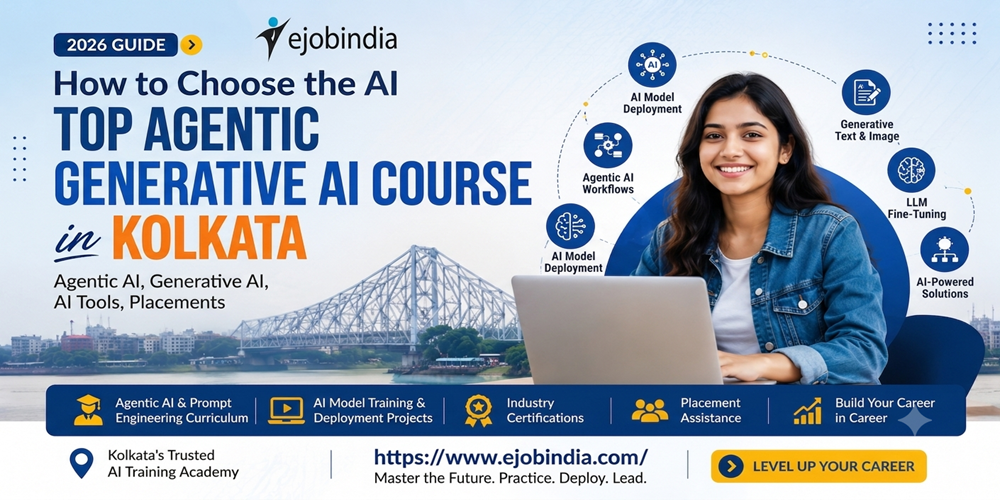
Generative AI Course in Kolkata: Your Complete Guide to Building a Career in AI
Artificial intelligence is no longer a concept confined to research labs or Silicon Valley boardrooms. It is reshaping industries across India — from healthcare and finance to e-commerce and education — and Kolkata is rapidly emerging as a hub for technology talent that wants to be at the centre of this transformation.
If you are a student, a fresh graduate, or a working professional wondering how to break into the AI field or upgrade your skills to stay relevant, you are asking exactly the right question. The demand for professionals who understand Generative AI — not just as users, but as engineers who can build with it — is growing faster than the supply of trained talent.
This guide covers everything you need to know about Generative AI, why it matters right now, what a quality Generative AI course in Kolkata should teach you, and why Ejobindia’s Generative AI Engineering Program is the right place to start your journey.
1. What Is Generative AI — And Why Should You Care?
Generative AI refers to artificial intelligence systems that can create new content — text, images, code, audio, and video — by learning patterns from vast datasets. Unlike traditional AI, which classifies or predicts based on existing data, Generative AI produces something new. ChatGPT writing an email, Midjourney generating an illustration, GitHub Copilot completing your code — these are all Generative AI at work.
The technology is built on Large Language Models (LLMs) — deep learning systems trained on billions of words of text, capable of understanding context, reasoning through problems, and generating human-quality responses. GPT-4, Claude, Gemini, LLaMA — these are all LLMs, and they are the foundation on which an entire generation of AI-powered products is being built.
But here is what most people miss: using ChatGPT is not the same as knowing how to build with it. Companies are not just hiring people who can prompt an AI. They are hiring engineers who understand how LLMs work under the hood, who can fine-tune models on proprietary data, build Retrieval-Augmented Generation (RAG) systems, design production-ready AI pipelines, and deploy them at scale. That engineering knowledge is what a Generative AI course is designed to give you — and it is what Ejobindia‘s program delivers.
2. The Generative AI Job Market: Why Kolkata Graduates Need This Skill Now
India is one of the fastest-growing AI talent markets in the world. According to industry reports, the demand for AI and machine learning professionals in India grew by over 40% in 2024, and Generative AI skills specifically are commanding salary premiums of 30–60% over equivalent roles without AI expertise.
In Kolkata, the IT sector — concentrated in Salt Lake’s Sector V and the New Town area — is actively recruiting for AI roles. Companies ranging from mid-size product firms to multinational service providers are building internal AI capabilities and need engineers who can work with LLMs, build intelligent applications, and maintain AI systems in production.
The most in-demand job profiles for Generative AI engineers in 2025-26 include:
- AI/ML Engineer — designing and deploying machine learning and generative AI models
- LLM Application Developer — building applications powered by GPT-4, Claude, Gemini, or open-source models
- RAG Systems Engineer — designing retrieval-augmented generation pipelines for enterprise knowledge bases
- MLOps Engineer — managing the deployment, monitoring, and versioning of AI models in production
- AI Product Developer — combining software engineering with AI to build commercial AI products
Starting salaries for trained Generative AI engineers in Kolkata range from ₹4.5 LPA to ₹8 LPA, with experienced professionals commanding significantly more. The window to enter this field at the ground floor — and grow with the market — is right now.
3. What Makes a Generative AI Course Worth Your Time and Money?
Not every course that puts ‘AI’ in its name is going to help you get a job or build real skills. Here is what separates a high-quality Generative AI course from a superficial one.
It Goes Beyond Tools and Teaches Fundamentals
A good course does not just teach you to call the OpenAI API. It teaches you why LLMs work the way they do — how embeddings represent meaning, what attention mechanisms do, why context windows matter, and how fine-tuning changes a model’s behaviour. Without these fundamentals, you cannot make good engineering decisions or troubleshoot problems in production.
It Covers the Full Engineering Stack
Generative AI engineering is not just about models. It involves Python programming, API design, vector databases, data pipelines, deployment infrastructure, monitoring, and security. A comprehensive course covers all of these — not just the glamorous parts.
It Builds Real Projects
Portfolio projects are what get you hired. The best courses have you build fine-tuned chatbots, RAG-powered document search systems, AI SaaS applications, and deployed AI APIs — not toy demos, but projects you can genuinely show to employers.
It Is Taught by Practitioners, Not Just Academics
Generative AI is an applied field that is changing rapidly. The best instructors are engineers who work with these systems in real-world contexts and can share practical insights that no textbook captures.
It Provides Placement Support
For freshers and career-changers, getting the first job is often the hardest part. A course that actively supports placement — with interview preparation, resume building, and industry connections — dramatically improves your chances of converting your training into employment.
4. Ejobindia’s Generative AI Engineering Course in Kolkata: A Detailed Look
Ejobindia’s Generative AI Engineering Program, located at the SDF Building, Sector V, Salt Lake, Kolkata, is one of the most comprehensive and practically oriented Generative AI courses available in the city. Here is what the program covers:
Program Basics
- Duration: 120 hours, conducted 3 days a week over approximately 4–5 months
- Mode: Hybrid — attend in-person at Salt Lake, Sector V or join online. Weekend batches available for working professionals.
- Fee: ₹35,000
- Certification: Trainee Generative AI Engineer, jointly awarded by Ejobindia and OS4ED India Pvt. Ltd.
- Placement Support: 100% placement assistance included
What You Will Learn: Module by Module
The course is structured across 12 modules, each building on the previous to take you from programming fundamentals to production AI deployment.
Module 1: Python for AI Development
Everything in Generative AI engineering is built in Python. This module ensures you have solid Python fundamentals — syntax, data structures, APIs, JSON handling, asynchronous programming, and FastAPI for building backend services. If you already know Python, this module reinforces best practices for AI-specific use cases.
Module 2: Machine Learning Fundamentals
Before you can work with LLMs, you need to understand how machine learning works. This module covers supervised and unsupervised learning, key algorithms, model evaluation, and hands-on model building with scikit-learn. Understanding ML gives you the foundation to reason about why LLMs behave as they do.
Module 3: Deep Learning with Neural Networks
LLMs are built on deep neural networks. This module introduces neural network fundamentals, training, backpropagation, and convolutional networks using PyTorch and TensorFlow. Hands-on projects include image and text classification — giving you direct experience with the building blocks of modern AI.
Module 4: Advanced Prompt Engineering
Prompting is not just writing a question — it is a craft. This module covers few-shot and chain-of-thought prompting, structured outputs, prompt chaining, and systematic prompt optimisation. These skills directly impact the quality and reliability of AI systems you build.
Module 5: LLM APIs and Open-Source Models
You will work with OpenAI’s GPT models, Hugging Face’s model hub, and locally-run open-source LLMs like LLaMA and Mistral. Understanding the tradeoffs between cloud-hosted and local models — cost, latency, privacy, customisation — is essential for real-world AI engineering.
Module 6: Fine-Tuning and Custom Models
Fine-tuning allows you to adapt a pre-trained LLM to a specific domain or task using your own data. This module covers fine-tuning concepts, LoRA (Low-Rank Adaptation) and PEFT techniques, dataset preparation, and model evaluation. This is one of the most sought-after skills in enterprise AI engineering.
Module 7: Embeddings and Vector Databases
Embeddings transform text into numerical representations that capture semantic meaning. Vector databases like FAISS and Pinecone store and retrieve these embeddings efficiently. This module covers semantic search, indexing, and similarity search — the foundation of RAG systems and AI-powered search applications.
Module 8: Advanced RAG Systems
Retrieval-Augmented Generation (RAG) is the architecture behind most enterprise AI applications — chatbots that answer questions from company documents, AI assistants with real-time knowledge, and intelligent search systems. This module does a deep dive into RAG architecture, chunking strategies, re-ranking, hybrid search, and production optimisation.
Module 9: AI Evaluation and Optimisation
Building an AI system is only half the work — making it reliable, fast, and cost-effective is the other half. This module covers techniques for reducing hallucinations, optimising cost and latency, and making principled decisions about when to use RAG versus fine-tuning.
Module 10: AI System Design
Thinking at the systems level is what separates junior AI developers from senior engineers. This module covers the architecture of production Generative AI applications, API versus local model decisions, and real-world system design case studies drawn from live industry examples.
Module 11: Deployment and MLOps
An AI model that cannot be deployed is a research experiment, not a product. This module covers deployment strategies, containerisation, monitoring, logging, and model versioning — the operational skills that production AI engineering demands.
Module 12: AI Security and Governance
AI systems introduce unique security risks — prompt injection attacks, data leakage, adversarial inputs, and bias. This module covers responsible AI practices, security considerations in LLM applications, and governance frameworks that are increasingly required by enterprise clients.
Capstone Projects
Rather than a single end-of-course project, Ejobindia’s program has you build four distinct capstone projects that demonstrate the full range of your skills:
- A fine-tuned chatbot trained on domain-specific data
- An advanced RAG system for intelligent document retrieval
- An AI SaaS application with a functional frontend and backend
- A fully deployed, end-to-end AI system accessible via a live URL
These four projects form a portfolio that you can present directly to employers — demonstrating not theoretical knowledge but genuine engineering ability.
5. Who Should Join This Generative AI Course?
The course is designed for:
- Tech / MCA / BCA freshers or final-year students who want to enter the AI field with competitive, market-ready skills
- Software developers and IT professionals who want to transition into AI engineering or add Generative AI capabilities to their existing skillset
- Working professionals in non-technical roles who have basic programming knowledge and want to pivot towards AI
- Entrepreneurs and product managers who want to understand AI engineering well enough to build or evaluate AI products
The only prerequisite is a genuine interest in technology and a willingness to put in the hours. Python basics help but are not mandatory — Module 1 is specifically designed to bring all learners to the required level.
6. Why Ejobindia Is the Right Place to Learn Generative AI in Kolkata
Salt Lake Location — Kolkata’s IT Heart
Ejobindia is located in the SDF Building, Module 617-618, 5th Floor, GP Block, Sector V, Salt Lake — which puts you physically in the heart of Kolkata’s IT corridor. This matters. You are networking and learning in the same geography where the companies hiring AI engineers are based.
Hybrid Flexibility
Life does not always allow for fixed classroom schedules. Ejobindia’s hybrid model lets you attend in-person at Salt Lake or join live classes online. Weekend batch options mean working professionals do not have to choose between upskilling and their current jobs. All classes are recorded, so you never miss a session.
100% Placement Support
Completing a course is only meaningful if it translates into employment. Ejobindia provides active placement support — resume building, mock interviews, access to hiring partner networks, and regular interview drives. Their track record with placement across multiple IT disciplines and their relationships with Salt Lake-area companies give students a genuine advantage in the job market.
Certification by Ejobindia and OS4ED India Pvt. Ltd.
The Trainee Generative AI Engineer certification is jointly awarded by Ejobindia and its software development division, OS4ED India Pvt. Ltd. This dual certification from a training institution and a working software company carries more weight than a certificate from a training institute alone — it signals that the curriculum is aligned with actual development practice.
Practical-First Curriculum
Every module in this course is designed around implementation, not just concepts. You write code from day one. You build systems, not slides. The capstone projects are real engineering challenges, not academic exercises. This approach means that by the time you finish the course, you have genuine experience — not just familiarity with terminology.
7. Career Paths After Completing the Generative AI Course
A Generative AI Engineering certification from Ejobindia prepares you for multiple high-growth career paths:
- Generative AI Engineer: Building LLM-powered applications and AI pipelines for product companies
- Machine Learning Engineer: Designing, training, and deploying ML and AI models at scale
- AI Application Developer: Creating commercial AI tools and SaaS products
- Data Scientist with AI Specialisation: Combining analytical skills with Generative AI capabilities
- MLOps Engineer: Managing the infrastructure and operations of AI systems in production
- AI Consultant: Advising businesses on AI strategy, implementation, and governance
The Generative AI field is projected to be one of the highest-growth technology domains through the rest of this decade. Professionals who develop deep engineering skills now will be well positioned for senior roles as the market matures.
8. The Right Time to Start Is Now
There is a narrow window in the lifecycle of any transformative technology where early skill development pays disproportionate dividends. For Generative AI, that window is open right now. The technology has matured enough to be deployable in production, companies are actively hiring, and the pool of genuinely trained engineers is still small relative to demand.
Waiting for the course to become more popular, for the technology to stabilise, or for salaries to firm up further means entering the market later — with more competition and fewer advantages for being early.
Ejobindia’s Generative AI Engineering Program gives Kolkata students and professionals a structured, practical, placement-supported path into this field. The next batch is forming now. If you are serious about building a career in AI — or future-proofing the career you already have — this is the right course, in the right city, at exactly the right time.
Reach out to Ejobindia at 9830228812 or 9830125644, or visit their campus at SDF Building, Sector V, Salt Lake, Kolkata to book a free career consultation and find out which batch is right for you.
FREQUENTLY ASKED QUESTIONS (FAQ)
Q1: What is this Generative AI course about?
Ejobindia’s Generative AI Engineering Program is a 120-hour, project-based course that teaches you to build real AI applications using Large Language Models (LLMs), RAG systems, embeddings, vector databases, fine-tuning, and MLOps. It goes well beyond basic AI usage and trains you as an engineering professional who can design, build, and deploy production Generative AI systems.
Q2: Who is this Generative AI course in Kolkata suitable for?
The course is designed for B.Tech, MCA, and BCA freshers and final-year students, software developers looking to transition into AI, working professionals wanting to add Generative AI skills, and anyone with a technology background who wants to enter the AI job market. No prior AI experience is required, though basic programming familiarity is helpful.
Q3: What is the duration and fee of the course?
The program consists of 120 hours of training, conducted 3 days a week over approximately 4–5 months. The course fee is ₹35,000. Classes are available in hybrid mode — online and offline — with weekend batch options for working professionals.
Q4: Where is Ejobindia located in Kolkata?
Ejobindia is located at the SDF Building, Module 617-618, 5th Floor, GP Block, Sector V, Salt Lake, Kolkata – 700091. This is in the heart of Kolkata’s IT corridor, close to the companies actively hiring AI engineers.
Q5: What certificate will I receive after completing the course?
Upon successfully completing the Generative AI Engineering Program, you receive the ‘Trainee Generative AI Engineer’ certification, jointly awarded by Ejobindia and OS4ED India Pvt. Ltd. (Ejobindia’s software development division). This dual certification from both a training and a development organisation reflects the practical, industry-aligned nature of the curriculum.
Q6: Does Ejobindia provide placement support after the course?
Yes. Ejobindia provides 100% placement assistance to all course graduates. This includes resume building, mock interviews, interview preparation sessions, access to hiring partner networks, and regular interview drives. Ejobindia’s placement team actively connects students with relevant job opportunities in Kolkata and beyond.
Q7: What projects will I build during this course?
You will build four capstone projects: a fine-tuned domain-specific chatbot, an advanced RAG system for intelligent document retrieval, an AI SaaS application with frontend and backend, and a fully deployed end-to-end AI system. These projects form a working portfolio that you present directly to employers during the placement process.
Q8: What is the difference between Generative AI and traditional AI or machine learning?
Traditional AI and machine learning systems are trained to classify, predict, or make decisions based on patterns in existing data. Generative AI systems — built on Large Language Models — go further by creating new, original content: text, code, images, and more. Generative AI requires a distinct set of engineering skills including prompt engineering, RAG architecture, fine-tuning, and LLM deployment, all of which this course covers.
Q9: Can I join this course if I am a working professional?
Yes. Ejobindia offers weekend batches specifically designed for working professionals. The hybrid format — allowing both online and offline attendance — adds further flexibility. All classes are recorded so you can review any session you miss.
Q10: What career roles can I pursue after completing this Generative AI course?
Graduates are qualified for roles including Generative AI Engineer, Machine Learning Engineer, AI Application Developer, MLOps Engineer, Data Scientist with AI specialisation, and AI Consultant. Starting salaries in Kolkata for these roles range from ₹4.5 LPA to ₹8 LPA, with strong growth potential as experience and AI market demand increase.
Q11: Is there a prerequisite for joining the Generative AI Engineering Program?
No formal prerequisite is required, though a basic interest in technology and some familiarity with programming is helpful. The first module of the course specifically covers Python for AI development, bringing all students to the required technical level before advancing to LLM and AI topics.
Q12: How do I enroll in the Generative AI course at Ejobindia, Kolkata?
You can enroll by calling Ejobindia at 9830228812 or 9830125644, visiting the campus at SDF Building, Sector V, Salt Lake, Kolkata, filling out the consultation request form on the website at ejobindia.com/generative-ai-course-kolkata.php, or reaching out via WhatsApp. A free career consultation is available to help you decide if this is the right course for your goals.
Pingback: Agentic AI with Python: Full Guide & Career Path | eJobIndia