
How a Loan Origination System Cuts Loan Processing Time by 70%
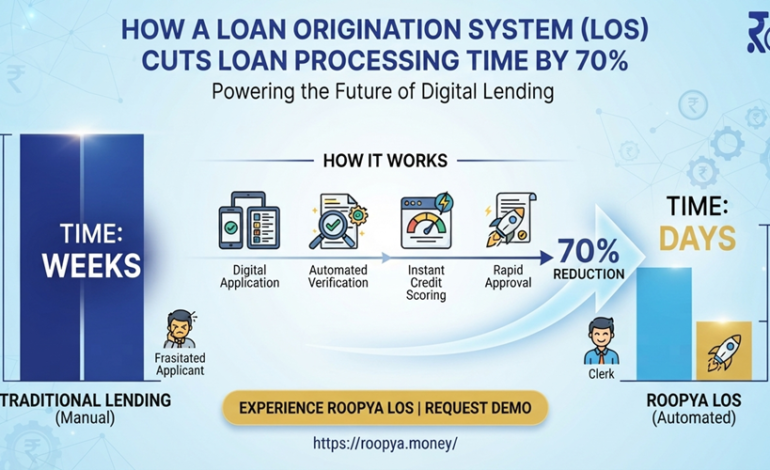
Time is the single most expensive resource in lending. Every hour a loan application sits in a queue — waiting for a document check, a credit bureau pull, a manual underwriter review, or a manager’s sign-off — costs your institution money, frustrates your borrower, and hands an opportunity to your competition. In a market where digital-first lenders can approve and disburse a personal loan in under 15 minutes, the traditional processing cycle of 3 to 7 days is not just inefficient — it is a commercial liability.
The technology that is reshaping this equation is the Loan Origination System (LOS). A modern, AI-powered LOS does not simply digitise the old paper-based process — it fundamentally redesigns it, eliminating bottlenecks that have existed for decades and replacing human-dependent sequential steps with automated, parallel workflows. The result? Lenders using platforms like Roopya consistently report reductions in end-to-end loan processing time of 60% to 70% — without sacrificing credit quality or compliance.
This article breaks down exactly how a Loan Origination System achieves this, step by step, with the data to back it up.
1. Understanding the Traditional Loan Processing Bottleneck
Before examining how a Loan Origination System solves the problem, it is worth understanding precisely where time is lost in a traditional lending operation. A manual loan processing workflow typically looks like this:
- Application receipt and data entry (1–4 hours): A borrower submits a physical or semi-digital application. A staff member manually enters data into the system — introducing transcription errors and delays proportional to volume.
- Document collection and verification (1–3 days): The borrower is contacted to submit income proof, identity documents, bank statements, and other supporting materials. Missing documents trigger follow-up calls. Each document is reviewed manually by a different team member.
- KYC and identity verification (4–24 hours): Customer identity is verified against government databases, often through manual lookup or semi-automated tools. In branch-based models, this may require an in-person visit.
- Credit bureau pull and analysis (2–8 hours): A credit officer manually initiates bureau enquiries, waits for reports, and then interprets the findings against internal credit policy — a highly variable process that depends heavily on individual skill and workload.
- Underwriting and credit decisioning (1–3 days): The file moves to an underwriter who reviews all data, documents, and bureau reports, then applies the institution’s credit policy to arrive at a decision. During peak periods, files queue for days.
- Sanction letter and agreement preparation (4–8 hours): A sanctioned loan triggers document generation — offer letters, loan agreements, repayment schedules — typically prepared manually or semi-automatically.
- Borrower review, eSign, and return (1–3 days): Physical agreements are couriered, signed, and returned. Delays here are entirely outside the lender’s control.
- Disbursement initiation (4–8 hours): Once signed agreements are received, disbursement instructions are prepared and submitted to the payments team.
Adding these up, even a well-run traditional lending operation has an end-to-end cycle time of 5 to 14 working days for a straightforward retail loan. A Loan Origination System targets every single one of these stages.
2. What Is a Loan Origination System?
A Loan Origination System is a software platform that manages the entire process of bringing a loan from first application to final disbursement. It is the operational core of a digital lending business — the platform that receives applications, orchestrates verifications, runs credit decisioning, generates documentation, and triggers disbursement.
A modern LOS is not a standalone tool. It is an integration hub, a workflow engine, a rules configurator, and an analytics platform — all in one. Roopya’s Loan Origination Platform, for instance, connects to 300+ pre-integrated APIs spanning credit bureaus, KYC providers, document verification services, eSign platforms, payment gateways, accounting systems, and banking data sources. All of these integrations work in concert, triggered automatically by the LOS as each application progresses through the workflow.
The key architectural distinction between a modern LOS and older loan processing software is parallelism. Traditional systems process loan applications sequentially — step A must complete before step B begins. A modern LOS processes multiple steps simultaneously. KYC, bureau pull, and document analysis happen concurrently the moment an application is submitted and consent is given. This single architectural change can cut processing time by 40% before any other optimisation is applied.
3. The Seven Ways a Loan Origination System Reduces Processing Time by 70%
3.1 Instant Digital Application Capture — Eliminating Data Entry Lag
The first time drain in traditional lending is the gap between a borrower expressing intent and a lender having usable application data. In manual operations, this gap can be hours or days. A Loan Origination System eliminates it entirely.
Roopya’s LOS provides configurable, mobile-responsive digital application forms that borrowers complete directly — on a smartphone, tablet, or desktop. Smart real-time validation checks PAN structure, Aadhaar format, IFSC codes, and pincode geographies as the borrower types, reducing incomplete submissions. Data flows directly from the borrower’s input into the LOS — there is no re-keying, no manual transfer, and no queue wait.
Time saved: What previously took 1–4 hours of staff data entry time is reduced to zero. The moment the borrower submits the form, the application is live in the system and processing has already begun.
3.2 Automated Parallel KYC — From Days to Seconds
Know Your Customer verification has historically been one of the longest stages in loan processing. Branch visits, manual document checks, semi-automated database lookups, and back-and-forth communications with the borrower could consume 24 to 72 hours — and that is for a clean case.
A Loan Origination System with pre-integrated KYC APIs transforms this completely. The moment a borrower submits their application and provides consent, Roopya’s LOS simultaneously triggers Aadhaar eKYC authentication, NSDL PAN verification, Digi locker document retrieval, and — where required — a Video KYC session. All of these checks run in parallel, not sequentially. Results are returned in seconds to minutes, and the KYC decision is taken automatically based on pre-configured rules.
For clean cases — which constitute the majority of retail loan applications — the entire KYC workflow completes in under 90 seconds. For cases requiring video KYC, the session is scheduled automatically and completed typically within the same business day.
Time saved: KYC time reduced from 24–72 hours to under 2 minutes for straight-through cases — a reduction of over 95%.
3.3 Automated Credit Bureau Integration — Real-Time Score Pulls
In a manual workflow, initiating a credit bureau enquiry requires a credit officer to log into a bureau portal, enter borrower details, wait for the report, download it, and then manually read and interpret the results against the credit policy document. This process is repeated across potentially four bureaus (CIBIL, Experian, CRIF, Equifax) and introduces significant variability depending on who is doing it and how busy they are.
Roopya’s Loan Origination System handles bureau pulls automatically. The moment consent is recorded, bureau APIs are triggered simultaneously for all required bureaus. Reports are received, parsed by the system, and key parameters — score, DPD history, outstanding balances, enquiry count, write-offs — are extracted and presented in a structured, comparable format. These parameters are then automatically fed into the Business Rule Engine for decisioning. No human touches this workflow unless the application is flagged for manual review.
Time saved: Bureau pull and analysis time reduced from 2–8 hours to under 60 seconds. More importantly, the consistency and accuracy of bureau data interpretation improve dramatically because it is system-driven rather than analyst-driven.
3.4 AI-Powered Document Analysis — From Days to Seconds
Document review is typically the stage where loan applications get stuck longest. A borrower uploads twelve documents. A credit analyst must open each one, read it, extract relevant financial data (net monthly income from salary slips, average monthly balance from bank statements, turnover and profit from GST returns), cross-check for consistency, and flag anomalies. For a complex self-employed case with three years of bank statements, this alone can take 4–6 hours per application.
Roopya’s LOS includes AI-powered OCR and NLP document analysis that automates this entire process. Uploaded documents are instantly classified by type (salary slip, bank statement, ITR, GST return, etc.) and processed by specialized AI models tuned for each document category. Key data fields are extracted automatically — income figures, cash flow patterns, tax filings, business turnover. The AI cross-references figures across documents, flags inconsistencies, and highlights potential fraud signals — anomalies that human reviewers, under time pressure, routinely miss.
Roopya’s document analysis engine operates with 99%+ accuracy and processes a complete document set in under 60 seconds. It runs 24 hours a day, 7 days a week, without fatigue, distraction, or lunch breaks.
Time saved: Document review time reduced from 4–6 hours to under 60 seconds per application — a reduction of 98%. Staff are freed from document processing to focus on genuine exception handling and relationship management.
3.5 No-Code Business Rule Engine — Instant, Consistent Credit Decisions
The underwriting stage is where the most time is lost in traditional lending — and where the most inconsistency is introduced. A manual underwriting process depends on a human being applying judgment, credit policy knowledge, and institutional experience to a specific application. Under high volume, applications queue for days. Decisions vary between underwriters. Policy exceptions are applied inconsistently.
A Loan Origination System with a Business Rule Engine (BRE) replaces the sequential human underwriting queue with automated, instant decisioning. Roopya’s no-code BRE allows credit and risk teams to configure every element of their credit policy through a visual interface — income thresholds, bureau score cutoffs, DPD tolerances, employment type eligibility, geographic restrictions, LTV ratios for secured products, product-level eligibility criteria — without writing a single line of code.
When an application completes KYC, bureau, and document processing, all extracted data parameters are automatically fed into the BRE. The engine evaluates the application against every configured rule in milliseconds and returns one of three outcomes: Approve (with the specific offer parameters), Reject (with decline reason codes), or Refer (to manual review with a pre-populated review summary). For lenders with well-configured credit policies, 70–80% of applications can be processed with zero human intervention — straight-through processing (STP).
Roopya’s BRE is also self-learning. It analyses historical approval and rejection patterns, identifies rules that are producing unexpected outcomes, and surfaces improvement suggestions to the credit team. Over time, the BRE becomes progressively more efficient and accurate.
Time saved: For STP-eligible applications, underwriting time drops from 1–3 days to under 5 seconds. Even for manual review cases, the BRE pre-populates a structured review summary, reducing analyst time by 60–70%.
3.6 Digital Agreement Generation and eSign — Eliminating Physical Document Delays
Once a loan is sanctioned, the traditional process requires generating a loan agreement — often manually or via a semi-automated template — printing it, couriering it to the borrower, waiting for it to be signed and returned, and then processing the returned document. This physical loop alone can add 2 to 5 working days to the disbursement timeline.
Roopya’s LOS generates the complete loan agreement package automatically upon sanction — personalised with the borrower’s details, loan terms, repayment schedule, and all required disclosures — and delivers it digitally within seconds. The borrower completes legally valid eSign through Aadhaar OTP-based authentication or Digilocker-based signing, from their device, in under 2 minutes. The signed agreement is returned to the system instantly and disbursement workflows are triggered automatically.
Time saved: Document generation and signing cycle reduced from 2–5 days to under 10 minutes. This is one of the single largest individual time savings in the entire origination process.
3.7 Automated Disbursement Triggers and Payment Integration
The final stage — initiating the actual loan disbursement — still requires manual action in many traditional systems. A disbursement officer reviews the completed file, confirms all pre-disbursement conditions are met, and manually initiates the payment instruction to the bank’s payment system.
In Roopya’s LOS, disbursement triggers are automated. Pre-disbursement condition checks (eSign completion, KYC clearance, collateral registration where applicable, insurance linkage where required) are monitored in real time by the system. When all conditions are satisfied, a disbursement instruction is automatically generated and — depending on the lender’s configuration — either auto-approved or presented to a disbursement officer with a single-click approval interface. Payment is processed through pre-integrated payment gateways and banking APIs.
Time saved: Disbursement initiation time reduced from 4–8 hours to under 15 minutes for auto-approved cases.
4. The Cumulative Impact: Before and After a Loan Origination System
Bringing all seven improvements together, here is how the processing timeline changes for a standard retail loan application:
- Application Data Entry: Before LOS = 1–4 hours → After LOS = 0 minutes (self-service)
- KYC Verification: Before LOS = 24–72 hours → After LOS = under 2 minutes
- Credit Bureau Pull & Analysis: Before LOS = 2–8 hours → After LOS = under 60 seconds
- Document Review & Data Extraction: Before LOS = 4–6 hours → After LOS = under 60 seconds
- Underwriting & Credit Decision: Before LOS = 1–3 days → After LOS = under 5 seconds (STP)
- Agreement Generation & eSign: Before LOS = 2–5 days → After LOS = under 10 minutes
- Disbursement Initiation: Before LOS = 4–8 hours → After LOS = under 15 minutes
Total end-to-end time — Before LOS: 5 to 14 working days. After LOS: under 30 minutes for clean STP cases. Even for complex cases requiring manual review, total processing time drops to 4–8 working hours. Average reduction across the portfolio: 65–75%.
5. Beyond Speed: The Hidden Benefits of a Loan Origination System
The 70% time reduction is the headline number, but it is far from the only benefit. A well-implemented LOS delivers compounding advantages that transform the economics and quality of a lending operation:
Better Credit Quality, Not a Trade-Off
A common misconception is that faster processing means looser underwriting. The opposite is true. Automated credit decisioning through a well-configured BRE is far more consistent than human underwriting. Every application is evaluated against the full credit policy — without exception, without fatigue, without individual bias. Roopya’s LOS customers consistently report improvement in portfolio quality alongside the processing speed gains, because the system applies the credit policy uniformly where human underwriters, under volume pressure, were making shortcuts.
Dramatic Reduction in Cost Per Loan
Processing time and cost per loan are directly correlated. When Roopya’s AI handles document analysis, bureau pulls, and decisioning automatically, the human effort per loan drops from several hours to minutes. Lenders on Roopya’s platform report cost-per-application reductions of 40–60%. At scale — processing thousands of applications per month — these savings are transformative for unit economics and product pricing competitiveness.
Higher Conversion Rates
Borrower intent is time-sensitive. A borrower who applies for a personal loan on Monday and does not hear back until Thursday is likely to have already accepted an offer from a faster lender by Tuesday. Real-time decisioning — a loan offer in the borrower’s inbox within minutes of application — dramatically improves conversion rates. Roopya’s customers report conversion rate improvements of 20–35% after implementing the LOS, driven entirely by speed.
Scalability Without Proportional Headcount Growth
In a manual lending operation, volume growth requires proportional headcount growth — more applications mean more underwriters, more document checkers, more data entry staff. A Loan Origination System breaks this linear relationship. Roopya’s cloud-based LOS scales horizontally to handle any volume — 100 applications a day or 100,000 — without adding headcount. This is one of the most powerful structural advantages of automated lending infrastructure.
Regulatory Compliance by Design
Every application processed through Roopya’s LOS generates a complete, time-stamped audit trail — every data pull, every decision taken, every document verified, every rule applied, every staff action logged. This audit trail is invaluable for RBI examinations, internal audits, and dispute resolution. Regulatory compliance is built into the process, not added on top of it.
6. Why Speed Alone Is Not Enough — Choosing the Right LOS
Not all Loan Origination Systems deliver the same results. The 70% processing time reduction is achievable when the LOS has specific characteristics. When evaluating a Loan Origination System, look for:
- True parallel processing architecture — not just digitised sequential steps. The LOS should run KYC, bureau, and document analysis simultaneously, not one after the other.
- Pre-integrated API ecosystem — bureau connections, KYC providers, and eSign platforms should be available out of the box, not requiring months of custom integration work.
- No-code configurability — your credit and operations teams should be able to modify workflows, credit rules, and product parameters without depending on a development team.
- AI-native document processing — the OCR and data extraction capabilities should be purpose-built for lending documents, not generic tools adapted for the use case.
- Proven straight-through processing rates — ask vendors for STP rates from live customers. 70%+ STP is achievable with a well-configured modern LOS.
- 1-day go-live capability — lengthy implementation timelines (months of setup) negate the speed benefit at the portfolio level. The best platforms, like Roopya, are designed for rapid deployment.
7. How Roopya’s Loan Origination System Delivers the 70% Reduction
Roopya is a no-code, AI-powered lending infrastructure platform built specifically for Indian NBFCs, banks, MFIs, and fintech lenders. Every architectural decision in Roopya’s Loan Origination Platform is oriented toward speed, accuracy, and compliance.
- Go Live in 1 Day: Pre-built product journeys, pre-integrated APIs, and a no-code configuration interface mean lenders can begin processing live applications within 24 hours of onboarding — not 6 months.
- 300+ Pre-Integrated APIs: CIBIL, Experian, CRIF, Equifax, Aadhaar eKYC, PAN, Digilocker, VKYC, multiple eSign providers, payment gateways, and GST data — all connected and ready.
- AI-Powered Document Processing: 99%+ accuracy on bank statements, salary slips, ITRs, GST returns — processing complete document sets in under 60 seconds.
- No-Code Business Rule Engine: Configure your entire credit policy through a visual interface. No developer needed. Rules go live immediately.
- Straight-Through Processing: Roopya customers achieve 70–80% STP rates, meaning the majority of applications are processed start-to-finish without any human intervention.
- Real-Time Decisioning: Credit decisions in milliseconds for STP cases. Referral cases come with pre-populated summaries that cut analyst review time by 60–70%.
- Zero Upfront Cost: Pay-as-you-use pricing. No large upfront licence fees. Accessible for early-stage NBFCs and large institutions alike.
- Always RBI-Compliant: Continuously updated for the latest regulatory requirements, with built-in audit trails, consent management, and bureau reporting.
Institutions currently running on Roopya — IndiaKaLoan, QuickFinShop, Recapita, Findoc, EazyCredit — have achieved consistent processing time reductions of 65–75% compared to their previous manual or semi-automated workflows.
8. Getting Started: What Does Implementation Actually Look Like?
One of the most common barriers to adopting a Loan Origination System is concern about implementation complexity. The experience of lenders on Roopya suggests this concern, while understandable, is misplaced when the right platform is chosen.
Roopya’s onboarding process is structured in four stages: first, product and journey configuration — selecting from 20+ pre-built loan product templates and customising forms, fields, and workflows through the no-code interface (typically completed in a few hours); second, credit policy configuration — setting up the BRE rules, scorecard parameters, and decisioning thresholds (completed by credit team without technical support, typically in 1 business day); third, API activation — enabling required bureau connections, KYC providers, and payment gateways from the pre-integrated library (completed by Roopya’s onboarding team within hours); and fourth, user onboarding and go-live — adding team members, configuring roles and permissions, and processing the first live application.
The entire process — from sign-up to processing a live loan application — is designed to be completed within one business day. This is not a marketing claim; it is the documented experience of Roopya’s customer base.
Speed Is a Strategy, Not Just an Outcome
In modern lending, processing speed is not a back-office metric — it is a front-line competitive weapon. The lender that reaches a qualified borrower with an approved offer first wins the business. The lender that processes 10,000 applications per month with a team of 10, while a competitor requires a team of 50 for the same volume, has a structural cost advantage that compounds over time.
A Loan Origination System is the infrastructure that makes both outcomes possible. By automating every parallelisable step — KYC, bureau pulls, document analysis, credit decisioning, agreement generation — a modern LOS consistently delivers processing time reductions of 60% to 70% or more. With Roopya, this transformation is available to any lender, on any scale, with a go-live timeline measured in hours, not months.
If your institution is still measuring loan processing time in days, the question is not whether you need a Loan Origination System. The question is how much market share you can afford to leave on the table while your competitors already have one. Request a free demo from Roopya and see the 70% reduction in your own numbers.

