
Why Roopya Is the Smart Choice for Loan Origination
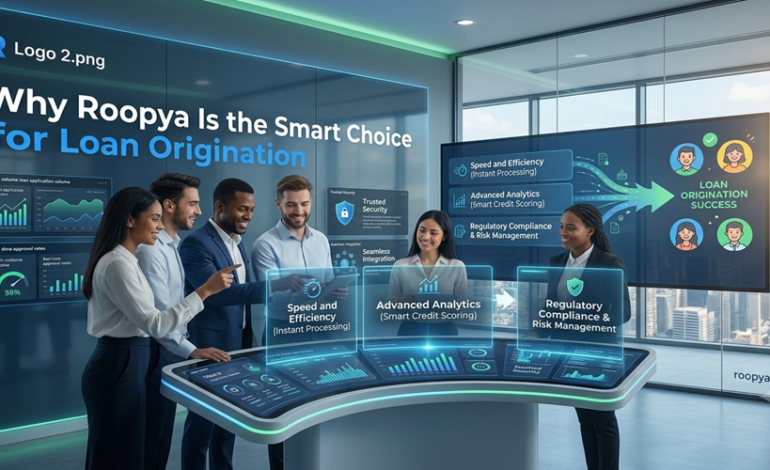
Lending has changed faster in the last five years than in the previous fifty. Borrowers now expect a loan decision in minutes, not weeks. Regulators expect airtight compliance and audit trails. Business teams expect to launch new loan products without waiting months for a development queue to free up. Traditional, code-heavy loan origination systems were never built for this pace, and NBFCs, banks, and fintechs that rely on them are finding themselves stuck — slow to go live, expensive to change, and hard to scale.
This is exactly the gap Roopya was built to close. Roopya is a cloud-based, no-code Loan Origination System (LOS) and Loan Management System (LMS) designed for modern lenders — NBFCs, banks, MFIs, and loan service providers who want to originate, underwrite, and manage loans without being weighed down by legacy infrastructure. In this article, we’ll walk through what loan origination actually involves, where most platforms fall short, and why Roopya has become a smart choice for lenders who want to go live fast, stay compliant, and scale without friction.
What Is Loan Origination, and Why Does the Platform Matter?
Loan origination is the entire journey a loan takes from the moment a borrower applies to the moment funds are disbursed. It typically includes application capture, KYC and identity verification, credit bureau checks, underwriting, policy-based decisioning, approval, documentation, and disbursal. Done manually, this journey is slow and error-prone. Done on a rigid legacy system, it’s fast to break and slow to fix.
A loan origination platform exists to automate this entire chain — reducing manual work, cutting down errors, shortening turnaround time, and giving lenders a single, centralized view of every application in the pipeline. But not all origination platforms are built the same way. Many still require developer involvement for every new loan product, every policy change, or every new lender integration. That’s the exact bottleneck Roopya was designed to eliminate.
The Core Reasons Roopya Stands Out
1. Genuinely No-Code, Not Just “Low-Code”
A lot of platforms market themselves as “configurable” but still need engineering support to launch a new product or tweak an underwriting rule. Roopya is built as a truly no-code lending infrastructure platform. Business teams — credit managers, product owners, operations leads — can configure loan products, onboarding journeys, and business rules through a visual interface, without writing a single line of code. That means the people who understand lending policy the best are the ones actually controlling it, instead of relaying requirements to a dev team and waiting in a queue.
2. Fastest Time to Go Live
Speed to market is often the single biggest constraint for a lender launching a new product or switching platforms. Roopya’s plug-and-play infrastructure is built to get a lender live in as little as one day. For an NBFC racing to launch a new loan product ahead of a market opportunity, or a fintech onboarding its first lending partner, that difference between weeks and a single day can define whether an opportunity is captured or missed.
3. Pay-As-You-Use Pricing
Traditional lending infrastructure often comes with large upfront licensing costs, long-term contracts, and expensive customization fees — a serious barrier for smaller NBFCs, MFIs, and new-age lenders trying to prove out a product before scaling. Roopya flips this model with a pay-as-you-use structure and zero upfront cost, so lenders pay in proportion to what they actually process. This makes it realistic for a lender to start small, test a product, and scale spend only as loan volumes grow.
4. 300+ Pre-Integrated APIs
Every loan journey depends on a web of third-party services: credit bureaus, bank statement analyzers, PAN and Aadhaar verification, video KYC, e-signature, payment gateways, and fraud checks. Building and maintaining these integrations independently is a significant technical undertaking. Roopya comes with over 300 pre-integrated APIs across these categories, so lenders aren’t starting from zero — they’re assembling a loan journey from services that are already connected and tested.
5. 20+ Pre-Configured Loan Products
Instead of building a loan product from a blank canvas, Roopya offers more than 20 pre-configured loan products and customer journeys — spanning personal loans, business loans, gold loans, payday loans, and more. A lender can take one of these as a starting template and adapt it to their specific policy, rather than designing an entire journey from scratch. This alone can compress a multi-week product launch into days.
6. A Self-Configurable Business Rule Engine (BRE)
Credit policy is rarely static — interest rates shift, risk appetite changes with the market, and new eligibility rules need to be rolled out constantly. Roopya’s no-code Business Rule Engine lets credit and risk teams configure approval workflows, eligibility rules, and pricing logic directly, through a visual interface, without raising a change request with engineering. This shortens the loop between “we want to change this policy” and “this policy is live.”
7. AI Woven Into the Core of the Platform
Roopya doesn’t treat AI as a bolt-on feature — it’s built into the core workflows that matter most to a lender’s speed and risk exposure:
- AI-powered document analysis extracts, verifies, and cross-checks identity documents and bank statements using OCR and NLP, aiming for high accuracy while flagging fraud and anomalies far faster than manual review.
- AI-enhanced Business Rule Engine learns from historical approval and rejection data, surfacing patterns and suggesting rule refinements — while keeping a human in the loop for final sign-off.
- Intelligent credit decisioning goes beyond a traditional bureau score, incorporating alternative data and behavioral signals to assess borrowers more holistically, which matters enormously for underserved or thin-file segments.
- AI-driven analytics and reporting lets teams ask questions in plain English and get instant, structured answers instead of waiting on a manual reporting cycle.
For lenders, the practical outcome of this AI layer is fewer manual bottlenecks in verification and underwriting, faster fraud detection, and credit decisions that can adapt as market and borrower behavior shifts — all without needing an in-house data science team.
8. Built for the Full Lending Lifecycle, Not Just Origination
While origination is the front door, a lender’s real risk and revenue exposure plays out over the life of the loan. Roopya extends past origination into a full-lifecycle platform:
- Loan Management System (LMS) for portfolio management, payment processing, amortization schedules, and a customer-facing servicing portal.
- Collections System with automated reminders, structured collection workflows, payment plans, and agent management to protect recovery rates.
- Early Warning System that uses predictive analytics and behavioral signals to flag potential defaults before they happen, rather than reacting after the fact.
- Lending Analytics and Advanced Reporting for portfolio-level visibility, performance metrics, and regulatory reporting.
This matters because a lender that originates loans on one system and manages them on another inevitably deals with data fragmentation, reconciliation headaches, and blind spots in risk visibility. Roopya’s single-platform approach keeps origination, servicing, collections, and analytics on one continuous data thread.
9. Deep Credit Risk and Analytics Capabilities
Beyond origination workflows, Roopya also supports advanced credit risk analytics — including credit scorecard development, application scorecards, Probability of Default (PD), Exposure at Default (EAD), Loss Given Default (LGD), and Expected Credit Loss (ECL) calculations, along with credit risk model validation and stress testing. For lenders that need to meet regulatory expected-credit-loss frameworks or want a more rigorous, data-backed underwriting approach, this analytics depth is built into the same platform rather than requiring a separate vendor.
10. Compliance Built In, Not Bolted On
Regulatory expectations for digital lenders keep tightening, and a platform that can’t keep pace becomes a liability. Roopya is designed to be continuously updated against evolving regulatory requirements, so lenders don’t have to treat compliance as a constant, separate engineering project layered on top of their origination stack.
11. Open API Architecture for Easy Integration
Very few lenders operate in isolation — most already run a CRM, an ERP, or other core business systems. Roopya’s open, comprehensive REST API architecture is built to connect with these existing tools, so adopting Roopya doesn’t mean ripping out and replacing a lender’s entire technology stack.
Who Roopya Is Built For
Roopya is designed to serve a wide range of lending organizations:
- NBFCs looking to modernize legacy origination systems or launch new loan products quickly.
- Banks that want a configurable digital front end without a multi-year core-system overhaul.
- MFIs serving high-volume, small-ticket loans where speed and cost efficiency are critical.
- Fintechs and digital-first lenders that need to move fast and iterate on products.
- Loan Service Providers (LSPs) operating within co-lending or embedded finance arrangements.
Because Roopya supports embedded finance use cases as well, it’s also relevant for non-financial businesses that want to offer lending as part of their own customer journey — without building lending infrastructure from the ground up.
The Business Case: What Choosing Roopya Actually Changes
For a lender evaluating platforms, the decision usually comes down to a few practical questions: How fast can we launch? How much will it cost us before we’ve proven the product works? How much engineering effort will this require on an ongoing basis? And how much risk are we taking on around compliance and fraud?
Roopya’s answer to each of these is structural, not just promotional. The one-day go-live timeline and zero upfront cost model directly reduce the risk of testing a new product or entering a new lending segment. The no-code configuration layer means product and credit teams aren’t permanently dependent on engineering bandwidth. The pre-integrated API ecosystem and pre-built loan products remove a large chunk of the technical groundwork that would otherwise consume months. And the AI-driven document verification, fraud detection, and credit decisioning tools give lending teams a level of automation and risk coverage that would otherwise require a separate, dedicated data science investment.
Put together, this is what makes Roopya a genuinely different proposition from a traditional LOS: it isn’t just a faster way to do what lenders were already doing — it changes how much operational and financial risk a lender takes on while getting there.
Conclusion
Choosing a loan origination platform is not just a technology decision — it’s a decision about how fast a lender can move, how much risk it takes on while scaling, and how much control its own credit and product teams retain over their own workflows. Roopya addresses all three: a no-code architecture that puts control back in the hands of business teams, a go-live timeline measured in days rather than months, a pricing model that removes upfront financial risk, and an AI-driven layer across document verification, credit decisioning, and analytics that keeps lending operations sharp as they scale.
For NBFCs, banks, MFIs, and fintechs that want to originate and manage loans without the weight of legacy infrastructure, Roopya offers a lending platform built for how lending actually works today — fast, data-driven, and continuously evolving. To see how it fits your lending operation, you can request a demo or explore the Loan Origination Platform in detail.
FAQs
1. What makes Roopya different from other loan origination platforms? Roopya is a truly no-code lending infrastructure platform, meaning business and credit teams can configure loan products and rules without developer support. Combined with a one-day go-live timeline, 300+ pre-integrated APIs, and built-in AI for document verification and credit decisioning, it removes most of the technical friction that slows down traditional LOS platforms.
2. How quickly can a lender go live on Roopya? Roopya is designed for rapid deployment, with lenders able to go live in as little as one day using its plug-and-play infrastructure and pre-configured loan products.
3. Does Roopya require coding or technical expertise to use? No. Roopya is a no-code platform. Loan products, customer journeys, and business rules can be configured through a visual interface by business users, without writing code.
4. What types of loans can be originated on Roopya? Roopya supports 20+ pre-configured loan products, including personal loans, business and SME loans, gold loans, payday loans, home loans, auto loans, and microfinance loans.
5. How does Roopya’s pricing work? Roopya uses a pay-as-you-use pricing model with zero upfront cost, so lenders pay based on actual usage rather than large upfront licensing fees.
6. Does Roopya only handle loan origination, or does it manage the full loan lifecycle? Roopya covers the full lending lifecycle — origination, loan management (LMS), collections, early warning/default prediction, and lending analytics — all on a single platform.
7. How does Roopya use AI in the lending process? Roopya applies AI across document analysis (OCR/NLP-based verification and fraud detection), an AI-enhanced Business Rule Engine, alternative-data-based credit decisioning, and natural-language analytics and reporting.
8. Who can use Roopya? Roopya is built for NBFCs, banks, MFIs, fintechs, digital lenders, and Loan Service Providers (LSPs), as well as businesses looking to embed lending into their own customer experience.
9. Is Roopya compliant with lending regulations? Yes. Roopya is built to be continuously updated in line with evolving regulatory requirements relevant to digital lending in India.
10. Can Roopya integrate with our existing CRM or ERP systems? Yes. Roopya offers an open, comprehensive REST API architecture, allowing integration with existing CRMs, ERPs, and other business systems.