Is It a Bruise or Melanoma? How to Identify the Critical Differences
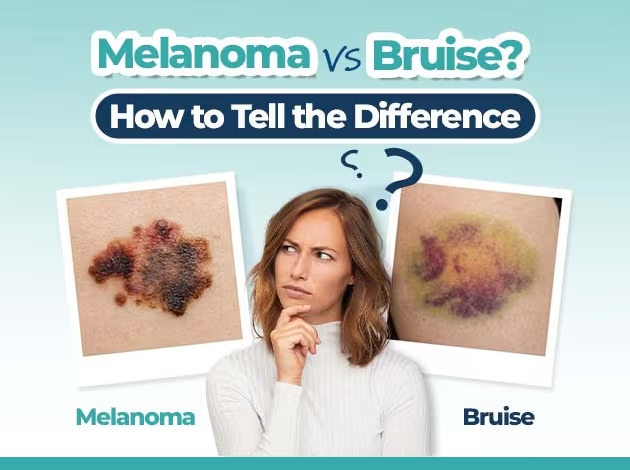
Discovering a dark spot, discoloration, or purplish mark on your skin or beneath a nail can be concerning. While most unexplained skin marks turn out to be minor trauma—such as a common bruise—certain forms of skin cancer can closely mimic the appearance of a hematoma.
Distinguishing between a benign skin injury and melanoma is essential for early detection, timely diagnosis, and effective treatment.
This guide breaks down the physical characteristics, underlying causes, timelines, and clinical warning signs that distinguish a bruise from serious skin lesions, helping you know when to monitor a spot and when to consult a medical professional.
Understanding the Basics: Bruise vs. Melanoma
To evaluate a suspicious skin mark, it helps to understand what causes each condition at a cellular level.
What Is a Bruise?
A bruise (ecchymosis) occurs when physical impact or friction ruptures tiny blood vessels (capillaries) beneath the skin without breaking the skin’s surface. Blood leaks into the surrounding subcutaneous tissue, creating a visible discoloration that changes color as the body reabsorbs the pooled blood over time.
What Is Melanoma?
Melanoma is a serious form of skin cancer that originates in melanocytes—the pigment-producing cells located in the basal layer of the epidermis. Unlike a bruise, which is caused by trauma and resolves naturally, a malignant lesion grows abnormally due to DNA damage (often caused by ultraviolet radiation or genetic factors) and will not heal on its own.
Key Differences: How to Tell Them Apart
While a fresh bruise and an early pigmented skin lesion may look similar initially, several physical traits can help you tell them apart.
1. The Healing Timeline
- Bruise: Follows a predictable healing trajectory. It typically starts reddish or purplish, shifts to dark blue or black, fades to green or yellow after 5 to 10 days, and resolves completely within 14 to 21 days.
- Skin Cancer / Melanoma: Does not fade or resolve. Instead, it persists for months, often growing, changing color, or becoming more defined over time.
2. Color and Pigmentation Patterns
- Bruise: Displays a relatively uniform, blended color that gradually diffuses at the edges as blood spreads beneath the tissue.
- Skin Cancer: Displays inconsistent, mottled pigmentation. A single lesion may feature shades of brown, black, blue, red, pink, or white within distinct borders.
3. Surface Texture and Feel
- Bruise: The skin surface remains smooth and intact (unless accompanied by a scrape), though the area may feel tender, swollen, or sore to the touch.
- Skin Cancer: May be flat or raised (nodular), rough, scaly, or prone to spontaneous bleeding, oozing, or crusting without physical injury.
4. Response to Trauma
- Bruise: Almost always traces back to a specific event—such as bumping into furniture, dropping an object, or intense physical activity.
- Skin Cancer: Appears spontaneously without any prior physical trauma or injury to the area.
Bruise vs. Melanoma: Visual Comparison Table
| Diagnostic Feature | Common Bruise (Ecchymosis) | Melanoma / Skin Lesion |
| Primary Cause | Ruptured capillaries / physical trauma | Uncontrolled melanocyte proliferation |
| Progression | Fades from purple/blue to green/yellow | Persists, expands, or changes appearance |
| Duration | Resolves within 2–3 weeks | Permanent unless treated clinically |
| Sensation | Tender or sore initially, then subsides | Asymptomatic, or may itch, bleed, or sting |
| Borders | Soft, blended, diffusing edges | Asymmetrical, irregular, or jagged borders |
| Location | Anywhere subjected to physical impact | Anywhere, including sun-exposed and hidden areas |
Subungual Melanoma: The “Bruised Nail” Dilemma
One area where confusing a bruise with cancer frequently occurs is under the fingernails or toenails.
A subungual hematoma is a collection of blood under the nail bed caused by slamming a finger in a door, dropping a heavy object on a toe, or wearing tight footwear. It appears as a dark red, purple, or black spot beneath the nail plate.
However, subungual melanoma—a rare variant of skin cancer that affects the nail matrix—can present almost identically in its early stages.
How to Evaluate a Dark Mark Under a Nail:
- Nail Growth: As a healthy nail grows outward, a subungual hematoma moves forward with the growing nail plate. A cancerous lesion remains fixed at the nail bed or matrix where it originated.
- Hutchinson’s Sign: If the dark pigmentation extends beyond the nail plate onto the surrounding cuticle or skin (eponychium), this is known as Hutchinson’s sign—a key diagnostic indicator that requires immediate dermatological evaluation.
- Pigmented Bands: Cancer under the nail often appears as a vertical dark stripe running from the cuticle to the tip of the nail, rather than a round, localized blood spot.
To better understand how dark marks under nails form and when they require clinical testing, review this detailed guide on melanoma or bruise key differences to help determine whether your symptoms warrant professional care.
The ABCDE Rule for Evaluating Suspicious Spots
When examining any new, unusual, or changing mark on your body, dermatologists recommend applying the ABCDE criteria:
- A – Asymmetry: One half of the spot does not match the other half in shape or outline.
- B – Border: The edges are irregular, ragged, notched, or blurred rather than smooth and round.
- C – Color: The color is not uniform. It includes varying shades of brown or black, or patches of pink, red, white, or blue.
- D – Diameter: The spot is larger than 6 millimeters across (about the size of a pencil eraser), although some malignant lesions can be smaller.
- E – Evolving: The spot changes in size, shape, color, or height over time, or develops new symptoms like itching, bleeding, or crusting.
Additionally, pay attention to the “Ugly Duckling” sign—a lesion that looks noticeably different from all the other moles and spots on your body.
When to See a Doctor?
While it is normal to develop occasional unexplained bruises, certain warning signs require evaluation by a general practitioner or dermatologist:
- A dark spot or discoloration that remains unchanged or grows larger after 3 to 4 weeks.
- A dark streak beneath a fingernail or toenail that does not grow out with the nail plate.
- Any spot that bleeds, oozes, itches, or becomes painful without physical irritation.
- A spot that satisfies one or more of the ABCDE criteria.
- Multiple unexplained bruises appear frequently without any history of injury, which may indicate underlying vascular or hematological conditions.
A specialist can use a non-invasive magnifying device called a dermatoscope to inspect the pigment structure of the skin in detail. If the spot appears suspicious, a small skin biopsy will be performed to provide a definitive diagnosis.
Frequently Asked Questions
Can a bruise turn into skin cancer?
No. A bruise is caused by blood leaking from damaged blood vessels and has no biological mechanism to turn into cancer. However, a malignant skin growth can sometimes bleed easily after minor friction, causing a small secondary bruise to form around it.
How long should I wait for a suspicious spot to fade before seeing a doctor?
Most standard bruises show noticeable fading within 7 to 10 days and clear up completely within 2 to 3 weeks. If a mark on your skin shows no signs of fading after 3 weeks—or if it continues to change—schedule a clinical skin exam.
Can melanoma grow under a nail without any prior injury?
Yes. Subungual melanoma is not caused by physical trauma or sun exposure. It develops spontaneously within the nail matrix, which is why any dark line or spot under a nail that appears without injury should be checked by a doctor.
What does an early-stage nodular melanoma look like?
Nodular melanoma often presents as a firm, raised bump that may be dark red, black, brown, or flesh-colored. Because it grows upward and downward rapidly, it can sometimes be mistaken for a blood blister, insect bite, or deep bruise.
Summary
Differentiating between a harmless bruise and a malignant skin lesion comes down to time, evolution, and pattern. A bruise is a temporary injury that heals, changes color, and disappears within weeks. In contrast, melanoma is a persistent, evolving growth that requires early medical intervention.