
Cloud PC: How a Cloud Computer Can Become Your Remote Gaming Desktop
A powerful desktop computer has traditionally been the foundation of PC gaming. However, hardware costs, upgrades, storage requirements, and maintenance can make a high-performance setup difficult to maintain. A cloud PC offers another approach by moving the computing hardware to a remote data center.
Instead of purchasing a powerful physical computer, users connect to a remote machine through the internet. Depending on the service, the same cloud computer can support gaming, productivity, development, creative applications, and other demanding workloads.
What Is a Cloud Computer?
A cloud computer is a virtual or remotely hosted computer that users access over the internet. The processing happens on remote infrastructure rather than entirely on the user’s local device.
A cloud computer can provide resources such as:
- CPU processing power
- RAM
- Storage
- GPU acceleration
- A remote desktop environment
- Internet-connected applications
The exact capabilities depend on the provider and selected configuration.
For users with an older laptop or lightweight computer, a cloud PC can provide access to computing resources that may be difficult to run locally.
Using a Cloud Gaming Desktop
A cloud gaming desktop is a cloud computer configured for gaming workloads. It can include a capable GPU and other resources required to run modern PC games.
Rather than rendering the game entirely on the local computer, the remote gaming desktop processes the game and streams the resulting video to the player’s device. Inputs from the keyboard, mouse, or controller are sent back to the cloud machine.
This setup can make gaming possible on devices that don’t have the hardware normally associated with modern gaming.
What Makes Cloud Gaming Different?
Cloud gaming changes the traditional relationship between a player and their computer.
With a conventional gaming PC, the user owns the hardware and is responsible for upgrades, repairs, storage, and other maintenance. With a cloud PC, much of the physical infrastructure is managed remotely.
This can provide flexibility, particularly for users who:
- Don’t want to build a gaming PC
- Use multiple devices
- Have limited local storage
- Want access to more powerful hardware
- Need a remote computer for more than gaming
However, cloud gaming also depends on network performance. Latency, connection stability, bandwidth, and server location can all influence the experience.
Choosing a Cloud PC
When comparing cloud PC providers, users should look beyond the headline specifications.
GPU performance is important for gaming, but CPU resources, RAM, storage, server locations, operating-system access, pricing, and usage policies also matter.
A cloud computer designed for gaming may also be useful for software development, AI workloads, content creation, or general productivity, depending on the available configuration.
Exploring SensePC
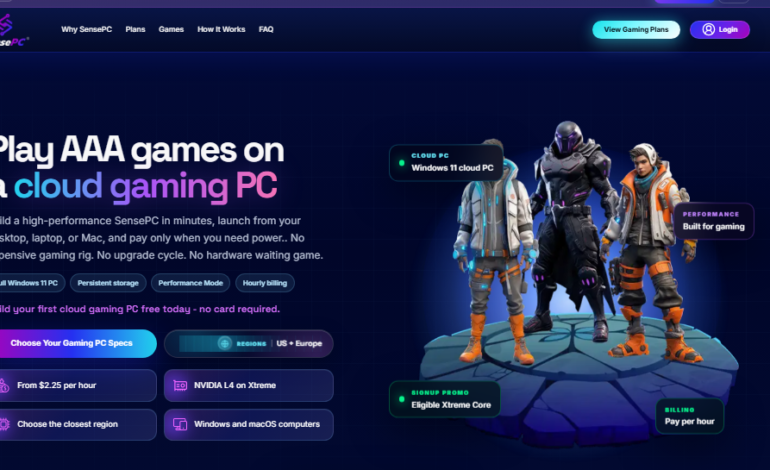
SensePC provides cloud-based PC environments designed for gaming and other computing requirements.
For users considering a cloud gaming desktop, comparing the available resources, network performance, pricing, and intended use can help determine whether a cloud-based setup is appropriate.
The ability to access a remote computer can also be useful when users move between locations or devices. Instead of keeping all applications and files tied to one physical machine, a cloud environment can provide a more flexible way to access computing resources.
Is a Cloud PC Right for You?
A cloud PC isn’t necessarily a replacement for every physical computer. Users who require maximum local performance, offline access, or specialized hardware may still prefer a traditional desktop.
For others, however, a cloud computer can provide an alternative way to access powerful resources without purchasing and maintaining an equivalent physical machine.
As cloud infrastructure continues to improve, the cloud gaming desktop is becoming another option for PC gamers who want flexibility, remote access, and scalable computing power. Comparing hardware, connectivity, pricing, and supported workloads can help users determine whether a cloud PC fits their needs.

