Loan Management Software for Fintechs
Why Fintechs Need Purpose-Built Loan Management Software
The fintech lending landscape in India and globally has undergone a seismic shift. Digital-first lenders — from NBFC startups to embedded finance platforms — are disbursing thousands of loans every day. Yet behind this explosive growth lies an operational bottleneck that silently kills margins: outdated, fragmented, or generic loan management systems.
Traditional banking software was built for branch-based operations. It cannot handle the velocity, flexibility, or automation demands of a modern fintech. Missed repayment reminders, manual reconciliation, rigid product configurations, and lack of real-time portfolio visibility are not just operational headaches — they translate directly into NPAs, regulatory penalties, and poor borrower experiences.
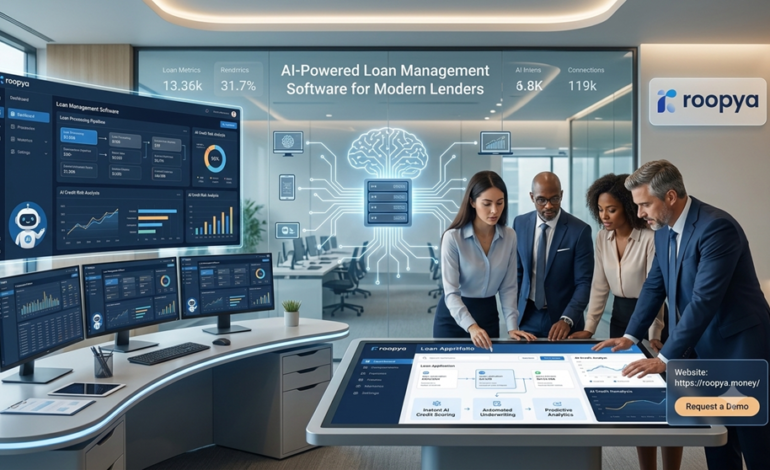
This is where Roopya’s Loan Management Software (LMS) for Fintechs changes the game. Built ground-up for India’s digital lending ecosystem, Roopya’s LMS gives fintechs complete control over their loan lifecycle — from disbursement to closure — with zero coding, pay-as-you-use pricing, and the ability to go live in as little as one day.
2. What Is Loan Management Software (LMS) for Fintechs?
A Loan Management System (LMS) is a technology platform that manages the post-disbursement lifecycle of loans. Unlike a Loan Origination System (LOS), which handles the application-to-disbursal journey, an LMS takes over once money is in the borrower’s hands.
For fintechs, a modern LMS typically covers:
- Loan account setup and disbursement confirmation
- Repayment schedule generation (EMI, bullet, flexi)
- Payment collection and automated reconciliation
- Interest accrual and fee calculations
- Prepayments, foreclosures, and loan restructuring
- NPA classification and provisioning
- Borrower communication and self-service portal
- Collections workflow and recovery management
- Regulatory reporting and complete audit trails
A purpose-built LMS for fintechs goes further — it integrates with payment gateways, bureau APIs, and accounting systems through open APIs, operates without IT intervention, and scales from 100 to 1,00,000 loans without re-architecting the entire technology stack.
3. Core Features of Roopya’s Loan Management Software for Fintechs
3.1 No-Code Loan Product Configuration
Fintechs launch multiple loan products — personal loans, BNPL, salary advances, supply chain finance, and more. Roopya’s no-code product builder allows you to configure any loan structure within minutes. Define repayment frequencies, interest calculation methods (flat, reducing balance, IRR), grace periods, moratorium windows, and fee structures without a single line of code. Business teams can own product configuration end-to-end, without waiting on engineering.
3.2 Automated Amortization & Schedule Generation
Roopya auto-generates accurate amortization schedules the moment a loan is disbursed. Whether it is an EMI-based personal loan, a bullet-repayment business loan, or a flexi-loan with variable drawdowns, the system computes and communicates the complete schedule instantly to both the lender’s operations dashboard and the borrower’s self-service portal. Any restructuring or prepayment automatically recalculates the schedule in real time.
3.3 Multi-Channel Payment Collection
Collect repayments through NACH mandates, UPI AutoPay, payment links, QR codes, and direct bank transfers — all within Roopya’s unified LMS. Each payment is automatically reconciled against the correct loan account, reducing the risk of misallocation and eliminating manual matching effort. Failed payment events trigger automated retry logic and borrower notifications without any manual intervention.
3.4 Collections & Recovery Workflow
Roopya’s built-in collections engine automates the entire delinquency management process. Configure bucket-wise collection strategies (0 DPD, 1-30 DPD, 31-60 DPD, 90+ DPD), trigger automated WhatsApp, SMS, and email reminders, assign field agents with geo-tagged visit tracking, and manage structured payment plans — all from a single intuitive interface. The system ensures the right borrower gets the right message through the right channel at precisely the right time.
3.5 Early Warning System (EWS)
Proactively identify loans heading towards default before they slip into NPA territory. Roopya’s EWS uses behavioural signals, repayment pattern analysis, and portfolio-level trend data to surface at-risk accounts 30 days before they become delinquent. This allows your collections team to intervene at the optimal moment — when the probability of recovery is still high — rather than reactively chasing overdue accounts.
3.6 Real-Time Portfolio Dashboard
See your entire loan book at a glance — total outstanding, collection efficiency ratio, DPD bucket distribution, vintage curve analysis, product-wise performance, and regional heat maps. Roopya’s executive dashboard gives fintech leadership the real-time visibility they need to make confident, data-driven decisions without waiting for end-of-day MIS reports compiled by the operations team.
3.7 Regulatory Compliance & Reporting
Stay compliant with RBI guidelines effortlessly. Roopya auto-generates CIBIL and bureau reporting files in prescribed formats, NPA classification reports aligned with the Income Recognition and Asset Classification (IRAC) norms, provisioning schedules, and audit-ready transaction logs. The platform is continuously updated to reflect the latest regulatory changes, meaning you never have to scramble when a new circular lands.
3.8 Open API & Integration Ecosystem
Roopya’s LMS connects with 300+ pre-integrated APIs including payment gateways (Razorpay, PayU, Cashfree), credit bureau providers (CIBIL, Experian, Equifax, CRIF High Mark), accounting systems, CRM platforms, and ERP tools. Open REST APIs with comprehensive documentation ensure seamless, two-way data flows with every layer of your existing fintech stack — without building custom connectors.
3.9 Borrower Self-Service Portal
Empower your borrowers with a branded, mobile-first self-service portal where they can view their loan account summary, download amortization schedules and statements, make payments, initiate prepayment requests, and raise service requests — reducing inbound support queries by up to 40% and improving Net Promoter Scores across your borrower base.
3.10 Multi-Lender & Co-Lending Support
Operating on a co-lending or loan participation model? Roopya handles complex fund-flow configurations including pool-based co-lending, direct assignment, and FLDG structures, making it the LMS of choice for fintechs working with bank and NBFC partners under the RBI’s priority sector lending co-origination framework.
4. Roopya LMS vs. Generic Loan Software: Key Differentiators
| Feature | Roopya LMS | Generic Software |
| Go-Live Time | 1 Day | 3–6 Months |
| No-Code Config | Yes | No |
| Pay-As-You-Use | Yes | Fixed License |
| Pre-integrated APIs | 300+ APIs | Manual Integration |
| Co-lending Support | Built-in | Custom Build |
| Regulatory Updates | Auto-updated | Manual Patches |
| AI Fraud Detection | Built-in | Add-on Cost |
| Borrower Portal | Branded | Generic or None |
5. Fintech Use Cases: Who Benefits from Roopya’s LMS?
5.1 Consumer Lending Fintechs (Personal Loans & BNPL)
High-volume, small-ticket lenders need automation above all else. At scale, manual follow-ups become impossible — a team of ten cannot effectively manage a portfolio of 50,000 loans. Roopya’s LMS automates the entire repayment lifecycle, from mandate presentation on the due date to automated escalation workflows if payment fails, keeping collection efficiency consistently north of 95% without adding headcount.
5.2 SME & Business Lending Platforms
Business loans are structurally complex — working capital limits with revolving drawdowns, bullet repayments at end of tenor, line utilization tracking, and frequent restructuring requests from borrowers navigating cash flow cycles. Roopya handles all of these with configurable repayment structures, partial disbursement tracking with drawdown scheduling, and structured restructuring workflows built directly into the platform.
5.3 Embedded Finance & BNPL Providers
If you embed lending into a non-financial product — an e-commerce marketplace, a B2B SaaS platform, or a supply chain ecosystem — your LMS needs to operate invisibly at massive scale. Roopya’s headless LMS architecture, exposed entirely via APIs, is purpose-built for embedded finance use cases where the end borrower never interacts with a traditional lending interface but expects flawless repayment experiences.
5.4 Microfinance & Grassroots Lenders
Group lending under the Joint Liability Group (JLG) model, weekly collection cycles, field agent management, and offline-first operation in low-connectivity geographies are fully supported. Roopya’s mobile-first approach and field agent application with offline sync capability make it ideal for microfinance institutions and business correspondents reaching India’s underserved borrower segments.
5.5 Co-Lending & Loan Service Providers (LSPs)
If you are a fintech acting as a Loan Service Provider (LSP) for bank partnerships under the RBI’s co-lending framework, Roopya’s co-lending module handles split disbursements based on agreed ratios, blended rate calculations for borrower communication, pool-level management for the partner bank’s portfolio share, and comprehensive partner reporting — all automatically and in real time.
6. The Roopya Advantage: Built for India’s Fintech Ecosystem
Most LMS platforms available in India were either built for Western markets or adapted from core banking systems designed for public sector banks. Neither was built with the Indian fintech reality in mind — UPI-first payment rails, bureau diversity across CIBIL, Experian, Equifax, and CRIF High Mark, RBI’s evolving Master Directions on Digital Lending, and the unique challenges of serving a predominantly credit-thin population outside Tier 1 cities.
Roopya was built in India, for India. Here is what that means in practice:
- Native UPI AutoPay and NACH integration with no middleware layer required
- Multi-bureau reporting in all RBI-prescribed submission formats
- Full compliance with RBI Digital Lending Guidelines issued in September 2022
- Support for Aadhaar-based eSign and DigiLocker document verification
- GST-compliant fee structures, invoicing, and tax reporting
- Borrower communication in 10+ Indian languages for vernacular engagement
7. Implementation & Onboarding: Go Live in 1 Day
One of Roopya’s most significant advantages is speed to market. Traditional LMS implementations follow a waterfall model that takes 3 to 6 months of requirements gathering, customization, UAT, and deployment. By the time a fintech goes live, the market opportunity may have shifted. Roopya’s plug-and-play cloud infrastructure changes this equation entirely:
- Day 1: Sign up and access the full platform environment
- Day 1: Configure your loan products using the no-code product builder
- Day 1–3: Connect payment gateway and bureau integrations from the pre-built library
- Day 3–7: Onboard borrower accounts and begin live disbursals
Roopya’s dedicated onboarding team provides structured support through the setup phase. They work alongside your team to configure products, test integrations, and train operations staff — ensuring your team is fully self-sufficient before handover. Ongoing support is available via in-app chat, a dedicated account manager, and Roopya’s comprehensive knowledge base.
8. Pricing: Pay Only for What You Use
Roopya’s pricing model was designed to remove the single biggest barrier to fintech growth: large upfront technology investments that consume runway before a single rupee of interest income is earned. There is no license fee, no implementation fee, and no minimum monthly commitment. You pay based on your actual transaction volume, meaning your technology cost scales in perfect proportion to your business performance.
This pay-as-you-use model is particularly valuable for:
- Early-stage fintechs that need enterprise-grade infrastructure without enterprise-grade costs
- Growth-stage platforms that cannot accurately forecast loan volumes 12 months in advance
- Mature lenders seeking to rationalise technology spend by moving from fixed-cost to variable-cost infrastructure
Visit roopya.money/pricing for current plan details, or contact Roopya’s team for a custom quote calibrated to your portfolio size, product mix, and geographic footprint.
9. Security, Data Privacy & Compliance
Roopya operates with enterprise-grade security standards across every layer of the platform:
- ISO 27001-aligned security practices and controls
- End-to-end encryption for all data in transit (TLS 1.3) and at rest (AES-256)
- Role-based access control (RBAC) for granular, need-to-know permission management
- Complete, tamper-proof audit trails for every action on every loan account
- GDPR and DPDP Act (India) compliant data handling and processing
- Regular third-party security audits and penetration testing
- Data residency in Indian cloud infrastructure for regulatory compliance
For fintechs operating within India’s Account Aggregator (AA) framework or building on OCEN (Open Credit Enablement Network) protocols, Roopya provides native AA integration for seamless financial data consent, sharing, and analysis — enabling truly consent-driven, data-rich credit decisioning.
10. AI-Powered LMS: The Next Frontier
Roopya’s AI layer enhances every aspect of the post-disbursement loan lifecycle, delivering measurable improvements in collection efficiency, fraud detection, and borrower experience:
- Predictive Collections: ML models score each account’s default probability 30 days in advance, enabling proactive outreach before delinquency occurs
- Behavioural Segmentation: Automatically cluster borrowers by repayment behaviour patterns to personalise communication tone, channel, and timing
- Dynamic Settlement Optimisation: AI recommends optimal settlement amounts based on borrower repayment history, outstanding balance, and recovery probability models
- Anomaly Detection: Real-time flags for unusual account activity — atypical prepayments, suspicious payment sources, duplicate applications, and potential fraud rings
- Conversational AI Support: NLP-powered chatbot handles routine borrower queries (outstanding balance, next EMI date, statement download) with 95% accuracy, 24 hours a day
Platform-wide, Roopya’s AI infrastructure delivers 60% better collection efficiency, 80% fraud reduction, and 10x faster document processing compared to manual operations — outcomes that directly impact the bottom line of every fintech on the platform.
11. Integration Architecture
Roopya’s open API architecture means it fits into any fintech technology stack:
- Core Banking System (CBS) integration for bank co-lending partnerships
- CRM integration (Salesforce, Zoho, LeadSquared) for lead-to-loan continuity
- Accounting and ERP integration (Tally, SAP, QuickBooks) for automated GL entries
- BI tools (Power BI, Tableau, Metabase) via dedicated data API
- Communication platforms (Exotel, Kaleyra, Gupshup) for borrower engagement
Webhooks deliver real-time event notifications to your systems for loan creation, payment success and failure, NPA reclassification, restructuring completion, and more — keeping every system in your stack synchronised without polling.
12. Outcomes from Roopya’s Customer Network
Roopya powers loan management operations for a growing network of modern lenders including IndiaKaLoan, QuickFinShop, Recapita, Findoc, EazyCredit, and Loan Seva. Common outcomes reported:
- 60% improvement in collection efficiency within the first quarter post-migration
- 80% reduction in manual reconciliation effort across operations teams
- 40% decrease in borrower support tickets through self-service portal adoption
- 10x faster MIS generation compared to spreadsheet-based reporting
13. Getting Started with Roopya’s LMS for Fintechs
Getting started is straightforward and risk-free:
- Step 1: Visit roopya.money and click Request a Demo
- Step 2: Speak with a Roopya lending solutions specialist who will understand your portfolio, products, and operational context
- Step 3: Receive a personalised platform walkthrough tailored to your specific loan products and use cases
- Step 4: Sign up, configure your products, and go live — in as little as one business day
There is no procurement process, no upfront fee, and no long-term contract lock-in. Roopya is designed for fintechs that move fast — and it keeps pace with you every step of the way.
(FAQs)
Q1. What is Loan Management Software for Fintechs?
Loan Management Software (LMS) for fintechs is a technology platform that automates the post-disbursement lifecycle of loans — including repayment scheduling, payment collection, interest accrual, collections management, and regulatory reporting. It replaces error-prone manual processes with automated, rule-driven workflows, enabling fintechs to manage large loan portfolios efficiently and profitably at scale.
Q2. How is Roopya’s LMS different from traditional loan management systems?
Roopya’s LMS is built natively for India’s digital lending ecosystem. Unlike traditional systems requiring months of implementation and heavy IT involvement, Roopya offers a no-code platform with 1-day go-live, pay-as-you-use pricing, 300+ pre-integrated APIs, and automatic regulatory updates. It is designed specifically for the velocity, flexibility, and compliance demands of modern fintechs — not adapted from legacy core banking software.
Q3. Can Roopya’s LMS handle multiple loan products simultaneously?
Yes. Roopya supports 20+ pre-configured loan products out of the box, including personal loans, business loans, BNPL, salary advance, gold loans, home loans, auto loans, and microfinance products. Each product can have its own independent repayment structure, interest calculation method, fee configuration, and collection strategy — all managed from a single unified platform with no code changes required.
Q4. How does Roopya handle payment collection and reconciliation?
Roopya integrates natively with NACH mandates, UPI AutoPay, payment links, QR codes, and bank transfers. Each incoming payment is automatically matched to the correct loan account and applied against outstanding principal, interest, and fees in the precise order defined by your product configuration. This eliminates manual reconciliation errors entirely and provides real-time, account-level collection status visibility.
Q5. Is Roopya compliant with RBI’s Digital Lending Guidelines?
Yes. Roopya’s platform is continuously updated to reflect the latest RBI guidelines and master directions, including the Digital Lending Guidelines issued in September 2022. Compliance features include KYC/AML workflow support, bureau reporting in prescribed submission formats, structured grievance redressal workflows, Key Fact Statement (KFS) generation, and data localization requirements.
Q6. Does Roopya support co-lending arrangements?
Yes. Roopya has a dedicated co-lending module that handles split disbursements at configured ratios, blended interest rate calculations for borrower-facing communication, partner-wise fund flow tracking, pool-level management for each lending partner’s portfolio share, and comprehensive regulatory reporting for bank-NBFC co-lending partnerships under the RBI’s co-origination framework.
Q7. What is the pricing model for Roopya’s Loan Management Software?
Roopya uses a pay-as-you-use pricing model with zero upfront cost, no fixed license fees, and no minimum monthly commitment. You pay based on actual transaction volumes processed through the platform — meaning your technology cost scales in direct proportion to your business. Visit roopya.money/pricing for current plan details, or contact the sales team for a custom enterprise quote.
Q8. How long does it take to go live on Roopya’s LMS?
Most fintechs are able to go live on Roopya’s LMS within 1 business day for standard loan products. The no-code product builder, pre-integrated API library, cloud-native architecture, and structured onboarding support eliminate the typical 3-6 month implementation timeline associated with traditional LMS platforms.
Q9. Can Roopya’s LMS integrate with our existing systems?
Yes. Roopya’s open REST API architecture enables seamless integration with CRM systems, accounting and ERP platforms, payment gateways, credit bureau providers, communication platforms, and business intelligence tools. Webhooks support real-time event notifications. 300+ APIs are pre-integrated and ready to activate without any custom development effort.
Q10. Is Roopya suitable for early-stage fintechs or only established lenders?
Roopya is purpose-designed for fintechs at every stage of growth. Early-stage fintechs benefit from zero upfront cost, rapid go-live, and enterprise-grade infrastructure that scales with them from Day 1. Established lenders benefit from the platform’s AI capabilities, co-lending module, open integration architecture, and ability to replace costly legacy systems without business disruption.