Low-Code, No-Code, High-Impact: Democratizing AI App Development for Non-Technical Teams
|
Key Takeaways:
|
|---|
A marketing analyst who has never written a line of production code can now stand up a working AI application before lunch. That capability arrived faster than most governance functions expected, and it is why artificial intelligence app development no longer looks like a queue in front of an engineering team. It looks like hundreds of small builds happening in parallel, most of them outside the sightline of IT. The bottleneck did not disappear. It moved.
That relocation is the argument worth taking seriously. Low-code and no-code tools did not replace developers; they changed what scarce means. When anyone can build, the scarce resource becomes oversight: knowing which apps touch regulated data, which models make consequential decisions, and who answers when one of them fails. Custom AI application development still matters, but its center of gravity is shifting from construction toward the harder question of control. This piece maps who builds now, what they gain, and the governance problem almost no organization planned for.
Who Actually Builds Now, and What That Changes
The developer population widened before the guardrails did. Business analysts, operations leads, finance managers, and marketers now assemble applications that a few years ago required a formal project and a staffed backlog. Microsoft’s 2025 Work Trend Index describes the rise of workers acting as “agent bosses” who direct AI rather than wait for it, and reports that 78 percent of AI users already bring their own tools into the workplace. Sanctioned or not, the building has started.
This shift produces two effects at once. The first is welcome: work that stalled in an IT queue now moves in days. The second is quieter and more consequential. Every citizen-built application is a small system with its own data access, its own model dependency, and its own failure modes, created by someone who was never trained to think about lineage or auditability. Multiply that by a department, then by an enterprise, and the aggregate looks less like productivity and more like an inventory nobody maintains.
The people writing professional code do not vanish in this picture. Their role changes from producing every app to defining the rails the citizen builds run on: approved models, vetted connectors, data boundaries, and escalation paths. Construction democratizes. Architecture does not.
What Non-Technical Teams Gain?
The case for handing building tools to business users rests on outcomes that show up quickly and measurably. AI app development solutions in the low-code category compress three costs at once.
- Speed to a working prototype: a functional application arrives in hours or days rather than the weeks a formal development cycle demands, because assembly replaces coding.
- Relief on the engineering backlog: routine internal tools, dashboards, and approval workflows leave the professional queue, freeing scarce engineers for the systems that genuinely need custom work.
- Lower cost per app: prebuilt models and connectors remove much of the labor that once dominated a build, so the marginal cost of one more internal application falls sharply.
- Proximity to the problem: the person who understands the workflow builds the tool for it, which shortens the loop between a business need and a usable answer.
Those gains are real, and they explain the adoption curve. McKinsey’s 2025 State of AI survey found that 88 percent of organizations now use AI in at least one function, yet only 7 percent report AI fully scaled across the enterprise. The distance between those two numbers is where democratized building lives: broad experimentation, thin governance, and value that has not yet compounded because nobody is managing the portfolio as a portfolio.
The Artificial Intelligence App Development Problem Nobody Staffed For
Here is the part that was not on anyone’s project plan. When building becomes trivial, the hard problems migrate downstream, and they arrive faster than the review functions built to catch them.
Consider what a single ungoverned AI application can carry. It may connect to a customer database without a data-processing agreement. It may route decisions through a model whose training data and bias profile no one has examined. It may persist prompts and outputs in a location outside the retention policy. None of that is visible in the tidy interface the builder used. Gartner reported in 2025 that 69 percent of organizations suspect or have evidence that employees are using prohibited public generative AI tools. Shadow AI is not a hypothetical; it is the default state of a democratized environment without controls.
Four failure modes recur and naming them is the first step toward managing them.
- Security and data exposure: citizen apps often reach directly into sensitive systems, bypassing the access reviews and encryption standards that govern sanctioned software.
- Model sprawl: with dozens of models embedded across hundreds of small apps, no single team can say which model makes which decision, or whether any of them drifted.
- Accountability gaps: when an automated decision harms a customer, ownership is unclear if the app was built by someone who has since changed roles and documented nothing.
- Compliance blind spots: regulations such as GDPR and emerging AI rules assume a traceable chain of responsibility that ad hoc building rarely produces.
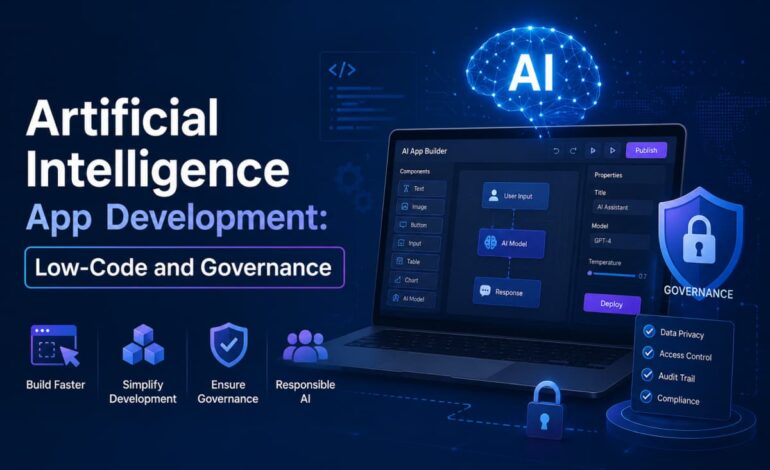
The governance response is not to shut the tools down; that ship has sailed and the productivity gains are worth keeping. The response is a control plane: a registry of what has been built, tiered approval based on data sensitivity and decision impact, enforced use of vetted models and connectors, and clear ownership assigned at creation. Governance here is a design choice made early, not a cleanup performed after an incident.
Where Custom AI Application Development Still Wins
Democratized tools handle a wide band of internal use cases well. They handle a narrower band poorly, and the gap is precisely where professional teams and specialist partners keep earning their place. Custom AI application development remains the right call whenever an application touches regulated data, drives revenue-critical decisions, or must integrate deeply with systems of record.
Several conditions push a build out of the citizen tier and into professional hands:
- Regulatory weight: applications handling protected health information, financial transactions, or personal data at scale need security architecture and audit trails that no-code layers do not expose.
- Deep integration: connecting to an enterprise resource planning core, a claims engine, or a proprietary data platform demands engineering that prebuilt connectors cannot reach.
- Custom model work: when off-the-shelf models miss the domain, fine-tuning, evaluation harnesses, and monitoring pipelines require code and disciplined machine learning operations.
- Scale and reliability: an application serving millions of requests needs performance engineering and failover design that visual builders abstract away rather than solve.
An experienced AI Application Development Company earns its role less by writing more code and more by drawing the line: which work belongs to citizen builders on approved rails, and which work needs a professional team with accountability for security, lineage, and outcomes. That judgment, applied early, is what keeps the two tiers reinforcing each other rather than colliding.
The Technologies Underneath the Abstraction
Understanding the stack helps leaders govern it. Three layers sit beneath every low-code AI build, and each carries its own risk.
The platform layer provides the visual builder, the runtime, and the deployment surface. It determines where apps run, how they scale, and what logging exists by default. The model layer supplies intelligence: prebuilt large language models, vision or speech services, and increasingly agentic components that plan and act across steps. The connector layer wires the app to data and other systems through APIs, database links, and workflow triggers.
The connector layer is where governance most often breaks. A drag-and-drop connection to a production database feels identical to a builder whether the target holds public marketing copy or regulated customer records. The interface hides the distinction that matters most. Effective artificial intelligence app development services therefore treat connectors as the primary control point, restricting which data sources citizen builders may reach and routing sensitive access through reviewed, professionally built components.
Agentic Builders and Where This Heads Next
The current shift is from apps that answer to apps that act. Agentic AI, in which software plans multi-step tasks and executes them with limited supervision, is moving into low-code platforms fast. Gartner projects that 40 percent of enterprise applications will feature task-specific AI agents by 2026, up from less than 5 percent in 2025. When a citizen builder can assemble not just a form but an autonomous agent that queries systems and takes actions, the governance stakes rise sharply.
Agents compound every risk already named. An ungoverned app exposes data; an ungoverned agent exposes data repeatedly, at machine speed, while making decisions no human reviewed. The organizations that will benefit are the ones treating agent governance as infrastructure now, before agentic building becomes routine: identity for agents, scoped permissions, audit logs of every action, and kill switches that work.
Two trends will define the next phase. Governance tooling is catching up, with platform vendors adding registries, policy enforcement, and observability that assume citizen building rather than fight it. And the professional role continues to move up the stack, from building individual apps toward designing and operating the guardrails that make thousands of citizen builds safe. Both trends point the same direction: the scarce skill is no longer the ability to build, but the discipline to build governably at scale.
Adoption will keep widening regardless of readiness. The question every leader now faces is whether the guardrails arrive before the sprawl does, or after the first incident forces the issue.
What Leaders Should Do About It
Democratized building rewards preparation and punishes drift. A workable program starts small and enforces consistently: publish an approved catalog of models and connectors, require every new app to register its data access and owner, and tier review by risk rather than treating all builds alike. Pair that with a professional team that owns the rails and the high-stakes builds, and citizen development becomes an asset rather than a liability. The goal is not control for its own sake. It is making the fast path also the safe path, so business users get speed and the enterprise keeps its footing.
The move from building bottleneck to governance bottleneck is not a problem to lament; it is a shift to manage deliberately. Organizations that treat artificial intelligence app development as a governed portfolio, rather than a scatter of well-meant experiments, turn democratized speed into durable advantage. That means investing in the control plane, the vetted stack, and the professional judgment that decides where custom work belongs. Teams weighing how to structure this can explore AI application development services that pair citizen enablement with professional governance, an approach Damco Solutions applies across regulated and integration-heavy builds. The winners in the next phase will be defined less by how fast they build and more by how well they govern what everyone is now building.