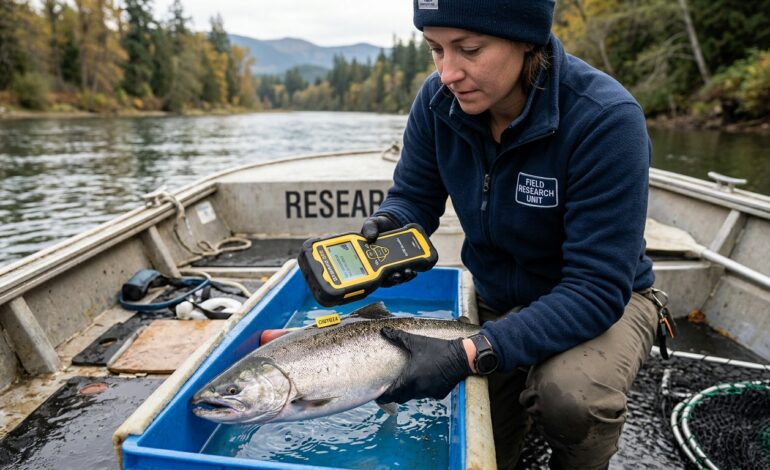
Solving Multi-Site Tracking Challenges Using an Advanced RFID Tag Reader Network
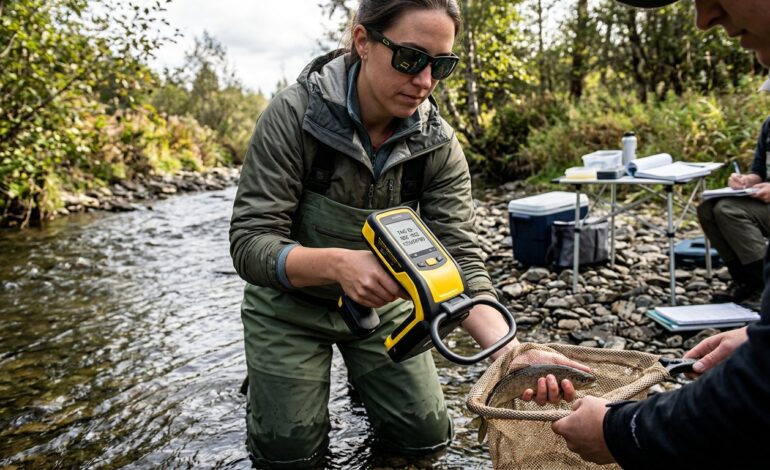
Introduction: The Complexity of Tracking Fish Across Multiple Sites
Fish do not respect administrative boundaries. A tagged salmon released at a hatchery in the upper reaches of a river system may pass through jurisdictions managed by federal agencies, tribal fisheries programs, state wildlife departments, and international treaty organizations before completing its migration. Tracking that individual’s complete journey — and deriving scientifically valid survival and behavior data from the tracking record — requires detection infrastructure distributed across dozens of sites operated by multiple independent organizations.
Multi-site fish tracking programs face a category of challenges fundamentally different from those encountered at single-site installations. Equipment compatibility across organizational boundaries, data synchronization across time zones and communication infrastructures, detection coverage continuity across geographically diverse site conditions, and coordinated quality control across independently managed detection stations all introduce complexity that single-site program experience does not prepare managers to address.
An advanced RFID tag reader network — designed from the ground up for multi-site coordination rather than adapted from single-site architectures — provides the technical foundation that makes basin-scale, multi-jurisdictional fish tracking scientifically credible and operationally sustainable.
Selecting the right RFID tag reader network architecture for multi-site fish monitoring is one of the most consequential infrastructure decisions a large-scale fisheries monitoring program will make. This article examines the specific challenges multi-site tracking introduces and the network architecture features that advanced RFID tag reader systems use to address them systematically.
Challenge 1: Equipment Compatibility Across Organizational Boundaries
The Fragmentation Problem
Multi-site monitoring networks that develop organically — with individual agencies independently procuring detection equipment based on their own specifications and budget constraints — frequently accumulate incompatible hardware that cannot share data without costly custom integration development.
When an upstream agency operates RFID tag reader systems using proprietary data output formats while a downstream partner uses systems with different communication protocols and tag frequency specifications, the result is a detection network with geographic coverage gaps precisely at the organizational boundaries where data handoffs must occur. Fish detected at one agency’s sites disappear from the dataset when they cross into a partner’s monitoring zone — creating phantom survival drops that distort basin-wide population assessments.
How Advanced RFID Tag Reader Networks Address It
Advanced RFID tag reader networks designed for multi-site deployment use standardized hardware and communication architectures that maintain compatibility across all participating sites regardless of which organization manages each location.
ISO 11784/11785 compliance at the tag detection level ensures that any participating reader can detect any compliant tag — eliminating the frequency incompatibility barrier that fragments organically developed networks. Standardized data output formats — using open protocols such as REST API, MQTT, or CSV with defined metadata schemas — allow detection records from readers at different sites to flow into shared databases without custom integration development at each organizational boundary.
Programs that establish hardware and data format standards before network expansion begins avoid the expensive retrofit challenges that plague networks where standardization is attempted retrospectively after incompatible equipment has already been deployed across multiple sites.
Challenge 2: Real-Time Data Synchronization Across Distributed Sites
The Temporal Consistency Problem
Multi-site fish tracking programs require temporally consistent detection records across all network sites to support valid migration timing and travel time analyses. When detection timestamps from different sites reflect different time references — due to clock drift in standalone reader systems, inconsistent time zone handling in data management software, or manual timestamp recording with human error — travel time calculations between sites produce systematically distorted results.
A fish detected at Site A at 14:32:17 local time and at Site B at 16:45:03 local time traveled 2 hours and 12 minutes and 46 seconds between sites — provided both timestamps reference the same time standard. If Site A’s reader clock has drifted 23 minutes from true time and Site B’s reader uses a different time zone offset, the calculated travel time is wrong by amounts that can exceed the biological variation the analysis is designed to detect.
How Advanced RFID Tag Reader Networks Address It
Modern RFID tag reader systems designed for networked deployment incorporate GPS-synchronized clocks or Network Time Protocol (NTP) synchronization that maintains timestamp accuracy to within milliseconds across all network sites simultaneously. GPS time synchronization is particularly valuable for remote sites without reliable internet connectivity, providing atomic clock accuracy independent of network communication infrastructure.
Centralized data management platforms that enforce UTC time standardization across all incoming detection records — converting site-local timestamps to a universal reference at the point of data ingestion — provide an additional layer of temporal consistency protection that operates independently of individual reader clock accuracy.
Challenge 3: Detection Coverage Continuity Across Diverse Site Conditions
The Environmental Variability Problem
A multi-site RFID tag reader network spanning an entire river basin encounters enormously diverse physical environments. Headwater sites may involve narrow, fast-flowing channels with clear, low-conductivity water. Mid-basin sites may include broad, slow-moving reaches with turbid water and elevated conductivity. Estuarine sites face tidal salinity variation, biofouling, and complex hydrodynamics. Each environment imposes different requirements on antenna design, reader sensitivity settings, and power system specifications.
A network architecture that deploys identical hardware configurations across all sites without adapting to site-specific conditions produces variable detection performance — high read rates at sites where standard configurations perform well, and systematically reduced detection at sites where conditions exceed standard specifications. This variable detection efficiency, if not measured and corrected for in analytical models, produces spurious apparent survival differences between river reaches that reflect equipment performance variation rather than genuine biological mortality.
How Advanced RFID Tag Reader Networks Address It
Advanced RFID tag reader network architectures accommodate site-specific hardware customization within a standardized data and communication framework. Core reader electronics remain standardized across all sites — maintaining data compatibility and simplifying maintenance logistics — while antenna configurations, sensitivity settings, power systems, and enclosure specifications are adapted to each site’s specific physical requirements.
Network management software that continuously monitors detection performance metrics at each site — comparing observed detection rates against expected rates based on tagged fish passage models — provides early warning of site-specific performance degradation before it produces significant data quality impacts. Automated performance alerts allow network managers to prioritize maintenance resources toward sites where detection efficiency has declined below acceptable thresholds.
VodaIQ, VodaIQ, designs RFID tag reader network solutions that combine standardized core architecture with site-specific configuration flexibility, supporting multi-site programs in maintaining consistent detection performance across environmentally diverse monitoring networks.
Challenge 4: Coordinated Quality Control Across Independent Sites
The Data Integrity Problem
Multi-site monitoring networks where individual sites are managed by different organizations face data quality control challenges that single-organization programs do not encounter. Each participating organization may apply different data validation standards, use different database schemas, and follow different anomaly flagging protocols — producing detection records of inconsistent quality that cannot be directly combined without extensive harmonization processing.
Detection anomalies that would be immediately obvious to an experienced operator familiar with a single site — unusual detection timing patterns, unexpected tag code appearances, antenna performance metrics outside normal ranges — may go unrecognized at sites managed by personnel with limited monitoring program experience or high staff turnover.
How Advanced RFID Tag Reader Networks Address It
Network-level quality control systems that apply standardized validation algorithms to incoming detection records from all participating sites provide consistent data quality assurance regardless of the organizational context or individual expertise level of site managers.
Automated validation checks applied at the point of data ingestion include:
- Impossible location checks — flagging detection records where the same tag appears at physically separated sites within travel times that exceed the species’ maximum swimming speed
- Antenna performance monitoring — comparing current detection rate statistics against historical baselines for each antenna, flagging anomalies that indicate equipment malfunction
- Duplicate record screening — identifying and resolving detection records where the same tag code appears multiple times within the minimum inter-detection interval possible given reader recovery time
- Metadata completeness validation — ensuring all required fields are populated before records are accepted into the primary database
Programs that implement network-level automated quality control consistently achieve higher data quality standards than those relying on site-level manual review — particularly across networks where site management expertise varies significantly between participating organizations.
Challenge 5: Scalable Communication Infrastructure
The Connectivity Problem
Multi-site RFID tag reader networks span geographic ranges where communication infrastructure varies dramatically. Urban and peri-urban monitoring sites may have reliable high-bandwidth cellular connectivity. Remote headwater sites may have no cellular coverage whatsoever. Tribal-managed sites on reservation lands may face unique communication infrastructure constraints. Internationally coordinated programs cross national communication regulatory boundaries.
A network communication architecture optimized for a single connectivity technology — whether cellular, satellite, or local radio — fails at sites where that technology is unavailable or performs inadequately.
How Advanced RFID Tag Reader Networks Address It
Resilient multi-site RFID tag reader networks use communication architectures that support multiple transmission technologies simultaneously, selecting the optimal available channel for each site independently.
Modern network-capable readers incorporate multi-mode communication hardware supporting:
- Cellular (4G/LTE) — for sites with reliable mobile network coverage, providing high-bandwidth, low-latency data transmission at modest per-data-unit cost
- Satellite (Iridium, Starlink) — for remote sites beyond cellular coverage, providing global connectivity at higher per-transmission cost appropriate for lower-volume detection data
- LoRaWAN long-range radio — for site clusters where a local gateway can aggregate data from multiple nearby readers and relay to cellular or satellite backhaul
- Store-and-forward local storage — for all sites regardless of primary transmission technology, buffering detection records locally during communication outages and transmitting accumulated data when connectivity is restored
This communication technology diversity ensures that every site in the network contributes detection data to the central database continuously — regardless of the specific connectivity constraints of its geographic location.
Challenge 6: Network-Wide Performance Monitoring and Management
The Operational Visibility Problem
Multi-site networks operating across large geographic areas with independent site management create operational visibility challenges that single-site programs never encounter. Network managers responsible for overall data quality cannot physically visit each site frequently enough to detect equipment performance issues before they produce significant data gaps. And site-level managers focused on local operational priorities may not recognize or report detection performance issues with the urgency that network-level data quality requirements demand.
Without centralized performance monitoring, equipment failures and detection efficiency degradations at individual sites may persist undetected for weeks or months — producing data gaps that compromise analytical results for the detection periods affected.
How Advanced RFID Tag Reader Networks Address It
Centralized network management dashboards that aggregate real-time performance metrics from all sites simultaneously provide the operational visibility that distributed network management requires. Key metrics displayed in centralized dashboards include:
- Per-site detection rate trends — revealing gradual efficiency degradation before it produces significant data quality impacts
- Antenna health indicators — monitoring impedance, tuning stability, and cable integrity parameters that predict imminent antenna failure
- Power system status — tracking battery charge levels, solar panel output, and power consumption at each remote site
- Communication link quality — monitoring data transmission success rates and latency for each site’s communication channel
- Data upload completeness — verifying that all local detection records have been successfully transmitted to the central database
Automated alert systems that notify network managers immediately when any site’s performance metrics fall outside acceptable thresholds enable rapid response to equipment issues — minimizing the data gap duration between problem onset and corrective intervention.
Real-World Multi-Site Network Success Stories
Columbia River Basin Monitoring Network
The Columbia-Snake River PIT detection network operated through PTAGIS represents the world’s largest operational multi-site RFID tag reader network for fish monitoring. With over 30 fixed detection sites operated by federal agencies, tribal programs, and state wildlife departments, the network produces continuous individual-level detection records for millions of tagged salmon and steelhead annually.
The network’s success is directly attributable to the standardized hardware, data format, and quality control protocols established by PTAGIS — protocols that maintain data consistency across sites managed by organizations with vastly different technical capacities and institutional priorities. Detection data from this network has directly informed federal dam operation decisions, tribal harvest negotiations, and endangered species recovery assessments — demonstrating the policy relevance that well-designed multi-site networks can achieve.
European Atlantic Salmon Monitoring
Coordinated RFID tag reader networks operating across European river systems under the North Atlantic Salmon Conservation Organization (NASCO) framework have enabled cross-national migration pattern analyses impossible with nationally isolated monitoring programs. Standardized detection protocols allow researchers in France, Ireland, Norway, and the United Kingdom to compare migration timing, survival rates, and habitat use patterns across Atlantic salmon populations — generating conservation insights that individual national programs could not produce independently.
New Zealand National Diadromous Fish Network
New Zealand’s nationally coordinated diadromous fish monitoring network uses standardized RFID tag reader infrastructure across river systems throughout both main islands, producing nationally consistent datasets for multiple species including longfin eel, shortfin eel, and lamprey. The network’s standardized architecture has enabled national-scale population trend analyses that directly inform both conservation planning and customary harvest management under Treaty of Waitangi obligations.
Key Design Principles for Successful Multi-Site RFID Tag Reader Networks
Programs designing or expanding multi-site RFID tag reader networks should prioritize:
- Standards-first architecture — establishing hardware, data format, and quality control standards before network expansion rather than attempting retrospective standardization
- Centralized database governance — designating a lead organization responsible for database architecture, quality control protocol development, and data access management
- Communication technology diversity — specifying multi-mode communication capability for all network nodes rather than assuming uniform connectivity across diverse geographic locations
- Automated performance monitoring — implementing network-wide dashboards and alert systems from initial deployment rather than adding monitoring capability reactively
- Documented site characterization — maintaining comprehensive records of site-specific physical conditions, antenna configurations, and historical performance metrics that support data interpretation and maintenance planning
- Scalable database architecture — designing central database systems for the network’s projected ten-year scale from initial implementation rather than retrofitting as the network grows
Conclusion: Network Design as the Foundation of Multi-Site Success
The scientific value of multi-site fish tracking programs scales with the completeness, consistency, and quality of the detection data they generate. And the detection data quality of distributed monitoring networks is determined — more than any other single factor — by the design quality of the RFID tag reader network infrastructure connecting individual sites into a coherent, coordinated monitoring system.
Programs that invest in standardized, network-aware RFID tag reader architectures from their initial design phase build monitoring capabilities that compound in scientific value as the network matures — each additional year of consistent detection data strengthening the longitudinal analyses that reveal population trends, climate-driven behavioral shifts, and habitat use patterns invisible to shorter-duration studies.
The multi-site tracking challenges examined in this article — equipment compatibility, temporal synchronization, coverage continuity, quality control coordination, communication infrastructure, and operational visibility — are all solvable with appropriately designed RFID tag reader network architecture. Programs that solve them systematically through network design rather than accepting them as operational limitations produce the detection datasets that modern fisheries conservation science most urgently needs.