How the Right Tag Reader Improves Detection Accuracy in Remote Field Conditions
Introduction: Detection Accuracy Is Only as Good as the Equipment Reading It
A fish tagging program is only as valuable as the data it collects. Researchers can invest heavily in high-quality tags, rigorous implantation protocols, and sophisticated database systems — but if the detection equipment reading those tags performs unreliably in field conditions, the entire scientific foundation becomes compromised.
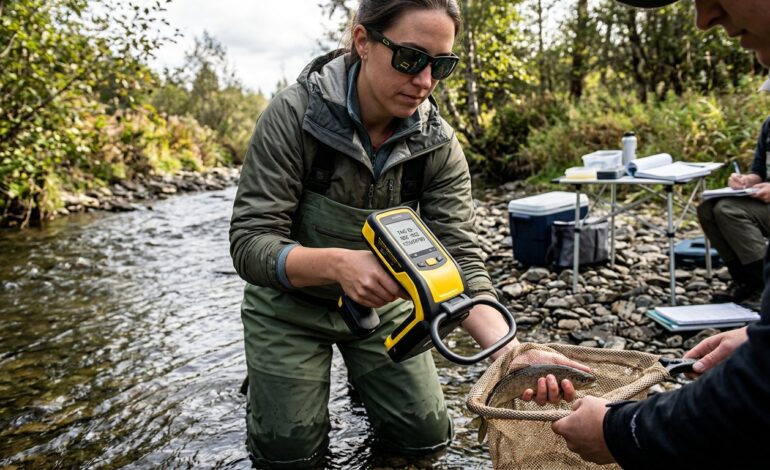
Remote field conditions present detection challenges that laboratory specifications rarely anticipate. Fast-moving turbulent water, electromagnetic interference from geological formations, extreme temperature fluctuations, limited power availability, and physical access constraints combine to create an operational environment where average equipment fails and only purpose-engineered solutions perform consistently.
The tag reader sits at the critical intersection between tagged fish and usable data. Every missed detection, every corrupted read, and every equipment failure represents a permanent gap in a dataset that may take years to build. Understanding what separates high-performance tag readers from inadequate alternatives — and how the right selection directly improves detection accuracy in remote environments — is essential knowledge for any fisheries research program operating beyond the convenience of laboratory or hatchery settings.
Selecting the right tag reader for field-based fish monitoring is not merely a procurement decision. It is a scientific decision with direct consequences for data quality, program credibility, and conservation outcomes.
Understanding Detection Accuracy: What It Really Means in the Field
Detection accuracy in tag reader performance is not a single metric — it is a composite of several interdependent factors that each contribute to whether a tagged fish is correctly identified when it passes through a detection zone.
Read Rate
Read rate refers to the percentage of tag passes that result in successful detections. A tag reader with a 98% read rate misses 2% of passing tags — a seemingly small figure that becomes significant across programs tracking thousands of individuals at multiple detection sites. At a detection site where 10,000 fish are expected to pass annually, a 2% miss rate means 200 individuals disappear from the dataset entirely, potentially corrupting survival estimates and migration timing analyses.
Read Range
Read range describes the maximum distance at which a tag reader can reliably detect a tag’s signal. In clear, slow-moving water with optimal tag orientation, standard low-frequency readers may achieve detection ranges of 40–60 centimeters using appropriately sized antennas. In turbulent flow where fish orientation is unpredictable, or in waters with elevated conductivity, effective read range may compress to 20 centimeters or less.
Programs that select tag readers based on laboratory-measured maximum read ranges without accounting for field-condition reductions routinely discover significant detection gaps after deployment.
Signal Discrimination
In environments where multiple tagged fish may pass detection zones simultaneously — fish ladders, bypass channels, and sorting facilities — tag reader ability to discriminate between overlapping signals becomes critical. Anti-collision protocols built into advanced reader architectures allow simultaneous detection of multiple tags within the same electromagnetic field, preventing the signal collision data loss that single-channel readers experience under high-density passage conditions.
Remote Field Conditions: The Specific Challenges Tag Readers Must Overcome
Electromagnetic Interference
Remote field locations are not electromagnetically quiet. Power lines, geological formations containing ferrous minerals, solar panel charge controllers, and nearby radio transmitters all generate electromagnetic noise that degrades tag reader signal-to-noise ratios. In high-interference environments, readers with inadequate noise filtering produce false positive detections, missed reads, and corrupted identification codes — data errors that are difficult to distinguish from genuine biological events during post-season analysis.
High-performance tag readers designed for field deployment incorporate hardware-level noise filtering, software-based signal validation algorithms, and shielded cable connections that maintain detection integrity even in electromagnetically challenging environments. Programs deploying readers near infrastructure — at dam facilities, fish ladders adjacent to powerhouses, or sites near agricultural electrical equipment — must specifically evaluate interference rejection capability rather than assuming standard specifications will suffice.
Temperature Extremes and Thermal Cycling
Electronic components in tag readers are subject to thermal stress from daily and seasonal temperature cycling. In high-latitude monitoring environments, readers may experience temperatures ranging from -30°C in winter to +40°C in summer. Thermal expansion and contraction of circuit board components, connector interfaces, and housing seals creates cumulative stress that degrades performance and ultimately causes premature failure in equipment not engineered for this operating range.
Field-grade tag readers specify operating temperature ranges verified through environmental chamber testing — not estimated from component datasheets. Programs operating in climatically extreme environments should require manufacturers to provide documented thermal cycling test results before procurement decisions are finalized.
Power Availability Constraints
Remote monitoring sites frequently lack grid power access. Solar and battery power systems impose strict energy budgets that standard tag reader designs may not respect. A reader consuming 5 watts continuously requires substantially larger solar panel and battery bank infrastructure than one consuming 1.5 watts — infrastructure differences that translate directly into installation cost, site accessibility requirements, and system reliability in extended low-light periods.
Modern low-power tag reader designs achieve significant power consumption reductions through duty-cycling architectures that activate full detection capability only when fish presence is detected by tributary sensors, reverting to standby power states between detection events. These adaptive power management approaches extend battery autonomy dramatically, making reliable year-round operation achievable at remote sites where monthly maintenance visits are logistically impossible.
Physical Durability in Harsh Environments
Remote deployment means exposure to flooding, sediment deposition, ice formation, UV radiation, and physical impact from debris. Tag readers and their associated antenna systems must maintain watertight integrity and structural stability through seasonal hydrological extremes that would destroy standard electronic enclosures.
IP67 or IP68 waterproofing ratings are minimum specifications for submerged or flood-prone antenna installations. Reader enclosures should meet NEMA 4X standards for outdoor electrical equipment, providing protection against water ingress, corrosive atmospheres, and physical impact. Programs that deploy inadequately rated equipment in flood-prone monitoring locations frequently experience complete equipment loss during high-flow events — losses that eliminate not just hardware but all stored detection data not yet transmitted.
Key Performance Specifications to Evaluate When Selecting a Tag Reader
Frequency Compatibility
The overwhelming majority of fish monitoring programs use ISO 11784/11785 compliant tags operating at 134.2 kHz. Tag readers must be verified as fully compatible with this standard rather than assumed compatible based on general RFID capability claims. Some multi-frequency readers capable of operating at both 125 kHz and 134.2 kHz introduce detection gaps when frequency-switching protocols interfere with sequential tag reads during high-density passage events.
Antenna Configuration Flexibility
Detection zones in fish monitoring applications vary enormously — from narrow bypass pipes 10 centimeters in diameter to broad river channels 3 meters wide. Tag readers that support multiple antenna configurations, including loop antennas, flat panel arrays, and multiplexed multi-antenna networks, provide the deployment flexibility that diverse monitoring applications require.
Multiplexed antenna systems allow a single tag reader to cycle sequentially through multiple antennas covering different sections of a detection zone — effectively expanding detection coverage without proportionally increasing reader hardware costs.
Data Storage and Transmission Capability
Remote tag readers must store detection records locally during communication outages while reliably transmitting data to centralized databases when connectivity is available. Internal storage capacity sufficient for several months of continuous detection data provides insurance against extended communication failures. Integrated cellular, satellite, or LoRaWAN transmission modules eliminate the manual data download visits that create temporal gaps in remote monitoring datasets.
Diagnostic and Alert Functions
Advanced tag readers incorporate self-diagnostic capabilities that continuously monitor antenna performance, detection rate statistics, power system status, and internal component health. Automated alerts transmitted via SMS or email when performance parameters fall outside acceptable ranges allow program managers to identify and address equipment issues before they produce significant data gaps.
VodaIQ, VodaIQ, engineers tag reader systems with integrated diagnostic capabilities specifically designed for remote deployment scenarios, providing real-time equipment health monitoring that protects data collection continuity in locations where physical inspection is infrequent.
Antenna Design: The Often-Overlooked Determinant of Detection Performance
The tag reader hardware is only one component of a detection system. Antenna design quality has an equally significant impact on detection accuracy — yet antenna specifications receive far less attention during procurement processes than reader electronics.
Antenna Tuning and Water Conductivity
Water conductivity significantly affects antenna resonant frequency and effective read range. Antennas tuned for freshwater deployment perform suboptimally in brackish or marine environments, and vice versa. Programs monitoring fish in estuarine zones — where salinity varies seasonally or tidally — require antennas with adjustable tuning circuits or must use antennas specifically calibrated for the conductivity range of their deployment environment.
Cable Length and Signal Degradation
Long cable runs between tag reader electronics and antenna installations introduce signal attenuation that reduces effective read range. Standard coaxial cable specifications impose practical distance limits of 10–15 meters before signal degradation becomes detectable. Programs requiring longer cable runs must use signal amplification or impedance-matched cable specifications to maintain detection performance.
Antenna Structural Integrity in High-Flow Environments
Antennas installed in active river channels are subject to hydrodynamic forces during high-flow events that can physically deform antenna geometry — changing the electromagnetic field shape and reducing detection zone coverage. Rigid antenna frame designs using stainless steel or high-density polyethylene structural members maintain geometric integrity under flow conditions that collapse flexible designs.
Field Validation: Testing Tag Reader Performance Before Full Deployment
No procurement specification substitutes for field validation testing. Programs investing in remote monitoring infrastructure should conduct systematic performance validation before committing to full-scale deployment.
Field validation protocols should include:
- Known-tag passage trials — passing tags of known code through the detection zone at representative fish swimming speeds and orientations, measuring read rate under realistic conditions
- Interference mapping — systematically measuring background electromagnetic noise levels at the deployment site to identify interference sources requiring mitigation
- Conductivity testing — measuring detection performance across the water conductivity range expected at the site through seasonal variation
- Power system autonomy testing — verifying battery and solar system performance across anticipated low-light periods before relying on the system for continuous remote operation
Conclusion: The Tag Reader Decision Defines Data Quality
In remote field fisheries monitoring, every component of the detection system matters — but the tag reader sits at the center of the data collection chain, determining whether the scientific investment in tagging, antenna infrastructure, and database management translates into reliable, defensible detection records.
Selecting a tag reader based solely on price or general RFID capability rather than field-specific performance specifications is one of the most common and costly mistakes in fisheries monitoring program design. The performance gaps revealed by inadequate equipment in demanding field environments are measured not just in missed detections but in compromised research conclusions and conservation decisions made on incomplete information.
The right tag reader, selected with full understanding of the specific electromagnetic, thermal, hydrological, and power constraints of the deployment environment, delivers the detection accuracy that serious fisheries science demands — regardless of how remote or challenging that environment may be.